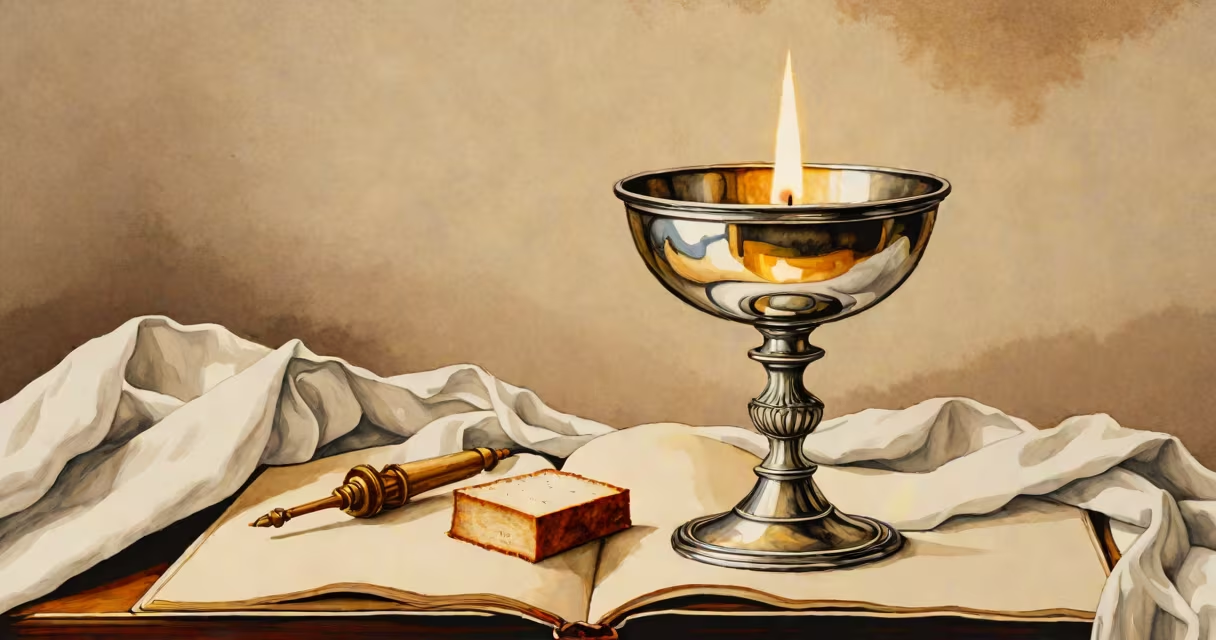
The sacrament of eucharist meaning refers to the central act of Catholic worship where bread and wine become the body and blood of Jesus Christ through consecration. This transformation, known as transubstantiation, is a doctrinal belief upheld by the Church since the Council of Trent (1551-1563). The eucharist is both a sacrifice and a meal, uniting believers with Christ and one another.
At Mass, the priest elevates the consecrated host and chalice during the Eucharistic Prayer. Catholics believe that during this moment, the substance of bread and wine changes entirely into the body and blood of Christ, though their appearance remains unchanged. This is not symbolic-it is a real, physical change according to Catholic teaching. The Catechism of the Catholic Church states: "The Eucharist is the source and summit of the Christian life" (CCC 1324).
Christ instituted the Eucharist at the Last Supper, recorded in all four Gospels. Matthew 26:26-28 says: "While they were eating, Jesus took bread, blessed it, broke it, and gave it to the disciples... This is my blood of the covenant, which will be shed for many." The early Church celebrated this meal weekly, as seen in Acts 2:42: "They devoted themselves to the apostles' teaching and to fellowship, to the breaking of bread and to prayer."
The Eucharist functions through a sequence of actions in the Mass: the preparation of gifts, the consecration, and the distribution. During the consecration, the priest repeats the words Jesus spoke: "This is my body," and "This is my blood." These words, called the Words of Institution, are believed to effect the change in substance.
After consecration, the host is distributed to the faithful. Receiving communion is not optional for practicing Catholics who are in a state of grace. The Church requires fasting for one hour before receiving. Those who have committed mortal sin must first go to confession. The Code of Canon Law specifies: "A person who has committed a grave sin must not receive the Eucharist without first going to confession" (Canon 916).
Receiving the Eucharist is not a passive act. It is a participation in Christ's sacrificial death and resurrection. The Catechism emphasizes: "The Eucharist is the efficacious sign and sublime cause of communion in the divine life" (CCC 1396). This means the sacrament doesn't just represent grace-it brings it.
The Eucharist appears in different forms depending on context and tradition. The most common is the daily Mass, held in parishes worldwide. There are also special celebrations such as the Easter Vigil, where the Eucharist is the first time it is celebrated after Lent. In emergencies, a priest may administer communion under the form of a single host, even if the wine is unavailable.
| Type | When Used | Key Feature |
|---|---|---|
| Daily Mass | Weekdays and Sundays | Standard liturgy with readings, prayers, and consecration |
| Easter Vigil | Saturday night before Easter Sunday | First Eucharist of the year; includes new members' initiation |
| Viaticum | Before death | Final communion; administered to the dying |
| Mass of the Presanctified | Great Lent, especially Wednesdays and Fridays | Host is consecrated earlier; no new consecration occurs |
Some traditions, like Eastern Orthodox Christianity, also believe in the real presence but use different theological language. They speak of "transformation" rather than "transubstantiation," though the outcome is similar. The Catholic Church explicitly defines transubstantiation as the change of the substance of bread and wine into Christ's body and blood, while the accidents (appearance, taste, texture) remain.
Many people assume the Eucharist is merely symbolic. This is incorrect in Catholic teaching. The Second Vatican Council affirmed: "The Eucharist is the source and summit of the Christian life" (Lumen Gentium 11). Symbolic interpretations are insufficient because they deny the reality of Christ's presence.
Another misconception is that the Eucharist is only for priests. In fact, laypeople are invited to receive communion regularly. The Church encourages weekly participation, especially on Sundays. According to the U.S. Conference of Catholic Bishops, about 50 million Catholics attend Mass weekly in the United States, with nearly 80% receiving communion.
A less obvious error is thinking that the Eucharist is only about memory. While it recalls the Last Supper and crucifixion, it is not merely remembrance. The Catechism states: "The Eucharist is the actual sacrifice itself" (CCC 1367). It makes present the saving event of Calvary in a non-bloody way.
In St. Mary's Parish in Chicago, a typical Sunday Mass begins at 9:00 a.m. The congregation sings hymns, listens to three Scripture readings, and hears a homily. At the Offertory, the offerings are brought forward. The priest then takes the bread and wine, prays over them, and says: "Take this, all of you, and eat it: this is my body..."
After the consecration, the priest raises the host and says: "Behold the Lamb of God." The congregation responds: "Lord, I am not worthy..." Then, people file forward to receive communion either on the tongue or in the hand. After Mass, a woman in her 70s says, "I've been coming here for 50 years. I still feel the same peace when I receive."
This moment illustrates the lived reality of the sacrament: it is not abstract theology. It is a personal encounter with Christ. The Church teaches that the Eucharist strengthens faith, fosters unity, and prepares souls for eternal life.
The sacrament of eucharist meaning is foundational to Catholic identity. It shapes how believers understand salvation, community, and divine presence. Without it, the Church would lack its central act of worship. The Catechism calls it "the most profound expression of the Church's life" (CCC 1327).
For those exploring religious practices, understanding the Eucharist clarifies why Catholics attend Mass, why they fast, and why they consider communion essential. It is not a ritual performed out of habit-it is a spiritual encounter grounded in history, scripture, and doctrine.