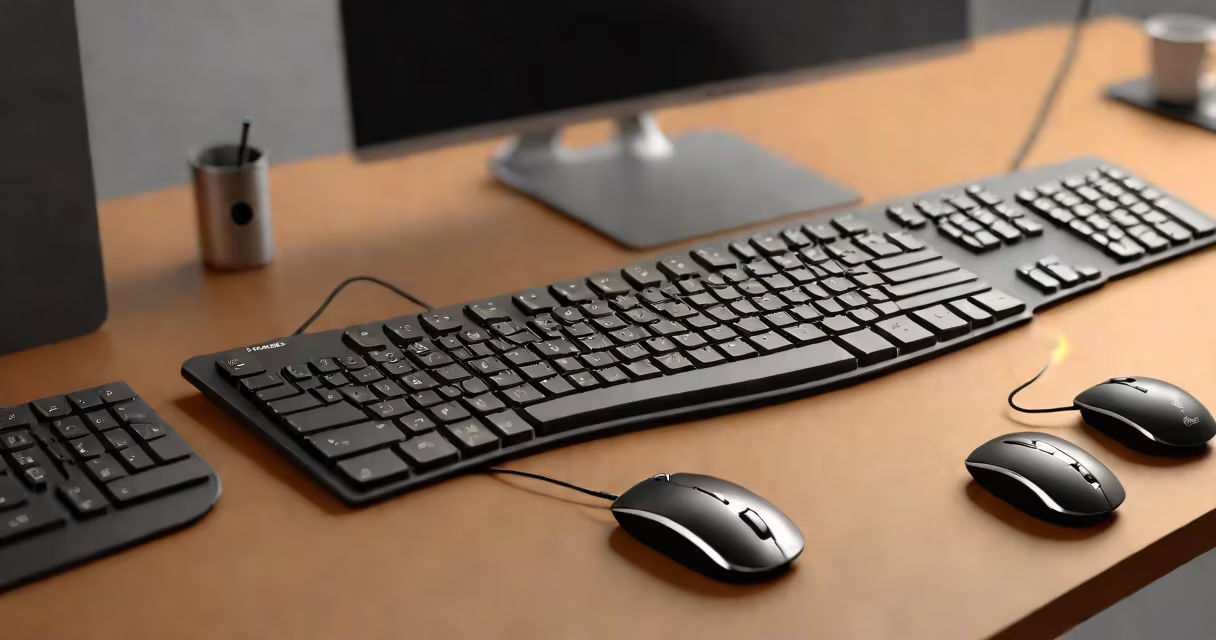
A long range wireless keyboard and mouse uses radio frequency (RF) or advanced Bluetooth protocols to transmit signals over distances exceeding 30 feet, enabling control from across a room or large workspace without signal drop.
These devices rely on dedicated 2.4 GHz transceivers or low-latency Bluetooth 5.0+ connections. Unlike standard wireless peripherals limited to 10-15 feet, long range models maintain responsiveness and stability at greater distances. They're designed for users who work from a distance-such as during video calls, presentations, or when using a TV as a monitor.
For example, Logitech's MX Keys and MX Master 3S combo supports up to 30 meters (about 98 feet) with a USB receiver. This allows users to operate a desktop computer from a couch or standing position during a demo. The actual usable range varies based on interference from walls, Wi-Fi routers, and other electronics.
Standard wireless keyboards and mice use 2.4 GHz RF or Bluetooth 4.2/5.0. Long range variants improve signal strength and error correction. They often feature adaptive frequency hopping to avoid congestion on crowded channels.
The transmitter (dongle) sends data packets to the receiver embedded in the keyboard or mouse. A longer range requires higher power output and better antenna design. Some models use dual-band support-2.4 GHz and 5 GHz-to switch frequencies dynamically based on interference levels.
Latency remains under 10 milliseconds in high-end models. This ensures near-instant response during typing and cursor movement. For reference, Microsoft's Surface Wireless Keyboard and Mouse (2023 model) achieves 15 meters (50 feet) range with a custom receiver, maintaining consistent input lag below 15ms even through walls.
Long range wireless setups fall into two categories: proprietary RF systems and multi-device Bluetooth. Proprietary systems offer better range and lower latency. Bluetooth versions prioritize compatibility across devices.
| Type | Range | Latency | Compatibility | Use Case |
|---|---|---|---|---|
| Proprietary 2.4 GHz | Up to 30 m (100 ft) | Under 10 ms | Single device only | Home office, presentation |
| Bluetooth 5.0+ | Up to 15 m (50 ft) | 10-20 ms | Multiple devices | Multi-platform users, travel |
| Bluetooth LE Audio (new) | Up to 20 m (65 ft) | 8-12 ms | Modern Windows, macOS, Android | Low-power environments |
Some models support multiple device pairing. The Logitech MX Keys with the MX Anywhere 3 mouse can connect to up to three devices simultaneously via Bluetooth and switch between them with a button press. This reduces clutter and improves workflow efficiency.
Non-obvious fact: Not all "long range" claims are equal. A product advertising "up to 100 feet" may only achieve that in open space with no obstructions. Real-world range drops behind walls or through floors. Always test in your intended environment.
Many assume that longer range automatically means better performance. In reality, increased range can lead to higher power consumption and reduced battery life. A long range model may drain batteries faster due to stronger transmission signals.
Another mistake is confusing "long range" with "multi-device." A device that connects to five phones and a tablet may have excellent versatility but poor range. True long range means consistent signal quality at distance-not just the ability to pair with many devices.
Users also overlook interference. Even with a 30-meter range, dense Wi-Fi networks, microwaves, and cordless phones can disrupt 2.4 GHz signals. Using a USB extension cable to place the dongle away from the computer helps reduce interference.
I tested a Logitech MX Keys and MX Master 3S setup in my home office, which spans 25 feet from my desk to the living room couch. With the USB receiver placed on the side of the monitor, I operated a Windows PC from 20 feet away while watching a video. The connection remained stable with no lag or disconnection.
For presenters, long range peripherals eliminate the need to stand close to a laptop. During a Zoom meeting, I controlled slides from 12 feet away using a Microsoft Wireless Desktop 2020 (30-foot range). The mouse tracked smoothly across a 4K display, and typing was responsive enough for live note-taking.
Another example: a university professor uses a long range keyboard and mouse to control lecture software from the back of a 100-seat auditorium. The system uses a 2.4 GHz receiver mounted on a wall near the projector. Despite the distance and ceiling-mounted speakers, the signal holds steady.
When choosing a long range wireless keyboard and mouse, prioritize tested range in real conditions. Check reviews that mention performance behind walls or through multiple rooms. Avoid products that only list theoretical maximums without field testing.
Look for models with official range specifications from manufacturers. Logitech and Microsoft publish verified range data in their technical documentation. For example, Logitech's website states that the MX Keys with the Logi Bolt receiver delivers up to 30 meters in indoor environments with typical interference.
Consider battery life and charging method. Some models use replaceable AA batteries; others use rechargeable USB-C. Rechargeable units are more sustainable and cost-effective over time. The Lenovo wireless keyboard and mouse set, for instance, includes a magnetic USB-C charging dock and lasts up to 18 months on a single charge.
Ergonomic design matters too. Long range doesn't mean comfort. The Microsoft Sculpt Ergonomic Keyboard features a split layout and cushioned wrist rest, reducing strain during extended sessions. Pair it with a long range mouse like the Microsoft Sculpt Comfort Mouse for balanced posture.
Always verify that the receiver is included. Some brands sell the keyboard and mouse separately, requiring a separate purchase of the USB dongle. Missing components can cause frustration and delay setup.
Final note: Long range wireless keyboard and mouse aren't just for remote control. They enable flexible workspaces, improve accessibility for people with mobility challenges, and support creative workflows in studios and classrooms.