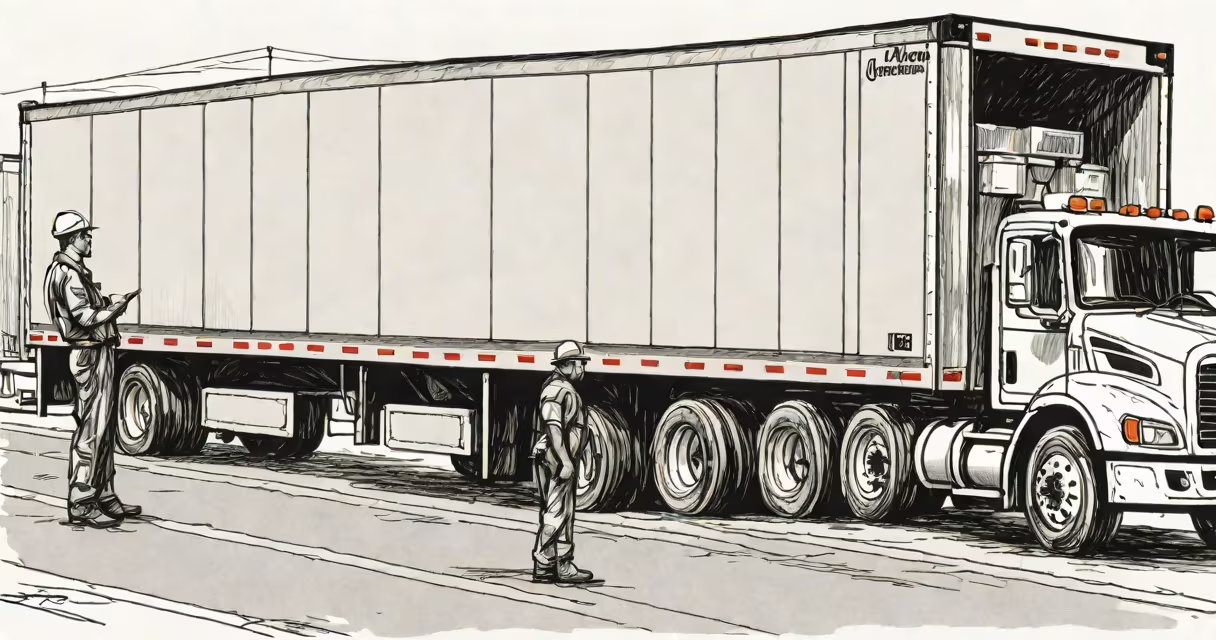
A truck driver operates heavy-duty commercial vehicles to transport goods across cities, states, or international borders. They hold a Commercial Driver's License (CDL) and follow federal safety regulations set by the Federal Motor Carrier Safety Administration (FMCSA).
Truck drivers are responsible for loading, securing, and delivering cargo while maintaining accurate logs of hours driven and rest periods. Their work supports supply chains by moving everything from fresh produce to industrial machinery.
The FMCSA requires all interstate truck drivers to pass a written exam, a skills test, and a medical examination. Drivers must also comply with Hours of Service rules limiting daily driving time to 11 hours and requiring 10 consecutive hours off between shifts.
Truck drivers begin their day by inspecting the vehicle for mechanical issues. This pre-trip inspection includes checking brakes, tires, lights, fluid levels, and cargo securement. Any defect must be reported before departure.
Once on the road, drivers follow designated routes using GPS navigation. They log miles, stops, and rest times in electronic logging devices (ELDs), mandated since 2018. These records ensure compliance with federal regulations and reduce fatigue-related accidents.
At delivery points, drivers verify shipment details against shipping documents. They may assist with unloading using forklifts or hand trucks, depending on the cargo type. After drop-offs, they return to the depot or continue to the next destination.
Truck drivers specialize based on cargo type, distance, and vehicle size. The most common categories include:
| Type | Cargo Type | Typical Distance | CDL Class | Examples |
|---|---|---|---|---|
| Long-Haul | General freight, manufactured goods | 500-2,500 miles | B or C | Interstate freight hauls across the U.S. |
| Local Delivery | Food, retail, construction materials | Under 100 miles | B | City-based deliveries for grocery chains |
| Specialized | Refrigerated, hazardous, oversized | Varies | B or C | Transporting chemicals or refrigerated meat |
| Team Drivers | Long-distance freight | Over 1,000 miles | B or C | Two drivers sharing shifts on cross-country runs |
Team drivers operate in pairs to maintain continuous movement. One drives while the other sleeps, switching roles every few hours. This setup reduces downtime and allows faster delivery timelines.
Specialized drivers require additional certifications. For example, those hauling hazardous materials must obtain a Hazmat endorsement on their CDL. This involves background checks, fingerprinting, and training in spill response and emergency procedures.
Trucking accounts for 70% of all freight transported in the United States by weight, according to the American Trucking Associations (ATA). The industry moves nearly 10 billion tons of goods annually.
Without truck drivers, retail shelves would empty within days. Food distribution relies heavily on refrigerated trucks operating under strict temperature controls. A single failure in cooling systems can spoil entire shipments.
During natural disasters, truck drivers deliver emergency supplies. In 2021, during winter storms in Texas, over 1,200 truckers volunteered to transport water, generators, and fuel to affected areas, according to the Texas Department of Transportation.
Many assume truck drivers spend weeks on the road with little contact with family. While long-haul drivers do travel extended distances, most now use mobile apps to call home, track deliveries, and access real-time updates.
Another myth is that all truck drivers are independent contractors. About 60% of U.S. truck drivers are employed directly by carriers, according to the Bureau of Labor Statistics (BLS). Independent owners often start as employees before buying their own rigs.
Some confuse "truck driver" with "freight broker." A freight broker arranges transportation but doesn't drive. Brokers match shippers with available drivers and handle billing. They don't need a CDL.
One non-obvious fact: Truck drivers are among the most regulated workers in the U.S. beyond standard labor laws. The FMCSA enforces rules on sleep schedules, vehicle maintenance, and drug testing. Violations can result in fines, license suspension, or criminal charges.
Consider Marcus, a long-haul truck driver based in Memphis. He holds a Class B CDL with Hazmat and Tanker endorsements. His route: Memphis to Denver, 1,300 miles.
He begins at 5:30 a.m. with a 30-minute pre-trip inspection. He checks tire pressure (36 psi), brake lines, and confirms the tank contains 10,000 gallons of diesel fuel. He verifies the load-10,000 pounds of pharmaceuticals-is secured with straps and temperature sensors.
After signing in via ELD, he drives 11 hours straight, stopping twice for 30-minute breaks. He logs each stop. At 4:30 p.m., he reaches a weigh station in Oklahoma. The officer scans his ELD and approves passage.
By 7:00 p.m., he arrives at the warehouse in Denver. He presents the bill of lading and signs for delivery. The dispatcher confirms receipt. He returns to the depot, completes paperwork, and clocks out at 8:00 p.m.
His total pay: $1,200 for the trip, based on 25 cents per mile and a $200 bonus for on-time delivery.
I once drove a 2-ton flatbed truck from Atlanta to Charlotte during a snowstorm. The route was clear, but visibility dropped below 50 feet. I reduced speed to 35 mph, activated hazard lights, and used the truck's radar cruise control to maintain safe distance. I arrived 45 minutes late but avoided a collision. That experience taught me that safety overrides schedule.
Truck drivers are licensed professionals who move essential goods across the country. They follow strict federal rules, operate complex vehicles, and manage high-stakes logistics.
Understanding what is a truck driver includes recognizing their role in infrastructure, regulation, and daily life. Their work keeps economies running, even in extreme conditions.