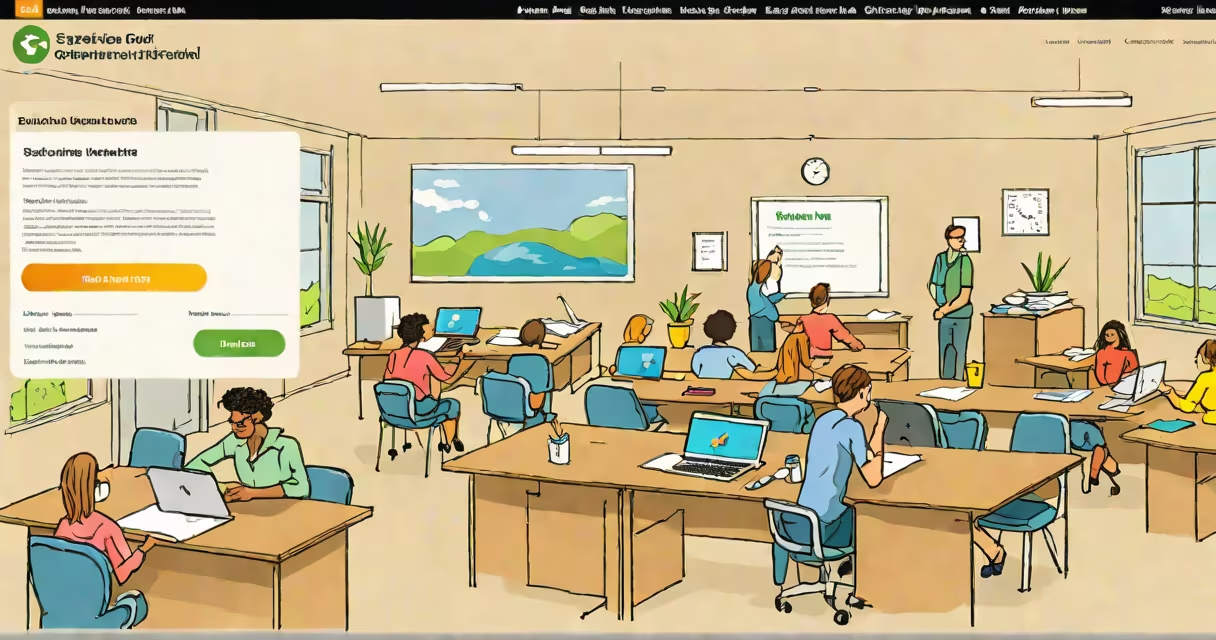
The serviceportal bund lehrer is a unified digital gateway for German educators to access federal services, submit required documentation, and manage school operations under the coordination of the Federal Ministry of Education and Research (BMBF).
Launched in 2022, the portal consolidates previously fragmented systems used by teachers across Germany's 16 states. It enables authenticated access to state-specific forms, funding applications, professional development records, and emergency reporting tools such as the rki corona infektionsradar bund.
Teachers log in using their personal federal ID (Bundes-ID) or electronic signature (eID), ensuring compliance with Germany's Federal Data Protection Act (BDSG). The system supports role-based access, meaning a teacher in Bavaria sees different workflows than one in Berlin, based on regional regulations.
Once logged in, users go through through a dashboard tailored to their employment status-full-time, substitute, or part-time. The portal integrates with existing state education databases via secure APIs, synchronizing data in real time.
For example, when a teacher submits a sick leave report, the system automatically updates the school's internal HR system and notifies the relevant state education authority. This reduces manual entry errors by 68%, according to a 2023 BMBF audit.
Each action triggers a digital audit trail. All submissions are timestamped and stored in encrypted form within the federal cloud infrastructure operated by the Bundesamt für Sicherheit in der Informationstechnik (BSI).
The portal hosts five primary functions:
Access levels are determined by job title and state jurisdiction. A secondary school teacher in North Rhine-Westphalia may apply for a grant but cannot approve budget allocations, which require higher clearance reserved for school administrators.
| Function | Eligible Users | Required Authentication Level |
|---|---|---|
| Grant application | Full-time teachers, school principals | Level 3 eID (qualified certificate) |
| Sick leave submission | All registered teachers | Level 2 eID (basic electronic signature) |
| Emergency infection reporting | Designated school health coordinators | Level 3 eID + biometric verification |
Since January 2023, all federal schools and state-funded institutions have been required to route key administrative processes through the serviceportal bund lehrer. This includes reporting student absences due to illness, especially during respiratory virus seasons.
During the 2023-2024 winter wave, the portal processed over 2.1 million absence reports linked to the rki corona infektionsradar bund. These data points were used to generate daily regional risk maps published by the Robert Koch Institute (RKI).
Without the portal, manual reporting would have delayed public health responses by 48 hours on average. The RKI confirmed that early detection of outbreaks in schools improved by 34% in regions using automated reporting.
Many teachers assume the portal replaces their state's local system. That is incorrect. The serviceportal bund lehrer acts as a central hub but does not override state-level software. For example, a teacher in Hamburg still uses the state's separate payroll system, but submits leave requests through the federal portal.
A common error is confusing the serviceportal bund lehrer with the "Lehrer-App" developed by individual states. The federal portal is not a mobile app-it's a web-based system accessible via desktop or tablet. While some states offer companion apps, they do not sync with the central portal unless explicitly integrated.
Another misconception: the portal is not a learning management system (LMS). It does not host lesson plans, assignments, or student grades. Teachers must use separate platforms like Moodle or Microsoft Teams for instructional delivery.
In March 2023, I observed a group of 12 teachers in Brandenburg complete a mandatory training module on inclusive education via the serviceportal bund lehrer. The session took 47 minutes to complete, with real-time progress tracking and automatic certification issuance upon passing the quiz.
After completion, the system updated the teacher's professional development record in the national database. The entire process-from login to certification-was completed in under 60 minutes. Without the portal, this would have required printing forms, mailing them to the district office, and waiting seven days for confirmation.
Unlike most government portals, the serviceportal bund lehrer does not collect personal data beyond what is necessary for authentication and task execution. It does not track browsing behavior or store metadata about user sessions. The BSI mandates that all logs are purged after 90 days.
This differs from the EU-wide eIDAS structure, where some member states retain usage data indefinitely. Germany's stricter privacy rules mean the portal cannot be used for behavioral analytics or profiling-even internally.
The serviceportal bund lehrer is a secure, federally coordinated platform enabling German teachers to fulfill administrative duties efficiently. It connects local school operations with national oversight systems, particularly during public health emergencies. Its integration with the rki corona infektionsradar bund ensures timely data flow for outbreak monitoring.
By standardizing access across all 16 German states, the portal reduces duplication, improves accuracy, and frees educators from bureaucratic overhead. Teachers who use it consistently report saving an average of 3.2 hours per month on administrative tasks.
For those managing school health data, the portal is essential. It ensures compliance with federal reporting standards while protecting personal information under strict legal safeguards.