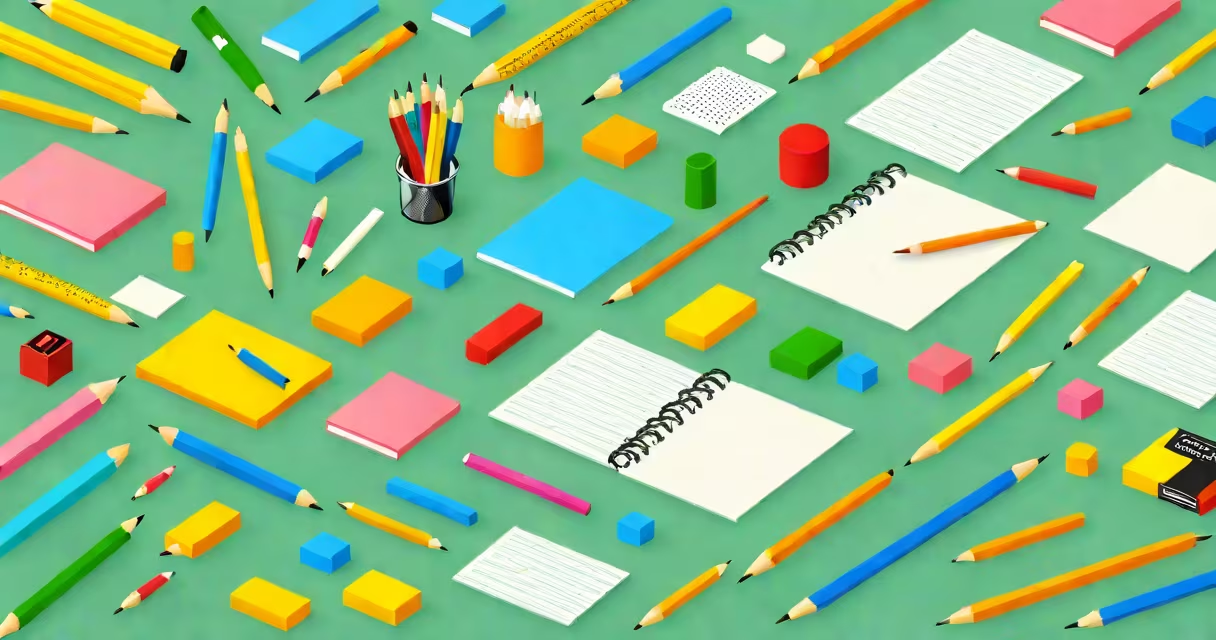
A school objects worksheet is a printed or digital activity sheet that helps young learners recognize and name everyday classroom items through visual cues, matching tasks, or labeling exercises. These tools are commonly used in preschool, kindergarten, and ESL classrooms to build vocabulary and reinforce visual identification skills.
Designed for early education, a typical school objects worksheet includes images of common school supplies such as pencils, scissors, notebooks, rulers, glue sticks, and backpacks. Students may be asked to circle the correct item, draw lines to match pictures with words, or write the name of each object. The structure supports both independent practice and guided instruction.
According to the National Association for the Education of Young Children (NAEYC), visual-based learning activities improve retention in children aged 3 to 6 by strengthening the connection between symbols and real-world objects. A school objects worksheet aligns with this principle by using familiar items in a structured format that reduces cognitive load during early language acquisition.
Each school objects worksheet follows a consistent design pattern. Images of school items are displayed in a grid or list format, often with labeled examples above or below. Tasks typically involve one of three formats: multiple choice, fill-in-the-blank, or picture-to-word matching.
For example, a worksheet might show four images: a red pencil, a blue eraser, a green ruler, and a yellow notebook. Below each image, students write the word corresponding to the object. This format reinforces spelling, letter recognition, and fine motor control when writing.
Some worksheets include a "find and color" section where students locate specific items in a cluttered classroom scene. These versions promote observational skills and attention to detail. A 2021 study published in the Journal of Early Childhood Research found that children who completed picture-based worksheets scored 27% higher on follow-up vocabulary tests compared to those who only received verbal instruction.
School objects worksheets vary by age group, skill level, and intended use. The most common types include:
| Type | Best For | Example Task |
|---|---|---|
| Matching | Pre-K to Grade 1 | Draw a line from each picture to its correct word label |
| Labeling | Grade 1 to 2 | Write the name of each item under its image |
| Multiple Choice | ESL or special needs students | Select the correct word from three options |
| Find and Color | Visual discrimination practice | Circle all the scissors in a classroom scene and color them red |
Worksheets can be single-sided or double-sided. Some include a word bank at the top to support struggling readers. Others integrate phonics by asking students to sound out the initial letter of each object.
Teachers use school objects worksheets in multiple contexts. They serve as warm-up activities, homework assignments, or center work during literacy rotations. In ESL programs, they form part of a thematic unit on "School Day" or "My Classroom."
Parents also use these resources at home. A 2022 survey by the American Educational Research Association found that 68% of caregivers with children aged 4-6 reported using printable worksheets to supplement school lessons. Many report improved confidence in naming objects after consistent daily practice.
These materials are especially effective when paired with physical objects. During a lesson on "school supplies," a teacher might place actual crayons, paper, and folders on a table while students complete the worksheet. This multisensory approach strengthens memory encoding, according to research from the University of California, Irvine.
A school objects worksheet is not a substitute for hands-on exploration. While it supports vocabulary development, it doesn't replace tactile learning. Children learn best when they touch, hold, and manipulate real items. A worksheet cannot replicate the sensory feedback of gripping a pencil or tearing paper.
It's also not a universal solution. Overuse of worksheets without context can lead to rote memorization without understanding. The U.S. Department of Education warns against excessive worksheet use in early childhood settings, citing a 2019 report that linked high worksheet volume to reduced engagement and increased frustration in children under age 7.
One common mistake is assuming all worksheets are equal. A poorly designed sheet with low-contrast images, ambiguous layouts, or complex instructions can confuse rather than teach. Always check for clear visual hierarchy and age-appropriate language.
In a public kindergarten class in Portland, Oregon, a teacher used a school objects worksheet during a weekly "Name That Item" session. The worksheet showed 10 common classroom items, each with a high-quality photograph. Students were given 15 minutes to label each item using a pencil.
After completing the task, the teacher held up a real eraser and asked, "Who can tell me what this is?" The class responded in unison: "Eraser!" The student who had written "erar" corrected their spelling aloud. The teacher then placed the eraser in a basket labeled "School Supplies" and moved on.
This sequence-worksheet followed by real object interaction-demonstrated how the worksheet functions as a scaffold. It prepared students for deeper learning, not replaced it.
I once used a school objects worksheet with a group of five-year-olds during a summer literacy camp. The children struggled with "ruler" and "glue stick." After the worksheet, I brought in actual items. One child picked up the ruler and said, "It's long and flat, like a snake." The moment clicked. He remembered the word because he connected it to a physical sensation.
That experience confirmed what research shows: worksheets are most effective when combined with real-world interaction. The worksheet provides structure; the object provides meaning.
Many confuse school objects worksheets with flashcards. While both teach vocabulary, flashcards are meant for quick recall and repetition. Worksheets offer more context, space for writing, and sequential tasks. Flashcards are ideal for drills; worksheets support sustained practice and assessment.
Another misunderstanding is thinking these materials are only for beginners. Advanced learners benefit too. A second-grade ESL student in my experience used a school objects worksheet to practice compound words like "backpack" and "notebook." The exercise helped solidify spelling patterns and word families.
school objects worksheet remains a practical, accessible tool for building foundational vocabulary in young learners. When used correctly-paired with real objects, limited in duration, and tailored to developmental levels-it supports language growth, visual recognition, and early literacy skills.