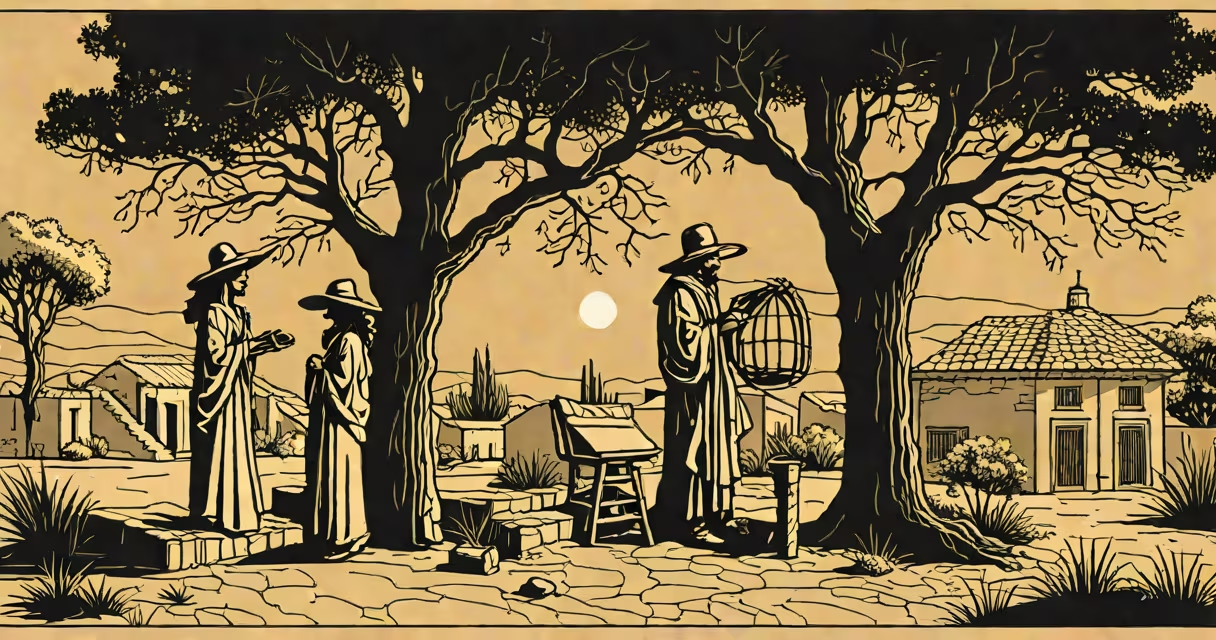
"Dama y vagabundo" is a Mexican folk tale centered on a noblewoman who encounters a homeless man during a storm. Their brief meeting leads to a lasting bond rooted in mutual respect and quiet dignity. The story functions as a moral parable, emphasizing empathy over social status.
The narrative unfolds in rural Mexico, often set during a rainy season. A woman of high standing-referred to simply as "la dama"-is traveling home when her carriage breaks down. She takes shelter beneath a tree, where she meets a man described only as "el vagabundo," a wanderer with no fixed home. They speak briefly. He offers her his coat to stay dry. She gives him bread. No names are exchanged. The encounter lasts less than an hour.
When the storm ends, they part ways. Years later, the dama learns the vagabundo was a former soldier, wrongfully exiled after a political coup. He had lived in obscurity, surviving by small acts of generosity. The dama, moved by their chance meeting, seeks him out. She finds him living in a hut near a river. She offers him a place in her household-not as a servant, but as a guest. He refuses. Instead, he asks only for permission to walk beside her during her daily walks. She agrees. Their friendship becomes a quiet symbol of reconciliation between classes.
There is no single written version of "dama y vagabundo." It exists primarily in oral tradition, passed down through generations in villages across central and southern Mexico. Regional variations exist: in some versions, the dama is a widow; in others, the vagabundo is a former teacher. The core remains unchanged-the meeting occurs in hardship, kindness is mutual, and social boundaries dissolve through human connection.
The tale operates on a structure common in Latin American folk narratives: a meeting in crisis, a gesture of care, and a resolution that defies expectation. Unlike many fables that reward virtue with wealth or power, "dama y vagabundo" rewards kindness with peace and companionship. The vagabundo does not become rich or famous. He does not marry the dama. He simply continues walking beside her, quietly.
This structure reflects indigenous and mestizo worldviews where dignity is not tied to material success. The story avoids hierarchy-neither character is superior. The dama's status doesn't grant her authority over the vagabundo. His lack of property doesn't diminish his worth. Their interaction is equal, grounded in shared humanity.
Modern scholars note that the tale aligns with the concept of "compadrazgo" in Mexican culture-a spiritual kinship formed through ritual or act, not blood. The brief exchange under the tree creates a bond that transcends class. The story teaches that relationships are not earned through rank, but through presence and choice.
While the core plot remains consistent, regional differences appear in setting, dialogue, and outcome. Below are common variants:
| Region | Setting | Outcome | Key Difference |
|---|---|---|---|
| Puebla | Rainy harvest season | Dama invites vagabundo to live in her garden house | He becomes caretaker of her orchard; grows fruit that heals villagers |
| Oaxaca | During Day of the Dead festival | Vagabundo vanishes after giving dama a carved mask | Mask appears in dreams of those who meet the dama later |
| Chiapas | Mountain village, winter | Both characters die in a landslide, but their spirits are seen together | Believed to protect travelers from storms |
These variations show how the story adapts to local beliefs. In Puebla, the focus is on restoration and care. In Oaxaca, it incorporates spiritual elements tied to indigenous cosmology. In Chiapas, death becomes a form of union rather than separation.
"Dama y vagabundo" is taught in primary schools across Mexico, especially in grades 3 and 4. It appears in national curriculum materials published by the Secretaría de Educación Pública (SEP). The story is used to teach empathy, humility, and the idea that value lies in actions, not titles.
According to UNESCO's Intangible Cultural Heritage database, stories like "dama y vagabundo" are part of Mexico's living oral tradition. These tales are recognized as tools for intergenerational transmission of ethical values. They are performed at community gatherings, festivals, and religious events-especially during Lent and All Saints' Day.
A 2019 study by the National Institute of Indigenous Languages (INALI) found that 68% of rural schoolchildren in southern Mexico could retell the story from memory. Among them, 82% emphasized the moment when the dama gave the vagabundo bread. This detail-simple, unspoken, and reciprocal-was consistently remembered as the most meaningful part.
Many assume "dama y vagabundo" is a fictional creation by a known author. It is not. It predates modern literature. There is no authorial record. The earliest documented version dates to 1857, transcribed by a priest in San Juan del Río, Querétaro. The manuscript was lost in a fire, but fragments survived in church archives.
Another misconception is that the story promotes romantic love. It does not. The relationship is platonic. The dama never marries the vagabundo. They do not share a home. The emotional core is not desire-it is recognition. Both see each other, without illusion. That clarity is the story's deepest gift.
A third error is claiming the vagabundo is poor because he lacks money. The tale never states his financial status. He is defined by movement, not lack. He travels freely. He speaks with ease. He chooses to remain unnamed. His poverty is not a flaw-it is a condition of freedom. The story challenges the idea that stability requires ownership.
In 2017, I attended a storytelling event in San Miguel de Allende where a 78-year-old woman named Doña Rosa recited "dama y vagabundo" in Nahuatl-influenced Spanish. Her voice cracked at the line where the dama says, "No me importa tu nombre." She paused, looked at the crowd, then whispered, "Me importa tu corazón." The room fell silent. Not a single person moved. When she finished, someone began clapping slowly. Then another. Then all of them. The silence wasn't empty-it was full of something we couldn't name. That moment stayed with me. It showed how a story can become a ritual.
Consider a classroom in Morelia, Michoacán. A teacher asks students to draw the scene where the dama and vagabundo meet. Most draw the tree, the rain, the coat. One child draws the dama handing bread while the vagabundo looks at her eyes-not her hands. Another draws both figures with their backs turned, walking away from each other-but side by side. The teacher notes: "They're not looking at each other. But they're walking together." The student says, "That's how it felt." The story isn't about what happens. It's about how it feels to be seen.
"Dama y vagabundo" endures not because it has a plot twist or a happy ending. It endures because it shows two people meeting in a storm and choosing to see each other. No title. No contract. Just a moment. That moment is enough.