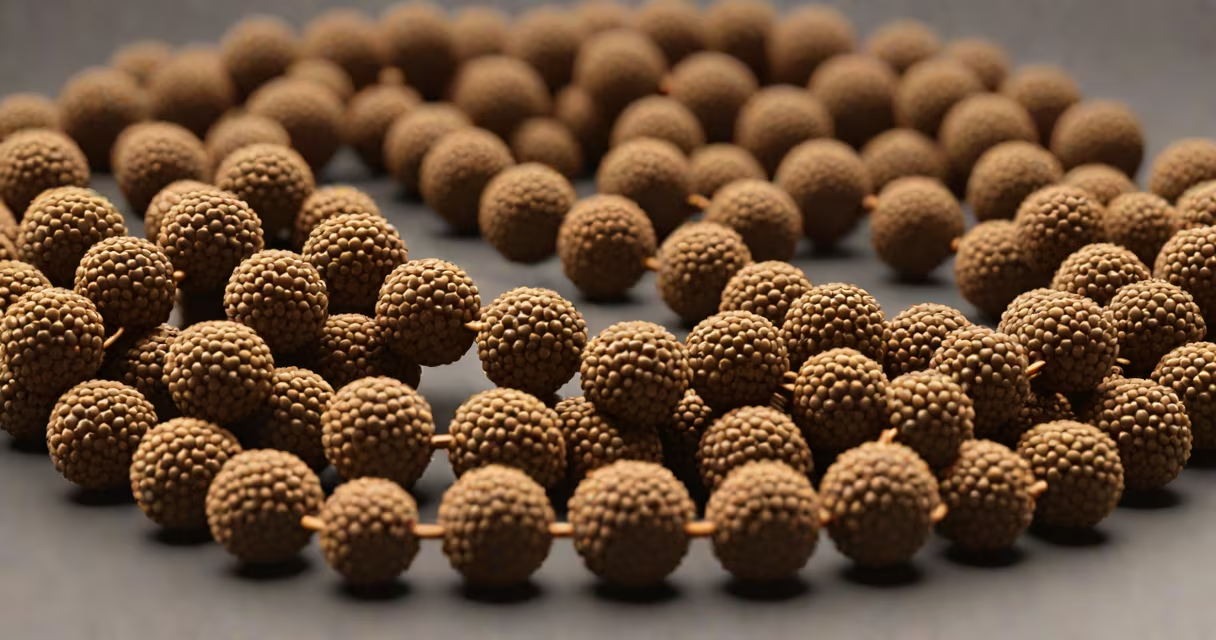
A bodhi seed mala is a traditional Buddhist prayer bead necklace made from the hard-shelled seeds of the Bodhi tree (Ficus religiosa), used to count mantras during meditation. Each mala contains 108 beads plus one larger guru bead, forming a complete cycle for focused repetition.
Bodhi seeds come from the tree under which Siddhartha Gautama attained enlightenment. The seeds are naturally dense, with a smooth, slightly waxy surface and a distinctive grayish-white color with dark brown or black markings. They are often left unpolished to preserve their organic integrity, making each mala unique in texture and appearance.
These malas are used primarily in Vajrayana and Theravāda Buddhist practices. The 108 beads represent the 108 human desires or defilements that must be overcome through mindful repetition. The practitioner moves one bead at a time with the thumb, reciting a mantra such as "Om Mani Padme Hum" or "Gate Gate Paragate Parasamgate Bodhi Svaha." After completing a full round, they reverse direction and continue, symbolizing the turning of the mind toward awakening.
The physical act of moving beads with the fingers grounds attention in the present moment. This tactile feedback reduces mental wandering and strengthens concentration. Each bead is touched once per mantra, creating a rhythmic, meditative loop that supports sustained focus.
For example, a practitioner using a bodhi seed mala to chant "Om Mani Padme Hum" 108 times would begin at the guru bead, move clockwise through the 108 beads, then return to the start by reversing direction. The process takes approximately 15-20 minutes at a steady pace, depending on breath and vocal speed.
Some traditions recommend using the index finger to touch the bead, but many prefer the thumb because it allows for smoother motion and better control. The thumb's contact with the bead provides subtle sensory input that reinforces presence, reducing the likelihood of autopilot mode during long sessions.
Bodhi seed malas are crafted exclusively from seeds harvested from mature Bodhi trees. These seeds are dried for several months to reduce moisture content and prevent cracking. They are then strung on a durable thread, typically silk or cotton, with a knot between each bead to maintain spacing and prevent tangling.
There are no standardized sizes, but most beads measure between 6mm and 10mm in diameter. Larger beads are often used in ceremonial settings, while smaller ones suit portable practice. The guru bead is usually twice the size of the others and may feature a small metal or wooden charm.
| Type | Material | Common Use | Distinctive Feature |
|---|---|---|---|
| Single strand | Bodhi seeds, silk thread | Daily meditation | Simple, lightweight, easy to carry |
| Double strand | Bodhi seeds, nylon cord | Yoga studios, retreats | More durable; resists fraying |
| With pendant | Bodhi seeds, silver or brass charm | Ceremonial offerings | Pendant often depicts Buddha or Dharma wheel |
Authentic bodhi seed malas are never machine-made. Each is hand-strung by artisans in India, Nepal, or Thailand. The process can take 4-6 hours per mala, depending on bead size and threading technique. Some makers add a small amount of natural beeswax to the thread to increase longevity and reduce friction.
Bodhi seed malas are central to daily meditation routines in Tibetan and Zen Buddhist communities. They are worn around the neck or carried in a pocket during walks, rituals, or silent retreats. Their natural weight-typically 150-250 grams-provides gentle resistance during movement, enhancing proprioceptive awareness.
In modern mindfulness circles, bodhi seed malas have gained popularity beyond religious contexts. People use them to track affirmations, breathwork sequences, or gratitude reflections. A 2022 study published in *Mindfulness* journal found that participants who used physical counting tools reported higher levels of sustained attention compared to those relying solely on mental counting.
One key advantage of bodhi seeds over synthetic materials is their acoustic quality. When rubbed together, they produce a soft, dry clicking sound-distinct from plastic or glass malas. This auditory cue reinforces the rhythm of the practice and helps maintain continuity during long sessions.
Many assume all malas are interchangeable. This is false. Bodhi seeds are spiritually significant due to their origin. Using a mala made from imitation seeds or dyed wood diminishes the symbolic weight of the practice. According to the *Tibetan Book of the Dead*, only authentic materials are suitable for ritual use.
Another error is treating the mala as a decorative accessory. While some wear them as jewelry, their primary function is functional: to support mental discipline. Wearing a bodhi seed mala during meditation is not fashion-it's a tool for training the mind.
A lesser-known fact: bodhi seeds are sensitive to humidity. Exposure to high moisture can cause swelling or cracking. They should be stored in a dry place, away from direct sunlight. Some practitioners wipe them gently with a dry cloth after use to remove oils from hands and prevent buildup.
I once attended a week-long silent retreat in northern Thailand where all participants used bodhi seed malas. On the third day, my mala slipped from my hand and broke. The thread snapped during a walking meditation. I felt immediate anxiety-not about losing the beads, but about disrupting the continuity of practice. A senior teacher later told me that the break was not a failure, but a reminder: the mala is not meant to last forever. Its impermanence reflects the core teaching of anicca, or change.
The bodhi seed mala is more than a string of seeds-it's a living artifact of contemplative tradition. Its simplicity belies deep cultural and spiritual significance. Unlike mass-produced alternatives, each mala bears the marks of handcrafting and the history of the tree it came from.
When choosing a bodhi seed mala, prioritize authenticity over aesthetics. Look for natural color variation, slight irregularities in bead shape, and a smooth, cool surface. Avoid malas with uniform coloring or glossy finishes-they're likely treated with shellac or resin.