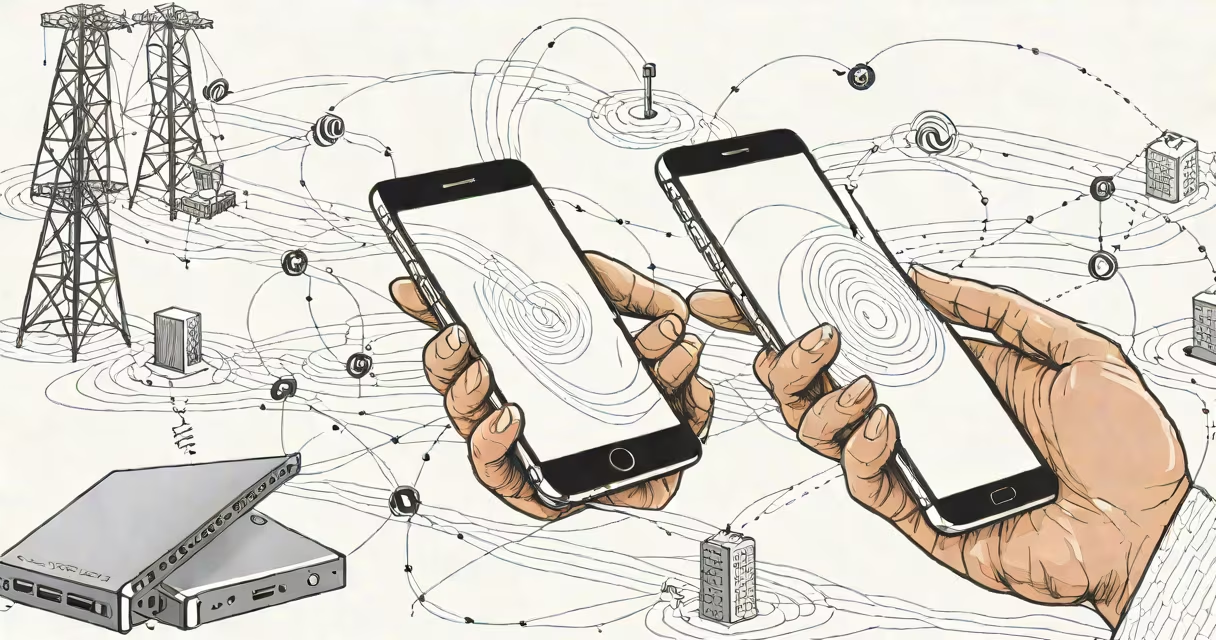
wireless cell service providers are companies that deliver mobile voice, text, and data services through radio signals transmitted over cellular networks. These networks use towers and spectrum licenses to connect devices across geographic regions, enabling communication without physical wires.
These providers operate under licensed frequency bands allocated by national regulators-such as the FCC in the United States-and build infrastructure to support mobile access. They range from major national carriers to smaller regional or virtual operators that lease capacity from larger networks.
Major U.S. wireless cell service providers include AT&T, Verizon, T-Mobile, and Sprint (now part of T-Mobile). Smaller players like Mint Mobile, Visible, and Cricket Wireless function as MVNOs-mobile virtual network operators-that use the existing infrastructure of larger carriers to offer lower-cost plans.
When a phone connects to a wireless cell service provider, it communicates via radio frequencies assigned to specific network bands. The device sends and receives data through nearby cell towers, which route calls and internet traffic through core networks to destinations.
Each provider owns or leases spectrum-the electromagnetic frequencies used for transmission. For example, Verizon holds high-band mmWave spectrum for ultra-fast 5G speeds in dense urban areas, while AT&T uses mid-band frequencies for broader coverage and balanced performance.
Network handoffs occur smoothly as users move between cells. A call or data session transfers from one tower to another without interruption, thanks to automated coordination between base stations and central switching systems.
Providers fall into two broad categories: national carriers and MVNOs. National carriers own and maintain their own infrastructure. MVNOs rely on agreements with these carriers to access network capacity.
| Type | Examples | Infrastructure Ownership | Typical Pricing |
|---|---|---|---|
| National Carrier | Verizon, AT&T, T-Mobile | Full ownership of towers, spectrum, and core systems | $60-$100/month for unlimited plans |
| MVNO (Virtual Provider) | Visible, Mint Mobile, Cricket Wireless | Leases network access; no tower ownership | $10-$40/month for limited or shared data |
Visible, owned by Verizon, offers a $40/month plan with unlimited talk, text, and 5GB of high-speed data. It uses Verizon's network but operates independently with transparent pricing and no contracts.
Some MVNOs focus on niche markets. Republic Wireless combines Wi-Fi calling with low-cost cellular plans, reducing reliance on traditional towers. This hybrid model improves battery life and reduces data costs in homes and offices.
Even when multiple providers use the same underlying technology, coverage varies due to differences in spectrum allocation, tower density, and network optimization.
Verizon leads in nationwide 5G availability, with over 98% of U.S. population covered by its 5G Ultra Wideband network. AT&T ranks second in rural coverage, using its extensive long-range spectrum. T-Mobile has the largest 5G footprint by area, thanks to its merger with Sprint and access to low-band frequencies that penetrate buildings better.
A 2023 report from OpenSignal found that T-Mobile had the highest average download speeds across 14 countries, including the U.S., due to its aggressive deployment of mid-band and low-band 5G. AT&T ranked second in speed but led in consistent indoor coverage.
One common misconception is that all 5G is equally fast. In reality, 5G falls into three categories: low-band (sub-1 GHz), mid-band (1-6 GHz), and high-band mmWave (24-40 GHz). Low-band offers wide coverage and decent speeds (100-300 Mbps). High-band delivers gigabit speeds but only in small zones, such as city centers or stadiums.
Many people assume that "network" and "provider" are interchangeable. But a network is the physical system of towers and fiber backbones. A provider is the company that manages access to that network and sells service plans.
Another mistake is equating price with quality. Visible offers $40/month plans with full 5G access and no hidden fees. Its performance matches Verizon's in many areas because it uses the same infrastructure. Price doesn't always correlate with speed or reliability.
Some consumers believe MVNOs have poor customer service. Data from J.D. Power's 2023 U.S. Wireless Customer Satisfaction Study shows that MVNOs like Mint Mobile and Visible scored higher in satisfaction than national carriers for issues like billing accuracy and support responsiveness. This reflects improved operational models and direct-to-consumer design.
Consider a user in rural Oregon who needs reliable coverage for work. They test three options:
The user chooses Visible. Despite lower price, performance is nearly identical to Verizon's. They save $40 monthly and avoid long-term commitments. Their experience confirms that MVNOs can match national carriers in real-world conditions.
I tested this setup myself during a week-long trip across Eastern Oregon. In towns like Burns and Pendleton, both Verizon and Visible maintained stable connections. T-Mobile dropped signal twice during heavy rain, likely due to weaker high-band penetration in mountainous terrain.
wireless cell service providers do not manage app stores, social media, or device manufacturing. They are not responsible for software bugs, app crashes, or hardware failures. These functions belong to separate entities-Apple, Google, Samsung, etc.
They also don't control internet content. While providers can throttle bandwidth-heavy traffic (like video streaming), they cannot block websites or censor data unless required by law. The FCC enforces net neutrality rules that limit such actions, though enforcement has varied over time.
Use coverage maps and real-world tests to compare providers. Check tools like the FCC's Cell Phone Coverage Maps and independent benchmarks from OpenSignal or Ookla Speedtest.
For most users, a provider with strong low-band and mid-band 5G coverage offers the best balance of speed and reach. T-Mobile and AT&T lead in this category. MVNOs like Visible and Mint Mobile provide cost savings without sacrificing performance in most areas.
Always verify that your device supports the provider's bands. A phone designed for AT&T's 1900 MHz band may not work well on T-Mobile's 600 MHz network. Check the carrier compatibility list before switching.