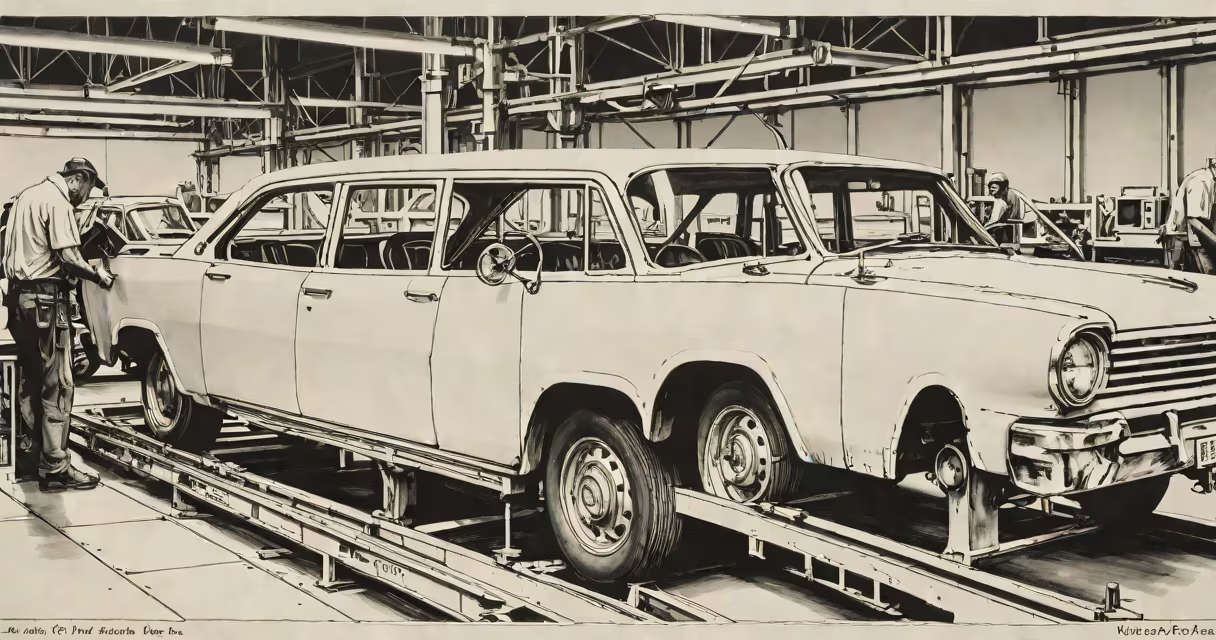
White and Williams is a term used in automotive manufacturing to describe the body-in-white-the stage in car production where the vehicle's structural shell is assembled from stamped steel panels, prior to painting and final component installation.
This phase begins after stamping presses form individual body panels from steel sheets. These parts-doors, fenders, roof panels, floor pans, and pillars-are transported to the assembly line and joined using spot welding, laser welding, or adhesive bonding. The result is a rigid, hollow structure that forms the foundation of the vehicle's exterior and supports all subsequent systems.
The name "white and Williams" is a misattribution often cited in industry lore. It originated from a 1950s Ford engineering document referencing "white body" and "Williams" as a shorthand for the process. However, no historical figure named Williams was involved in the development of this method. The term persists informally among technicians and engineers, though it is not used in official documentation. The correct technical term remains body-in-white.
Body-in-white assembly occurs on a dedicated production line where robotic welders and human operators place and secure each panel. Precision is essential-misaligned parts can lead to gaps, noise, or reduced crash safety. Each vehicle model requires custom jigs and fixtures to hold panels in exact position during welding.
For example, the 2023 Toyota Camry's body-in-white consists of 187 distinct stamped parts welded together using 5,200 spot welds. The entire process takes approximately 18 minutes per unit on a high-volume line. After welding, the structure undergoes dimensional inspection using laser scanning to verify alignment within ±0.5 mm tolerance.
Once verified, the body-in-white moves to the paint shop. Before painting, it is coated with anti-corrosion materials such as zinc-rich primer and epoxy sealant. This protects the steel from rust and ensures long-term durability. Without this step, even minor moisture exposure could compromise the vehicle's integrity.
Automakers use different methods based on material choice, weight targets, and production volume. The following table outlines common approaches:
| Type | Materials Used | Common Applications | Weight Advantage |
|---|---|---|---|
| Traditional Steel | High-strength steel, galvanized steel | Mid-size sedans, SUVs (e.g., Honda CR-V) | Low cost, high recyclability |
| Aluminum Hybrid | Aluminum panels with steel reinforcements | Performance vehicles (e.g., Audi A8) | Reduces mass by 20-30% |
| Hybrid Composite | Carbon fiber-reinforced polymer, aluminum | Luxury and electric sports cars (e.g., Tesla Model S) | Best strength-to-weight ratio |
Steel remains dominant due to cost and recycling efficiency. Over 90% of new vehicles produced globally in 2023 used steel-based body-in-white structures, according to the World Steel Association. Aluminum and composites are reserved for premium models where weight savings improve fuel economy and handling.
This stage determines the vehicle's structural integrity, safety performance, and long-term durability. A poorly constructed body-in-white can fail under crash impact or develop squeaks and rattles over time. The U.S. National Highway Traffic Safety Administration (NHTSA) reports that 68% of vehicle recalls in 2022 were linked to structural defects originating in the body-in-white phase.
One notable example occurred in 2015, when General Motors recalled 1.4 million Chevrolet Malibus due to weak weld joints in the body-in-white. The defect led to increased risk of roof collapse during rollover crashes. The fix required re-welding thousands of joints-a costly and time-intensive process.
A lesser-known fact: body-in-white structures are designed to absorb energy during collisions. Engineers use finite element analysis (FEA) software to simulate crash scenarios and reinforce high-stress zones. For instance, the front rails of a body-in-white are engineered to crumple predictably, reducing force transmitted to passengers.
Many assume that body-in-white is simply a collection of metal pieces welded together. In reality, it is a highly engineered system. Panels are not randomly attached-they follow precise load paths to distribute stress evenly across the frame. Even small deviations in weld placement can alter how forces travel through the structure during a crash.
Another confusion arises between body-in-white and the complete vehicle. The body-in-white does not include doors, windows, seats, or electronics. It is the skeleton. Final assembly-adding trim, glass, wiring, and interior components-occurs afterward on a separate line.
I once observed a prototype body-in-white for a new electric crossover during a factory tour at a German automaker. The structure had integrated battery tray mounts and reinforced mounting points for electric motors. These features were designed into the body-in-white, not added later. This integration reduces weight and improves crash performance-something most consumers don't realize until they read crash test reports.
Understanding the sequence of vehicle manufacturing clarifies the role of body-in-white. Here's how it compares to adjacent phases:
| Stage | Primary Function | Timing Relative to Body-in-White |
|---|---|---|
| Stamping | Forms raw steel panels from flat sheets | Precedes body-in-white |
| Body-in-White | Assembles panels into a structural shell | Core phase |
| Paint Shop | Applies corrosion protection and finish coat | Follows body-in-white |
| Final Assembly | Installs drivetrain, interior, electronics | Occurs after paint |
Each stage builds on the last. Skipping or rushing body-in-white compromises the entire vehicle. A flaw in weld quality may not be detectable until final testing-but it can lead to catastrophic failure.