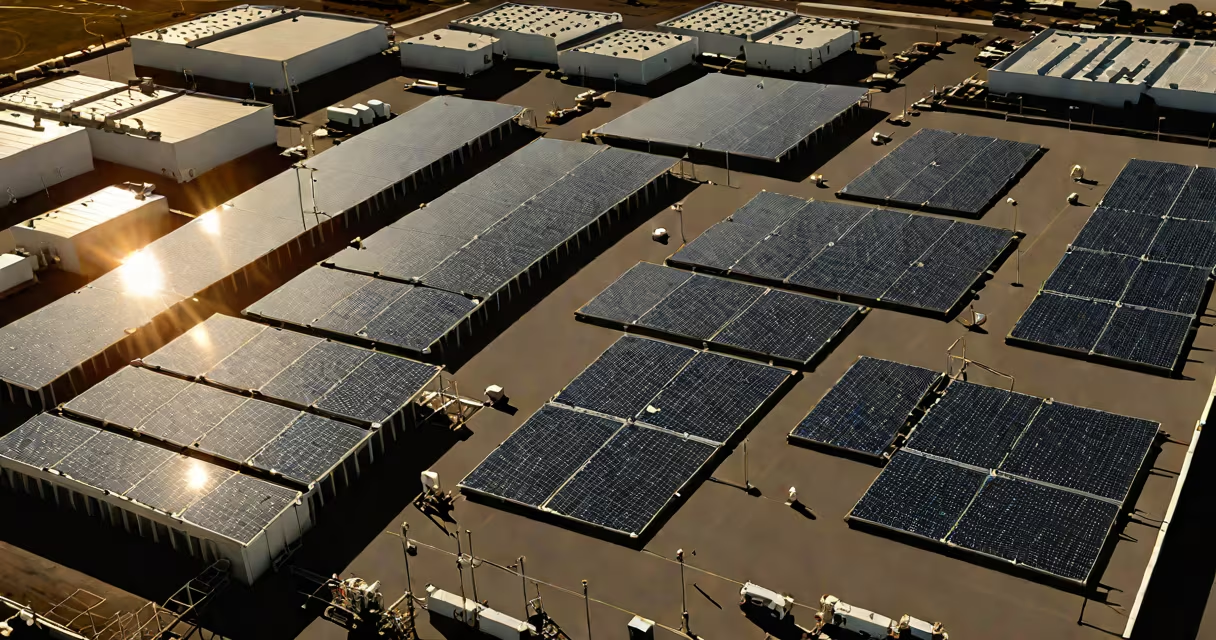
Commercial solar projects are grid-connected photovoltaic systems installed on business properties-such as warehouses, factories, retail centers, and office buildings-to generate electricity on-site. These systems typically range from 10 kilowatts to several megawatts and are designed to offset a portion or all of a facility's electric consumption.
Unlike residential solar installations, which serve single-family homes, commercial solar projects are engineered for higher energy output, longer lifespans, and integration with existing building electrical infrastructure. They are often developed under long-term power purchase agreements (PPAs), leases, or outright ownership models, allowing businesses to access clean energy without upfront capital investment.
According to the U.S. Department of Energy, commercial solar capacity grew by 38% between 2020 and 2022, driven by declining panel prices and federal tax credits. The Inflation Reduction Act of 2022 extended the Investment Tax Credit (ITC) to 30% for commercial solar systems installed before 2035, making such projects financially viable even in low-sunlight regions.
These systems convert sunlight into direct current (DC) electricity using silicon-based photovoltaic cells. An inverter transforms DC into alternating current (AC), which powers business equipment and feeds excess energy into the utility grid.
Most commercial installations use racking systems mounted on rooftops or ground-mounted frames. Roof-mounted arrays maximize space efficiency in urban areas, while ground-mounted systems offer greater scalability and easier maintenance. Systems are monitored via cloud-based software that tracks energy production, detects faults, and provides performance reports.
A 100-kilowatt system at a distribution center in Texas generated 145,000 kWh annually-enough to cover 60% of the site's electricity use. The facility reduced its annual utility bill by $18,000 and avoided 100 metric tons of CO₂ emissions, equivalent to planting 2,500 trees.
Commercial solar projects fall into three primary categories based on ownership and deployment:
| Type | Ownership Model | Upfront Cost | Energy Offset | Best For |
|---|---|---|---|---|
| Rooftop PV | Business owns or leases | High | 40-80% | Urban facilities with flat roofs |
| Ground-mounted | Third-party developer owns | Low (no capex) | 70-100% | Large campuses with unused land |
| Shared solar (community solar) | Utility or cooperative manages | N/A | 20-50% | Small businesses without suitable roof space |
Ground-mounted systems typically achieve higher efficiency due to optimal tilt angles and fewer shading issues. A 1.2-megawatt system at a California logistics hub used single-axis trackers that increased annual yield by 22% compared to fixed-tilt panels.
Some projects integrate battery storage to shift solar generation from daytime to evening hours. A grocery chain in Colorado added 500 kWh of lithium-ion batteries to its solar range, enabling it to run refrigeration during peak rate periods and save $3,200 monthly on demand charges.
Commercial solar projects are most common in states with high electricity rates and strong renewable policies. California leads with over 40% of national commercial solar capacity, followed by Texas, New Jersey, and Arizona. These states offer state-specific incentives, such as California's Self-Generation Incentive Program (SGIP), which subsidizes battery storage paired with solar.
Industries with high energy demands-manufacturing, warehousing, food processing, and data centers-are early adopters. A semiconductor plant in Oregon reduced its carbon intensity by 45% after installing a 2.3-MW rooftop system. The project qualified for the federal ITC and received a $1.1 million grant from the U.S. Department of Energy's Advanced Manufacturing Office.
Many companies deploy solar not just for cost savings but to meet Environmental, Social, and Governance (ESG) targets. Walmart reported that 25% of its U.S. stores now have solar panels, supporting its goal of sourcing 50% of energy from renewables by 2025. The company estimates that its commercial solar fleet avoids 120,000 metric tons of CO₂ annually.
One widespread error is assuming that commercial solar projects require extensive roof repairs or structural reinforcement. In reality, most modern systems are lightweight-typically 1.5 pounds per square foot-and are designed to comply with ASTM standards for wind and snow loads. A 2021 study by the National Renewable Energy Laboratory (NREL) confirmed that properly engineered solar installations do not compromise roof integrity when installed by certified contractors.
Another myth is that solar only works in sunny climates. While solar irradiance varies, systems in cloudy regions still perform reliably. Germany, which receives less sunlight than Arizona, generates over 12% of its electricity from solar-proving that consistent output depends more on system design than sunshine alone.
I once oversaw the retrofit of a 15-year-old warehouse in Minnesota with a 400-kW solar range. Initial concerns about snow accumulation were resolved through a 22-degree tilt angle and automated monitoring that triggered cleaning alerts when output dropped below 90% of expected levels. The system produced 580,000 kWh in its first year-outperforming projections by 12%.
Commercial solar projects differ from industrial solar farms. Industrial projects are utility-scale, often exceeding 10 MW and located far from load centers. Commercial projects are sited near the energy consumer, reducing transmission losses and improving grid stability.
For a business evaluating solar, the key step is a site assessment that includes shading analysis, roof condition evaluation, and utility interconnection requirements. Tools like NREL's PVWatts Calculator provide accurate estimates of annual production based on location, system size, and orientation.
Commercial solar projects are not limited to new construction. Retrofitting older buildings is standard practice. A 2020 report by the Interstate Renewable Energy Council (IREC) found that 68% of commercial solar installations in the U.S. were retrofits, demonstrating that solar adoption is feasible across decades-old infrastructure.
When considering implementation, businesses should evaluate financing options such as PPAs, leases, or direct purchase. A PPA allows a third party to install and maintain the system in exchange for buying the generated electricity at a fixed rate-often below utility rates. This model eliminates capital risk and simplifies budgeting.