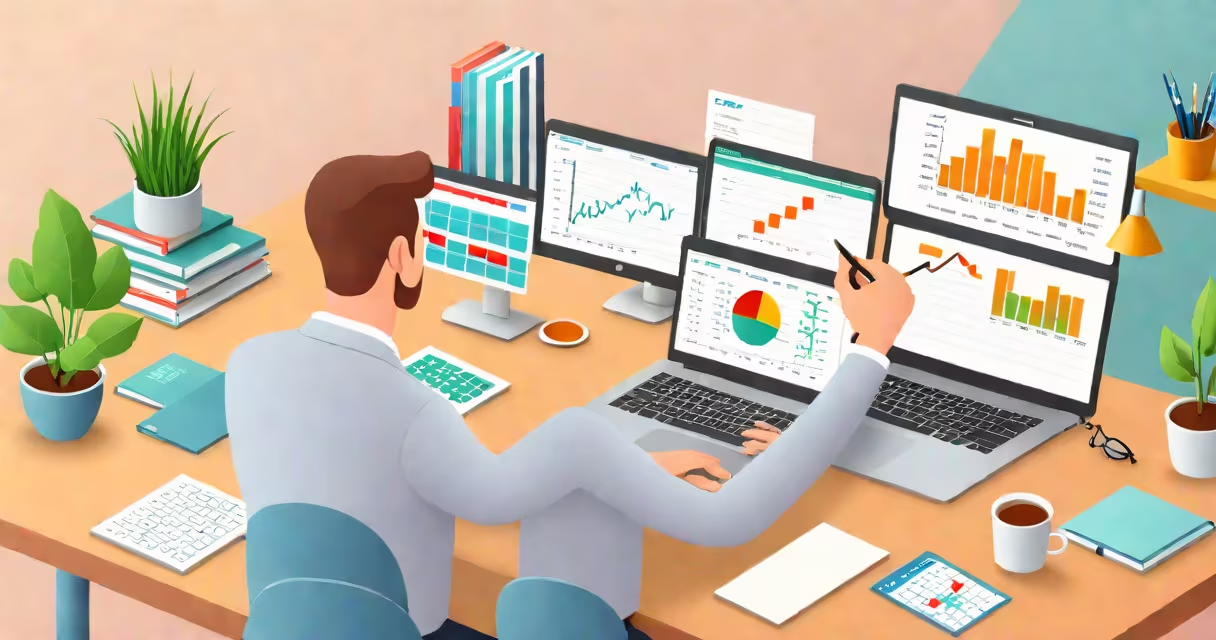
Forecasting in business uses past data, market trends, and statistical models to predict future sales, demand, cash flow, or performance. It turns historical patterns into actionable insights for planning and decision-making.
Businesses rely on forecasting to anticipate customer needs, allocate resources efficiently, and avoid stockouts or overproduction. A retailer might forecast holiday sales to adjust inventory levels months in advance. A startup may project revenue growth to secure funding. Without forecasting, planning becomes guesswork.
Accurate forecasts reduce risk and improve responsiveness. They inform budgeting, staffing, production schedules, and investment strategies. The process combines quantitative analysis with qualitative judgment, especially when external factors like economic shifts or new regulations affect outcomes.
Forecasting begins with collecting relevant historical data-sales records, website traffic, order volumes, or economic indicators. This data is cleaned, normalized, and analyzed for patterns such as seasonality, trends, or cyclical behavior.
Statistical methods then model future values. Simple techniques like moving averages smooth out noise in time-series data. More advanced models, such as ARIMA or exponential smoothing, account for trends and seasonal fluctuations. Machine learning algorithms now power many forecasts by identifying complex, non-linear relationships in large datasets.
For example, a grocery chain uses daily sales data from 50 stores over three years. It identifies that demand for frozen pizza spikes every Friday and during major sports events. Using this pattern, the system predicts weekly demand with 92% accuracy, adjusting supply orders automatically.
Businesses apply different forecasting approaches based on their goals and available data. The most common types include:
| Type | Purpose | Common Methods | Example |
|---|---|---|---|
| Demand Forecasting | Predict customer demand for products or services | Time-series analysis, regression, machine learning | A clothing brand forecasts winter coat sales using past holiday data and weather trends. |
| Financial Forecasting | Project revenues, expenses, and cash flow | Top-down, bottom-up modeling, scenario analysis | A SaaS company projects Q4 revenue based on current subscription growth and churn rates. |
| Sales Forecasting | Estimate future sales volume and value | Historical trend extrapolation, pipeline analysis | A B2B software vendor estimates next quarter's deal closures based on sales team pipeline. |
| Resource Forecasting | Plan staffing, equipment, or facility needs | Workforce modeling, capacity planning | A hospital predicts patient admissions to schedule nursing staff across shifts. |
Each method varies in complexity and required inputs. Demand forecasting often uses granular transaction data. Financial forecasting relies heavily on accounting systems and assumptions about growth or inflation. Sales forecasting may integrate CRM data with sales cycle timelines.
Forecasting supports strategic and operational decisions across departments. Marketing teams use it to time campaigns. Supply chain managers depend on it to prevent shortages. Finance leaders build budgets around projected income.
For instance, a food manufacturer uses demand forecasting to plan raw material purchases. By analyzing past sales and upcoming holidays, it reduces waste by 18% and cuts storage costs by $270,000 annually. The same company uses financial forecasting to set quarterly targets and track progress against them.
Forecasting is essential during uncertainty. During the 2020 pandemic, retailers that adjusted forecasts based on real-time foot traffic and online behavior reduced inventory losses by up to 40%. According to the Forecasting Principles site, organizations using formal forecasting processes report 25% higher forecast accuracy than those relying on intuition alone.
Many assume forecasting in business is purely mathematical. In reality, it blends data science with domain expertise. A model predicting a 30% drop in sales due to a trend might fail if it ignores a new product launch or a competitor's pricing change.
Another myth is that forecasts must be 100% accurate. Accuracy is measured in error margins-most business forecasts aim for 85-95% precision. A 10% margin of error is acceptable when planning for a 12-month horizon. The goal is not perfection but improved decision quality.
Some confuse forecasting with budgeting. Budgeting sets spending limits based on assumed outcomes. Forecasting predicts actual results. You forecast sales, then use that number to create a budget. Confusing the two leads to misaligned plans and resource gaps.
I once worked with a retail client who rejected a machine learning-based demand forecast because it predicted lower holiday sales than their gut feeling suggested. After testing both versions, the model-driven plan reduced overstock by 37% and increased profit margins by 6.2 percentage points. The data won.
Effective forecasting requires consistent data quality, regular model updates, and cross-functional collaboration. Teams should review forecasts monthly, compare predictions to actual results, and refine assumptions.
Popular tools include Microsoft Excel with Power Pivot, Tableau for visualization, and specialized platforms like Oracle Adaptive Intelligence or ForecastPro. Cloud-based solutions integrate with ERP and CRM systems, enabling real-time updates.
Start small: pick one key metric-like monthly sales or inventory turnover-and build a forecast using the last 12-24 months of data. Apply a simple moving average first, then test more advanced models. Track accuracy over time using Mean Absolute Percentage Error (MAPE).
Forecasting in business is not a one-time task. It's a continuous process of refining predictions based on new data and changing conditions. When done well, it transforms uncertainty into clarity and enables proactive, informed decisions.