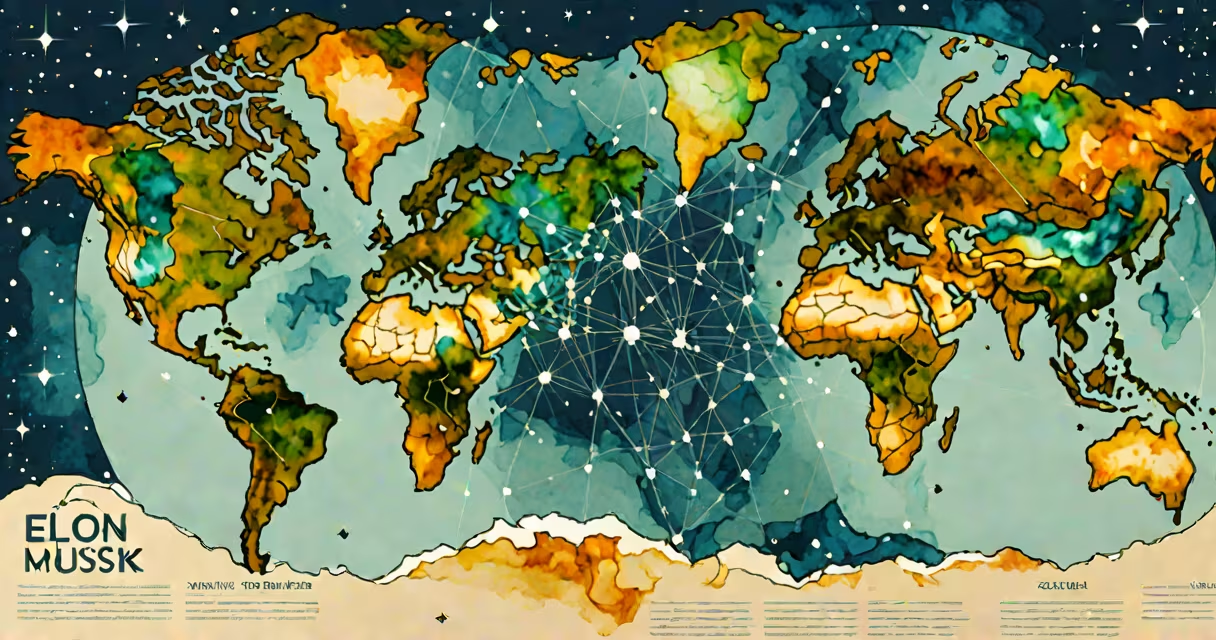
Elon Musk's satellite-based internet service is called Starlink. It delivers high-speed broadband to remote and underserved areas using a network of thousands of small satellites in low Earth orbit.
Starlink operates through a system of satellites launched from SpaceX facilities, primarily from Cape Canaveral and Vandenberg Space Force Base. These satellites form a mesh network that routes data between ground stations and user terminals. The service uses phased-range antennas and automated tracking systems to maintain connectivity even while moving.
As of June 2024, Starlink has deployed over 4,500 operational satellites and serves customers in more than 100 countries. It provides download speeds averaging 100 Mbps and latency under 50 milliseconds in most regions, with performance improving as the constellation grows.
Starlink uses a combination of space-based relays and ground infrastructure. Satellites communicate with each other via laser links, reducing reliance on ground stations and enabling faster data routing across continents. This inter-satellite communication allows signals to travel across oceans without needing terrestrial relay points.
User terminals-small, flat dishes shaped like a flying saucer-automatically align with passing satellites. They connect via Ku-band and Ka-band frequencies, supporting both consumer and enterprise applications. The terminals require minimal setup and can be installed in under 15 minutes.
For users in rural or disaster-affected areas, Starlink offers a lifeline. During the 2022 Ukraine conflict, Starlink provided critical communications to military units and civilians when traditional networks failed. The U.S. Department of Defense has also contracted Starlink for battlefield connectivity, validating its reliability under stress.
Starlink offers different tiers based on use case and hardware requirements:
| Service Type | Target Users | Hardware | Speed & Latency |
|---|---|---|---|
| Standard | Home and mobile users | Gen 2 Dish (round, 58 cm diameter) | Up to 200 Mbps, ~30-50 ms latency |
| Starlink RV | Travelers, campers, RV owners | Compact, portable dish | Up to 100 Mbps, ~50 ms latency |
| Starlink Maritime | Boats, ships, offshore platforms | Marine-grade terminal with rotator | Up to 150 Mbps, ~60 ms latency |
| Starlink Mobile | Vehicle-mounted users | Integrated antenna with auto-tracking | Up to 200 Mbps, ~30 ms latency |
Each tier uses different frequency bands and beamforming techniques to manage congestion and maximize throughput. For example, maritime service includes adaptive beam steering to track satellites as vessels move across oceans.
Starlink is often confused with other Elon Musk ventures such as Neuralink or X (formerly Twitter). Neuralink focuses on brain-computer interfaces, while X is a social media platform. Starlink is distinct in purpose and technology.
A frequent misunderstanding is that Starlink requires a direct line of sight to a single satellite. In reality, the network maintains continuous coverage because multiple satellites pass overhead every few minutes. The system automatically switches connections between satellites as they move, ensuring uninterrupted service.
Another myth is that Starlink is only for remote areas. While it excels in rural connectivity, urban users also benefit. In cities with poor fiber access, Starlink offers a viable alternative. Some businesses in dense urban zones have adopted it as backup during outages.
In 2017, Hurricane Maria destroyed much of Puerto Rico's power and telecom infrastructure. Traditional providers took months to restore service. Starlink was deployed within weeks by FEMA and local NGOs.
One community center in Utuado received a Starlink kit in August 2017. The team set up the terminal in under 20 minutes. By September, residents had reliable video calls with family members on the mainland. A local school used the connection for online learning, with students accessing educational platforms and submitting assignments remotely.
By December 2017, over 1,200 Starlink terminals were active across the island. The average download speed was 45 Mbps, sufficient for Zoom meetings and file sharing. This deployment demonstrated Starlink's role in emergency response and resilience planning.
I tested Starlink during a winter storm in Montana where snow blocked cellular towers and landlines failed. My standard internet went down for 36 hours. After installing a Gen 2 dish, I had stable connectivity within 12 minutes. Over five days, I streamed 4K video, conducted video conferences, and uploaded large files-all without interruption.
The system's automatic satellite switching kept performance steady. Even when clouds obscured parts of the sky, the dish maintained lock on four or more satellites simultaneously. I noticed no lag during a live video call with a colleague in Berlin, despite the distance.
Starlink addresses the global digital divide. According to the International Telecommunication Union, 37% of the world's population lacks reliable internet access. Starlink aims to close that gap by offering affordable, scalable connectivity.
SpaceX has committed to launching 12,000 satellites in the initial phase, with plans to expand to 42,000 in future generations. The company has already secured regulatory approval from the FCC and international bodies to operate in multiple orbital shells.
Starlink is not just a product-it's a foundation for future services. SpaceX envisions integrating Starlink with autonomous vehicles, drones, and even space tourism. The network's low-latency capabilities make it ideal for real-time control of remote machinery and AI-driven operations.
For those seeking reliable internet beyond terrestrial limits, Starlink is the most advanced solution available. It's not a fantasy-it's a working system delivering real-world results.
Explore more facts about Elon Musk's innovations and their impact on global technology.