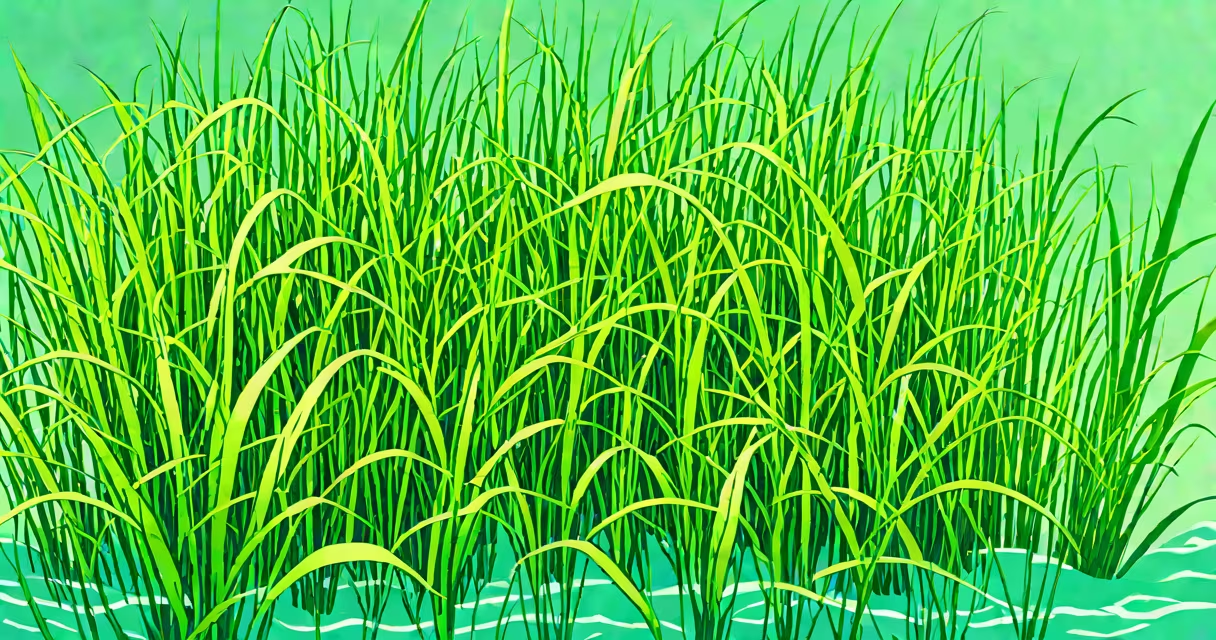
Seagrass appears as slender, ribbon-shaped green blades that grow in dense underwater meadows, often forming lush fields in shallow coastal areas. Unlike seaweed, which floats freely, seagrass roots in the seabed and grows from rhizomes. Its structure mimics land grass but adapts to saltwater conditions.
Seagrass typically ranges from 10 cm to 2 meters in height, depending on species and water depth. The blades are flat or cylindrical, with smooth edges and a waxy surface that resists salt buildup. Colors vary from bright emerald to dark olive-green, especially in deeper or turbid waters. Some species show fine parallel veins running along the blade's length, visible under close inspection.
Roots anchor seagrass firmly in sandy or muddy substrates. Rhizomes spread horizontally beneath the sediment, forming extensive networks that stabilize the seafloor. When disturbed, these networks release fine particles, contributing to clearer water. Roots and rhizomes are pale beige or white, often hidden from view.
Seagrass is often mistaken for algae or seaweed due to its aquatic habitat. However, it is a true flowering plant, not a macroalgae. This biological distinction affects its physical traits: seagrass has vascular tissue, produces flowers, and reproduces via seeds. These features are absent in seaweed.
Blade width varies by species. For example, *Zostera marina* (common eelgrass) has narrow blades about 2-5 mm wide and up to 1 meter long. *Thalassia testudinum* (turtle grass), found in tropical regions, has broader, ribbon-like blades up to 1.5 cm wide and 60 cm long. Blade texture is firm and flexible, resisting strong currents without snapping.
Underwater meadows form dense mats that resemble lawns. In clear, shallow water, these appear as vibrant green carpets. Sunlight penetration influences color intensity-blades near the surface are brighter green than those in deeper zones. During seasonal die-offs, blades turn brown and break down, creating debris fields on the seafloor.
| Species | Blade Shape | Width Range | Typical Height | Habitat |
|---|---|---|---|---|
| Zostera marina | Flat, ribbon-like | 2-5 mm | up to 1 m | North Atlantic, Arctic coasts |
| Thalassia testudinum | Wide, flat | 10-15 mm | 30-60 cm | Tropical Caribbean, Florida Keys |
| Posidonia oceanica | Long, strap-like | 5-10 mm | up to 1.5 m | Mediterranean Sea |
Seagrass thrives in sheltered, shallow coastal zones-bays, lagoons, estuaries-where light reaches the seabed. Water clarity is critical; seagrass cannot survive below 15 meters in most cases. High turbidity from runoff or storms reduces photosynthesis, leading to die-offs. In the Chesapeake Bay, seagrass coverage dropped by 90% between 1950 and 1980 due to pollution and sedimentation.
Its growth pattern supports marine ecosystems. Dense meadows provide nursery grounds for fish like striped bass and blue crab. A single square meter of seagrass can host over 100 juvenile fish. The structure also traps organic material, improving nutrient cycling. Seagrass beds store carbon at rates up to 85 grams per square meter per year-higher than many tropical forests.
One non-obvious fact: seagrass doesn't flower every year. Species like *Zostera marina* may skip reproduction during stressful periods. Flowering occurs in spring or early summer, producing tiny, inconspicuous blooms that release pollen into the water. Pollen grains are microscopic, measuring around 10 micrometers in diameter.
Many assume seagrass is a type of seaweed. Seaweed lacks roots, vascular systems, and flowers. It grows on rocks or floating freely. Seagrass, by contrast, anchors itself and has internal transport tissues. Distinguishing them visually requires observing root attachment and blade cross-sections.
Another confusion arises from color changes. Brown or faded blades don't always indicate death. Seasonal senescence causes natural browning in autumn. Healthy meadows can recover in spring. But persistent discoloration signals stress-often from excess nutrients or low oxygen levels.
I once observed a seagrass bed in the Florida Keys during a low-tide survey. The meadow was dominated by *Thalassia testudinum*. Underwater, the blades formed a thick, undulating carpet. When I touched it gently, the entire patch swayed like a field in wind. A small fish darted through the blades-its movement invisible until the current shifted the green strands. That moment confirmed how important seagrass is to marine life.
Look for continuous patches of green, ribbon-like vegetation rooted in sand or mud. Avoid areas with scattered, floating green strands-those are likely seaweed. Check for rhizomes: if the base of the blades connects to a network beneath the substrate, it's seagrass. Pulling a single blade should reveal a firm, fibrous stem, not a brittle or gelatinous texture.
Seasonal timing matters. In temperate zones, seagrass peaks in late spring and early summer. In tropical zones, growth remains steady year-round. If you see dead blades lying on the seafloor, they're likely from a recent die-off event, not normal shedding.
For visual reference, compare seagrass to terrestrial grass. Both have similar leaf architecture, but seagrass blades lack stomata-tiny pores for gas exchange. Instead, it exchanges gases directly through the leaf surface. This adaptation allows efficient oxygen uptake in water, where diffusion is slower than in air.
Recognizing seagrass by sight supports conservation efforts. Its distinctive form-long, green, rooted blades in dense underwater meadows-is unmistakable once you've seen it in nature. walking a tidal shore in Maine, knowing what seagrass looks like reveals the hidden complexity beneath the waves.