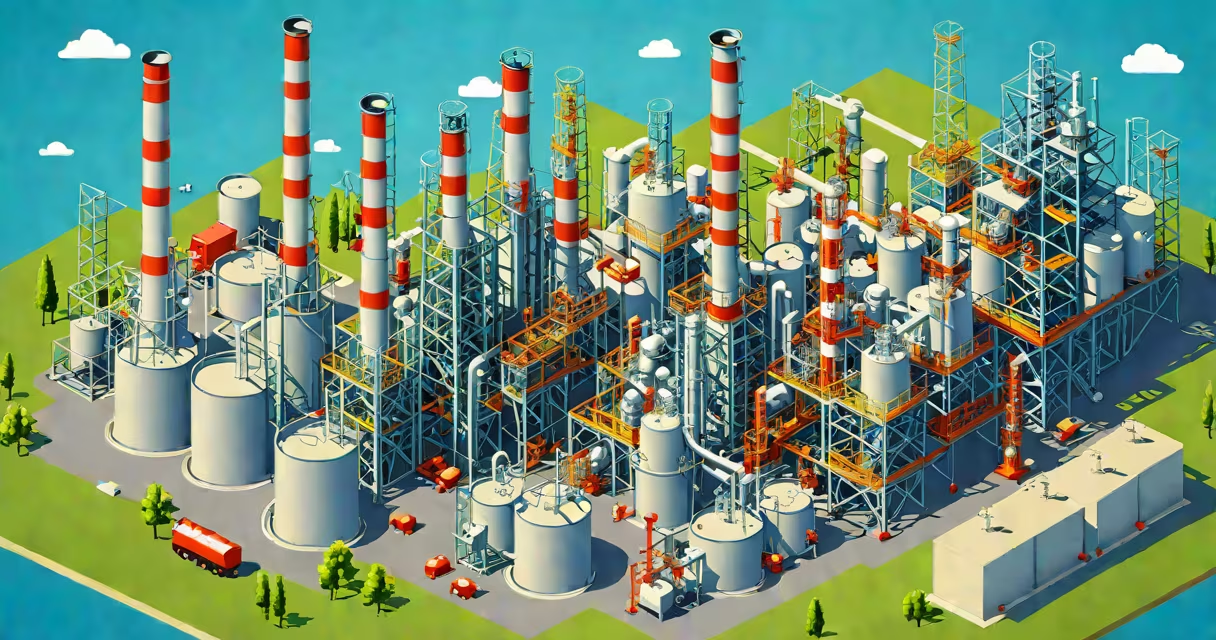
Refining oil means converting raw crude oil into marketable products such as gasoline, diesel, jet fuel, lubricants, and petrochemical feedstocks through physical and chemical processes. This transformation occurs in large-scale facilities called refineries, where crude oil is heated, separated, and chemically altered to meet performance and environmental standards.
The process begins with crude oil extracted from underground reservoirs. It contains a complex mixture of hydrocarbons-molecules made of hydrogen and carbon-with varying chain lengths and boiling points. Without refinement, crude oil cannot power vehicles, heat homes, or serve as raw material for plastics.
Refining oil is not a single step but a sequence of operations including atmospheric and vacuum distillation, catalytic cracking, hydrotreating, alkylation, and reforming. Each stage targets specific molecules to produce high-value outputs. For example, a barrel of crude oil yields about 19 gallons of gasoline after refining, according to the U.S. Energy Information Administration (EIA).
Crude oil enters a refinery as a liquid at ambient temperature. It is first preheated and then fed into a distillation column, where it is vaporized at around 350°C (662°F). As vapors rise, they cool and condense at different heights based on boiling point. Lighter hydrocarbons like propane and butane condense near the top; heavier ones like diesel and lubricating oils form lower down.
After distillation, the resulting fractions undergo further processing. Naphtha, a light fraction rich in short-chain hydrocarbons, goes to catalytic reforming. Here, platinum-based catalysts rearrange molecules to increase octane rating, producing high-performance gasoline components. A single reformer unit can process up to 100,000 barrels per day, depending on refinery size.
Heavy residual oils from distillation are sent to fluid catalytic crackers (FCC units). These break long chains into shorter, more valuable molecules. FCC units convert about 20-30% of crude oil into gasoline, boosting yield. Modern refineries use advanced control systems to adjust catalyst flow and temperature in real time, improving efficiency and reducing emissions.
Refineries use several core technologies to maximize output and quality. The table below outlines key processes and their primary outputs.
| Process | Input Fraction | Main Output | Key Technology |
|---|---|---|---|
| Atmospheric Distillation | Crude oil | Naphtha, kerosene, diesel | Vertical distillation column |
| Catalytic Reforming | Naphtha | High-octane gasoline blendstock | Platinum-rhenium catalyst |
| Fluid Catalytic Cracking (FCC) | Heavy gas oil | Gasoline, propylene | Recycled catalyst bed |
| Hydrotreating | Diesel, kerosene | Sulfur-free fuels | Hydrogen + nickel-molybdenum catalyst |
Each process addresses a specific challenge: removing sulfur, increasing octane, or breaking down heavy molecules. For instance, hydrotreating reduces sulfur content from 5,000 ppm in raw diesel to less than 15 ppm-required for compliance with EPA's ultra-low sulfur diesel standard.
Modern refineries integrate these steps into continuous flows. A typical integrated refinery processes 200,000 barrels per day. The largest, such as the ExxonMobil Baytown Refinery in Texas, operate 24/7 with automated monitoring systems tracking pressure, temperature, and flow rates in real time.
Oil refining occurs primarily in regions with access to crude supply and transportation infrastructure. Major refining hubs include the U.S. Gulf Coast, Western Europe, and parts of Asia. The U.S. has 130 operating refineries, accounting for nearly 20% of global capacity, according to the EIA.
Refining is essential because crude oil cannot be used directly. Its composition varies widely by region-Middle Eastern crude tends to be lighter and sweeter (low sulfur), while Venezuelan crude is heavier and sour (high sulfur). Refineries must adapt processes to handle these differences.
For example, the Chevron Richmond Refinery in California processes heavy Canadian crude that requires extensive coking to remove carbon residues. Without this step, the resulting fuel would fail emissions tests. The refinery uses delayed cokers to convert residual oil into petroleum coke-a solid byproduct used in steelmaking and electrodes.
A common misconception is that refining oil creates waste. While byproducts exist-such as asphalt and petroleum coke-modern refineries recycle over 90% of materials. Residuals are repurposed: asphalt for road paving, coke for industrial furnaces, and even hydrogen recovered from hydrotreating for reuse in other processes.
People often confuse refining with extraction or drilling. Extraction pulls crude oil from the ground; refining transforms it into usable forms. Drilling is upstream; refining is downstream in the petroleum industry.
Another error is assuming all refineries produce the same mix of products. Refineries tailor output based on demand. A refinery near a major airport may prioritize jet fuel; one in a densely populated area may focus on gasoline. The 2022 U.S. Energy Information Administration report shows that U.S. refineries produced 9.2 million barrels per day of gasoline, 4.1 million barrels of diesel, and 1.5 million barrels of jet fuel.
One non-obvious fact: the energy required to refine oil exceeds the energy stored in the final product. According to the International Energy Agency (IEA), refining consumes about 10% of the total energy content of crude oil. This means a barrel of gasoline contains roughly 55 million BTUs, but refining it takes about 5.5 million BTUs-equivalent to running a 100-watt bulb for 60 days.
I once observed a simulation at a refinery training center where operators adjusted FCC reactor temperature to balance gasoline yield against coke formation. A 5°C increase boosted gasoline output by 1.2%, but also raised coke production by 3%. The trade-off highlighted how small changes impact both economics and environmental output.
Refining oil is not a one-size-fits-all process. It adapts to crude quality, regulatory requirements, and market demand. The goal is to extract maximum value from each barrel while minimizing environmental impact.
Understanding what refining oil means reveals the complexity behind everyday fuels. From crude to car, the process involves precise chemistry, massive infrastructure, and constant optimization. The next time you fill your tank, remember: that gasoline passed through multiple stages of separation, reaction, and purification before reaching the pump.