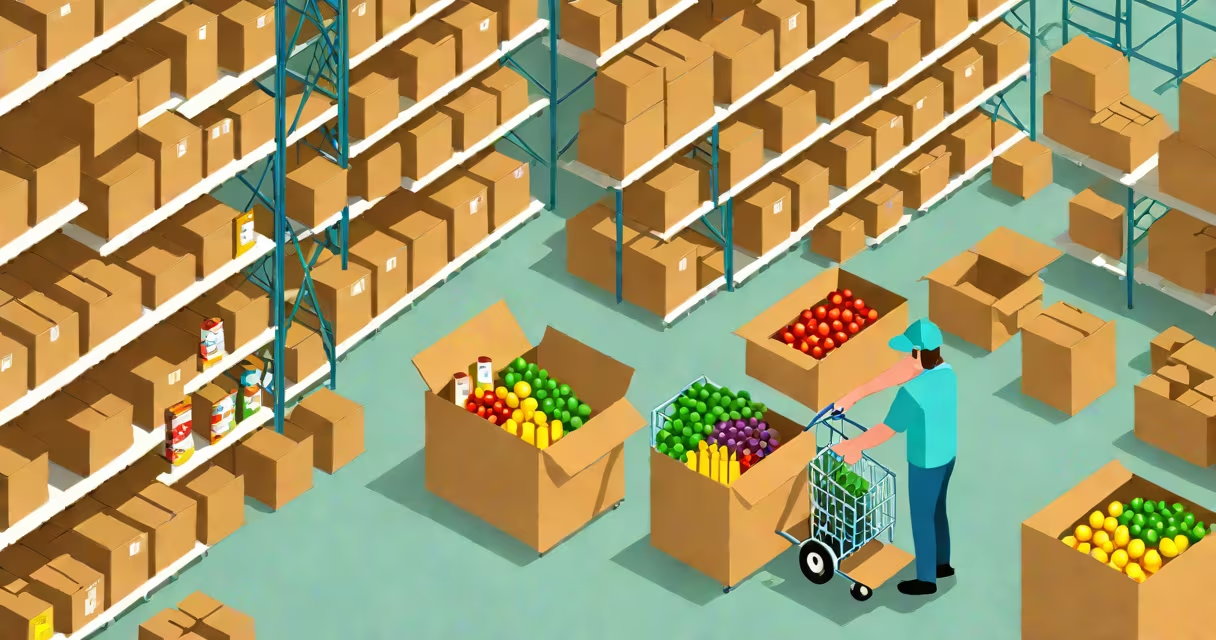
The Tarrant County Food Bank is a nonprofit organization that collects, stores, and distributes food to partner agencies across Tarrant County, Texas. It operates as a central hub for hunger relief, serving over 160 local food pantries, soup kitchens, and shelters.
Founded in 1981, the food bank receives donations from grocery retailers, farms, manufacturers, and individual donors. It then sorts, packages, and ships food to frontline organizations that distribute it directly to people facing food insecurity. The organization relies on volunteers and staff to process and deliver 1.2 million meals each month.
It is not a direct food provider to individuals. Instead, it supplies other nonprofits with food, which they distribute through their own channels. This model allows for efficient scaling and helps food reaches communities most in need through trusted local partners.
The Tarrant County Food Bank functions as a centralized distribution network. It does not serve meals directly but enables hundreds of community-based programs to do so. When a food pantry in Arlington or a shelter in North Richland Hills needs supplies, they request them through the food bank's system.
Upon receiving a request, the food bank pulls inventory from its warehouse, which holds everything from canned vegetables to fresh produce and protein items. Items are sorted by expiration date, nutritional value, and dietary needs. A typical shipment includes 150-200 pounds of food per pallet, enough to feed 300-500 people for a week.
For example, in January 2023, the food bank processed 4.1 million pounds of food, including 1.8 million pounds of fresh produce donated by local farms. That volume supported 1.2 million meals delivered to 167 partner agencies across 12 cities in the county.
The food bank maintains tiered relationships with partner organizations based on need, capacity, and location. These partnerships fall into three categories:
| Type | Examples | Frequency of Delivery | Food Volume per Shipment |
|---|---|---|---|
| Emergency Feeding Sites | Shelters, mobile pantries | Weekly | 100-200 lbs |
| Community Pantries | Church-based food centers, school meal programs | Biweekly | 200-400 lbs |
| Long-Term Programs | Senior nutrition centers, youth feeding initiatives | Monthly | 400-600 lbs |
Each partner agency must complete a registration and compliance review before receiving food. This ensures proper storage, handling, and tracking. The food bank uses a digital inventory system called FoodTrak to monitor shipments and prevent waste.
A common misconception is that the food bank provides food to anyone walking in off the street. It does not. Individuals must go through a partner agency to access food. For example, someone in Fort Worth seeking help must visit a participating church pantry or call a local hotline to be referred to a partner site.
Tarrant County Food Bank serves a population of 2.3 million people, with 1 in 6 residents living below the poverty line. In 2022, 12.4% of households reported food insecurity, according to the U.S. Department of Agriculture's Food Security Survey. The food bank responds to this demand by focusing on high-need zip codes such as 76104 (Northside), 76110 (Westside), and 76118 (Southwest).
It prioritizes nutritious, shelf-stable food to reduce spoilage and support health. Over 60% of distributed items are fruits, vegetables, whole grains, and protein-rich foods. This aligns with USDA guidelines for healthy food distribution. In 2023, the food bank launched a "Fresh Start" initiative to increase fresh produce delivery by 40% compared to 2022.
One non-obvious fact: the food bank does not accept cash donations directly. Instead, it encourages monetary gifts through its website or via payroll deduction programs. Funds are used to purchase food at wholesale rates, which reduces costs by 20-30% compared to retail prices. This cost efficiency allows the organization to stretch every dollar further.
Many assume the Tarrant County Food Bank is a government program. It is not. It is a private nonprofit under IRS 501(c)(3) status, governed by a board of directors and funded primarily through private donations and grants. The federal government funds only about 15% of its annual budget.
Another confusion arises around food quality. Some believe donated food is unsafe or expired. In reality, the food bank follows strict safety protocols. All donated food undergoes inspection for temperature, packaging integrity, and expiration dates. Any item past its sell-by date is discarded. According to the Food and Drug Administration (FDA), food past its "best by" date is still safe to consume if stored properly.
I once volunteered at a sorting shift during a winter storm in February 2022. We processed 22,000 pounds of donated food in eight hours. One box contained 120 cans of low-sodium beans-exactly what a senior center in Southside Fort Worth had requested. That moment showed me how precise and responsive the system is when coordinated correctly.
Key differences include:
Both organizations rely on volunteer labor-Tarrant County averages 1,500 volunteer hours per week-but Tarrant County has a formalized training program for new volunteers, including food safety certification.
The Tarrant County Food Bank is a critical infrastructure for hunger relief in North Texas. It does not provide food directly to individuals but enables 167 partner organizations to do so efficiently and safely. Its operations are driven by donation volume, supply chain coordination, and a commitment to nutritious, timely food delivery.
Understanding how it functions clarifies why direct donations of food are less effective than monetary contributions. Every dollar spent through the food bank's procurement system yields 3-4 meals. The organization remains focused on reducing food insecurity through strategic distribution, not just charity.