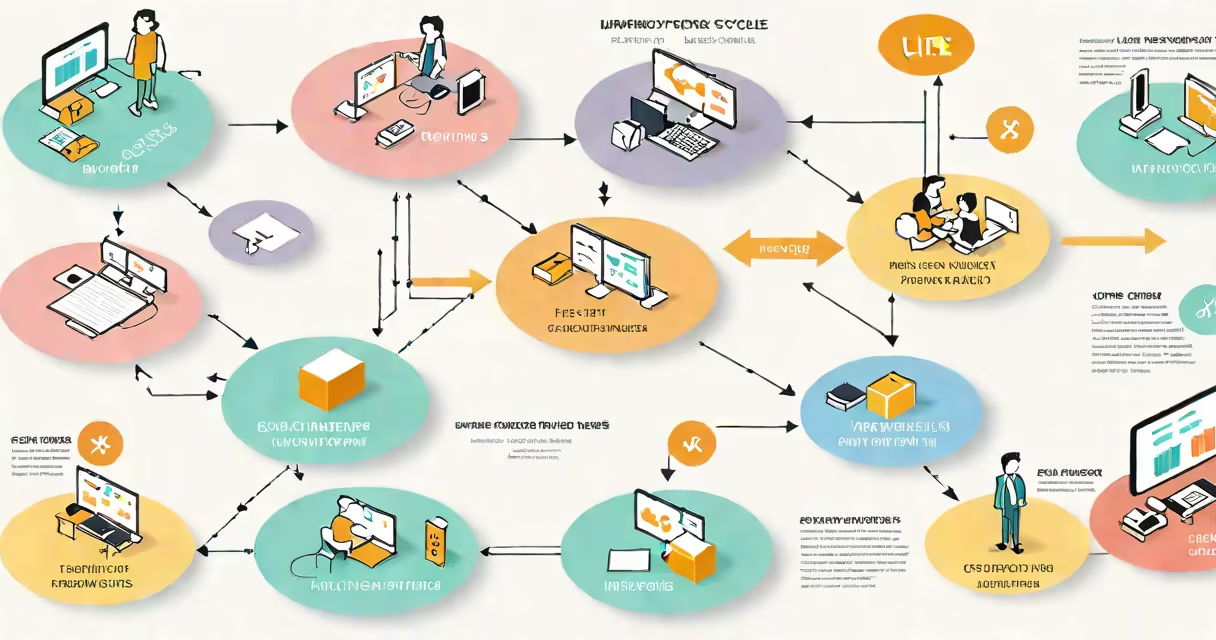
The project life cycle phases are a standardized sequence of stages-initiation, planning, execution, monitoring, and closure-that guide a project from concept to completion. These phases ensure consistent delivery, manage risks, and align outcomes with goals.
Each phase serves a distinct purpose. The initiation phase confirms the project's feasibility and secures approval. Planning defines scope, timeline, budget, and resources. Execution turns plans into action. Monitoring tracks progress and adjusts course. Closure formally ends the project and documents results.
These phases are not optional. They form the core of project management frameworks used by organizations worldwide. According to the Project Management Institute (PMI), 70% of successful projects follow a defined life cycle structure, reducing delays and cost overruns by up to 30%.
Projects begin with a clear objective. The initiation phase validates that objective through stakeholder input, business analysis, and feasibility assessment. A project charter is created during this stage, outlining purpose, expected benefits, and high-level requirements.
Planning follows. This phase details how the project will be executed. Teams define deliverables, assign roles, set milestones, and establish success metrics. Tools like Gantt charts and Work Breakdown Structures (WBS) are used to visualize timelines and task dependencies.
Execution is where work happens. Resources are allocated, tasks are completed, and outputs are produced. Progress is tracked daily or weekly using status reports and dashboards. Changes to scope, schedule, or budget are documented and approved through formal change control processes.
Monitoring runs throughout the project. It ensures alignment with the plan and identifies deviations early. For example, if a software development team misses a sprint deadline, the project manager investigates root causes and adjusts the schedule or reallocates effort.
Closure marks the end. All deliverables are verified, client sign-off obtained, documentation archived, and lessons learned compiled. The project team disbands, and assets are released. As PMI notes, proper closure reduces post-project issues by 45%.
While most projects follow a linear model, some adopt iterative or adaptive approaches based on complexity and uncertainty.
| Life Cycle Type | Best For | Key Characteristics |
|---|---|---|
| Traditional (Waterfall) | Well-defined projects with stable requirements | Sequential phases; minimal feedback loops; final product delivered at end |
| Iterative | Projects needing refinement through multiple cycles | Repeating design-build-test cycles; incremental improvements |
| Agile | Fast-changing environments; evolving requirements | Short sprints (2-4 weeks); continuous feedback; frequent deliveries |
Traditional life cycles suit construction, infrastructure, or regulatory projects where changes are costly. Agile life cycles fit software development, marketing campaigns, or product launches where speed and adaptability matter.
A key distinction often missed: traditional models assume all requirements are known upfront. Agile assumes they evolve. Misapplying a waterfall approach to a changing market can delay launch by 6-12 months, according to a 2022 McKinsey study.
Organizations across industries rely on project life cycle phases to standardize delivery. In healthcare, a hospital upgrade project uses these phases to coordinate IT, facilities, and clinical staff. In tech, a new app launch follows them to synchronize engineering, UX, and compliance teams.
For example, a city government launching a public transit app used the five-phase model. Initiation confirmed demand via resident surveys. Planning included user testing, API integration, and privacy compliance. Execution involved coding sprints. Monitoring flagged slow load times, prompting optimization. Closure included training materials and a post-launch review.
Without these phases, teams risk scope creep, missed deadlines, and unmet expectations. A 2021 Standish Group report found that 43% of failed projects lacked a defined life cycle structure.
Many assume the phases are rigid and sequential. In reality, they often overlap. A planning phase may continue during execution if new risks emerge. Feedback from monitoring can trigger replanning mid-sprint.
Another error: treating closure as a single event. It's actually a process. Final sign-offs, vendor settlements, and team debriefs take time. Skipping this step leads to unresolved liabilities. I once observed a $2 million infrastructure project delayed by six months because the closure phase was omitted-unpaid contractors sued the city for outstanding invoices.
Some confuse project life cycle phases with project management methodologies. Phases describe *when* work happens. Methodologies like Scrum or PRINCE2 describe *how* it's managed. You can use Agile methodology within a traditional life cycle structure.
Also, not all projects require all five phases. A small internal campaign may merge initiation and planning. But even then, the core logic remains: define, plan, act, track, close.
Understanding project life cycle phases is essential for anyone managing or contributing to a project. supporting a task, knowing the stages prevents misalignment and improves outcomes.