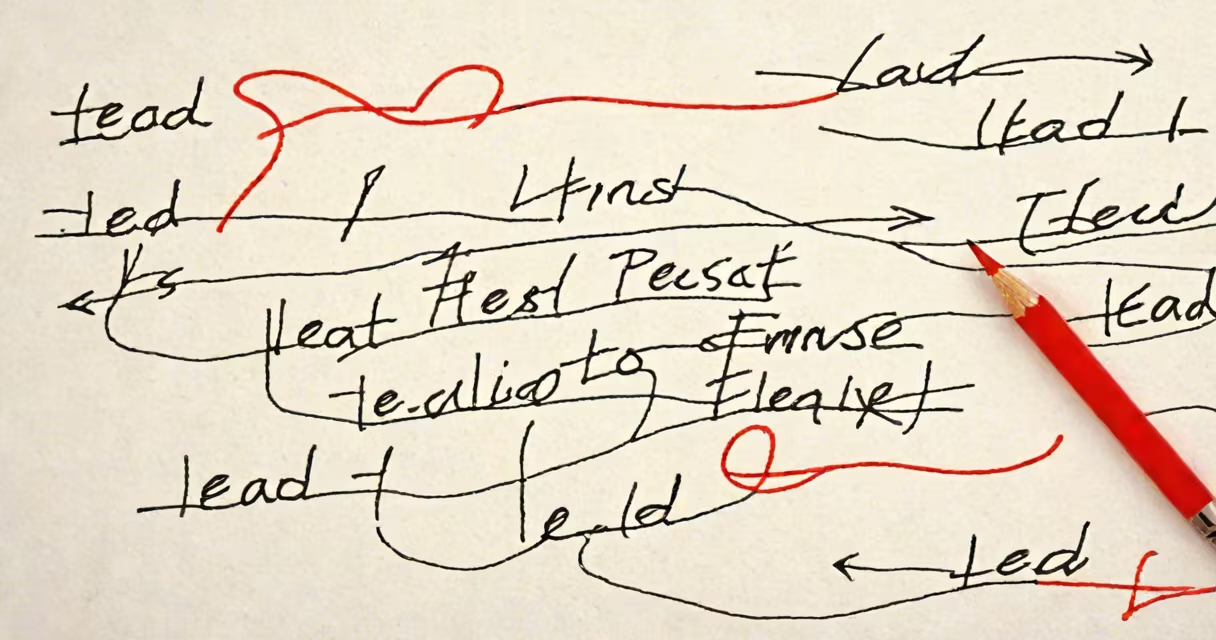
The past tense of the verb "lead" is "led," not "lead." This is a common point of confusion because "lead" (pronounced /lēd/) and "led" (pronounced /led/) sound similar but are different forms of the same verb.
"Lead" functions as both a present tense verb meaning to guide or direct, and as a noun referring to the metal. Its past tense form is "led," which is pronounced the same way as the noun "led" but spelled differently. The verb does not follow regular -ed conjugation patterns-it's an irregular verb.
For example: "She led the team through the project." Here, "led" is the past tense of "lead." Using "lead" instead would be incorrect: "She lead the team..." is grammatically wrong in standard written English.
The verb "lead" changes form based on tense and context. In the present tense, it's "lead" - as in "He leads the department." In the past tense, it becomes "led" - as in "He led the department last year."
This shift is consistent across all subjects: "I led," "you led," "he led," "we led," "they led." The spelling remains "led" regardless of subject or sentence structure.
When using auxiliary verbs, the base form returns: "They have led the initiative since January." The past participle is also "led," making it consistent in perfect tenses.
"Lead" belongs to a group of irregular verbs that do not follow standard conjugation rules. Others include "run" → "ran," "go" → "went," and "take" → "took."
These verbs require memorization rather than pattern recognition. For "lead," the key is remembering that the past tense is "led" - even though it sounds like the present tense form.
Confusion often arises because "lead" (present) and "led" (past) are homophones - they sound identical but differ in spelling and function. This is why misuses appear in spoken language and informal writing.
A frequent error is writing "I lead the meeting yesterday" instead of "I led the meeting yesterday." The time marker "yesterday" demands past tense, so "led" is required.
Another mistake occurs in reported speech: "She said she lead the tour." Correct: "She said she led the tour." The past tense must match the time frame of the action.
Even native speakers sometimes mix up "lead" and "led" in casual conversation. But in formal writing, such errors reduce clarity and credibility.
Consider this sentence: "The CEO led the company through the financial crisis." Replacing "led" with "lead" creates a grammatical error: "The CEO lead the company..." is incorrect.
Another example: "After years of planning, the team finally led the project to completion." The past tense verb "led" correctly shows that the action occurred in the past.
Using "lead" in place of "led" in academic papers, business reports, or legal documents can result in rejection or editorial correction. Accuracy matters in professional contexts.
| Form | Spelling | Pronunciation | Use Case |
|---|---|---|---|
| Present tense | lead | /lēd/ | She leads the team. |
| Past tense | led | /led/ | She led the team. |
| Past participle | led | /led/ | She has led the team for five years. |
People confuse "lead" and "led" because they sound alike. The pronunciation difference is minimal - both are pronounced with a soft "d" at the end. However, the spelling is distinct.
"lead" as a noun (the metal) is pronounced /lēd/, which further blurs the line between the noun and the past tense verb. This double meaning increases the chance of error.
According to the Grammarly Blog, irregular verbs like "lead" are among the most frequently misused in English writing, especially in digital communication where spell-check tools may not flag them.
I once reviewed a job application where the candidate wrote: "I lead the marketing campaign and won awards." The sentence was in a cover letter describing past achievements. I corrected it to "I led the marketing campaign..." - the past tense was essential for accuracy. The employer later confirmed that such errors reduced the perceived professionalism of the submission.
Other irregular verbs with similar structures include:
These verbs don't add -ed in the past tense. Instead, they undergo vowel shifts or consonant changes. "Lead" → "led" follows this pattern, not the regular -ed rule.
For comparison, regular verbs like "walk" → "walked" or "talk" → "talked" follow predictable spelling rules. But "lead" does not - it's irregular and must be learned by rote.
The past tense of "lead" is always "led." It is not "lead." The word "lead" is the present tense form. The past tense is "led," spelled with an 'e' and pronounced with a hard 'd' sound.
When in doubt, test the sentence: "She led the team" sounds correct. "She lead the team" does not. Trust your ear, but verify with grammar rules.