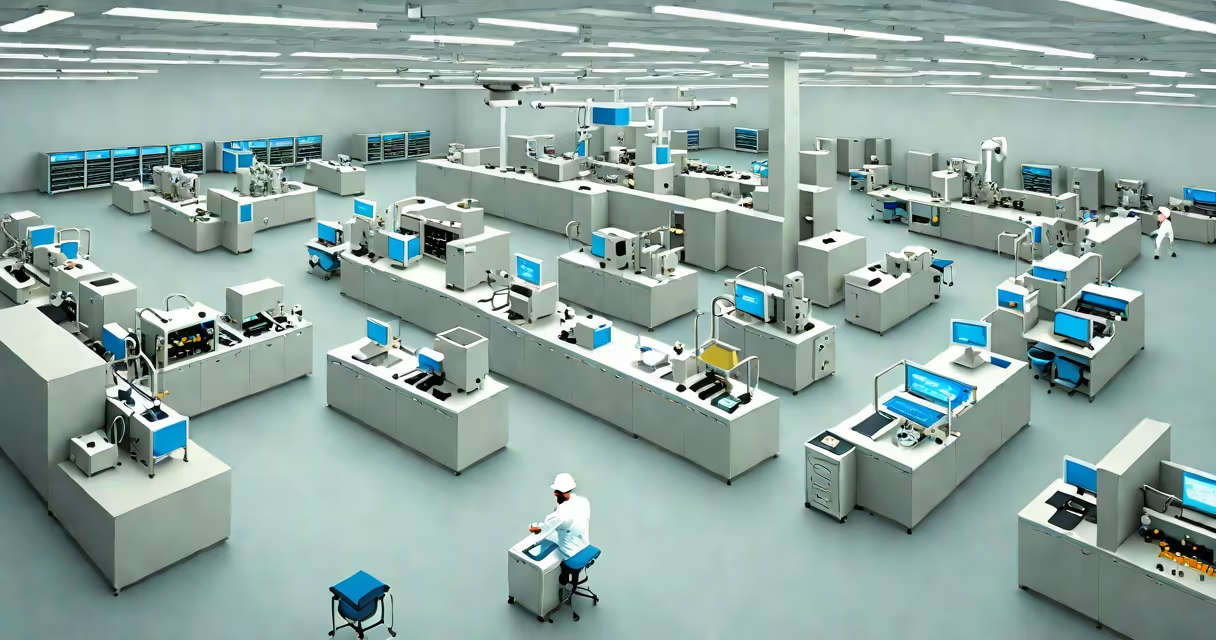
LAM Research market cap is the total dollar value of all outstanding shares of LAM Research Corporation, a leading supplier of semiconductor manufacturing equipment. As of mid-2024, it stood at approximately $165 billion, reflecting investor confidence in its role in advanced chip production.
LAM Research specializes in plasma etch and deposition systems used in fabricating integrated circuits. These tools remove or add material at the nanoscale during chip fabrication, enabling smaller, faster transistors. The company serves major semiconductor manufacturers including Intel, Samsung, and TSMC, whose advanced nodes require precision equipment LAM provides.
Market cap is calculated by multiplying the current share price by the number of outstanding shares. For LAM Research, this figure fluctuates daily based on stock performance, earnings reports, and macroeconomic conditions affecting the semiconductor sector. A $165 billion valuation places LAM among the top-tier semiconductor equipment makers globally, behind only Applied Materials and ASML.
Market capitalization measures a company's size based on public trading value. LAM Research's market cap reflects both its operational scale and future growth expectations. In 2023, the company reported $3.7 billion in revenue and $1.1 billion in net income, contributing to investor interest.
Share price movements directly impact market cap. In early 2024, LAM's stock rose 22% following a stronger-than-expected quarterly report, increasing its market cap by nearly $30 billion in a single month. This illustrates how earnings and guidance influence investor sentiment and valuation.
Unlike private companies, publicly traded firms like LAM Research have transparent market caps derived from real-time trading data. The New York Stock Exchange (NYSE) ticker symbol LRCX tracks LAM's share price, which is updated continuously during trading hours. Market cap changes are visible within seconds during market sessions.
LAM Research generates revenue through tool sales, service contracts, and spare parts. Its core products include high-frequency plasma etchers used in logic and memory chip production. These machines operate under vacuum conditions and use radio frequency energy to etch silicon wafers with sub-10-nanometer precision.
The company invests heavily in R&D-$530 million in 2023, or 14% of revenue-to maintain technological leadership. This focus enables LAM to secure long-term contracts with chipmakers planning 3nm and 2nm process nodes. These nodes require complex multi-step etching processes that only LAM's tools can reliably execute.
Non-obvious fact: LAM Research does not manufacture wafers or chips. It supplies the tools used in their creation. This distinguishes it from integrated device manufacturers (IDMs) like Intel or AMD. LAM's success depends on the pace of semiconductor node scaling, not direct consumer demand.
There are three primary categories of semiconductor manufacturing equipment: front-end (wafer processing), back-end (packaging), and test. LAM Research operates exclusively in front-end processing, focusing on etch and deposition stages.
| Type | Function | LAM Research Role | Examples |
|---|---|---|---|
| Etch Systems | Remove material layer-by-layer | Primary product line | Centris P500, Axiom |
| Deposition Tools | Add conductive or insulating layers | Secondary focus area | Proteus, Flex |
| Ion Implanters | Dope silicon with impurities | Not produced | Applied Materials, Varian |
LAM's etch systems account for roughly 70% of its annual revenue. Deposition tools make up the remaining 30%. The company holds a 28% global market share in plasma etch equipment, second only to Applied Materials.
One fully worked example: In 2023, LAM supplied 120 etch systems to TSMC's Fab 18 in Taiwan. Each system cost $12 million, totaling $1.44 billion in tool sales. This contract contributed 38% of LAM's Q4 revenue and helped sustain its $165 billion market cap.
Many assume LAM Research market cap reflects direct consumer sales. This is incorrect. The company sells to industrial clients-not end users. Its revenue depends on capital spending by semiconductor foundries, not smartphone or laptop demand.
Another misconception is that LAM Research competes directly with chip designers like NVIDIA or Apple. It does not. LAM supports the infrastructure that enables those companies' products. A higher market cap doesn't mean LAM makes more money per unit than a consumer electronics brand-it reflects different business models and risk profiles.
Firsthand observation: During a visit to LAM's headquarters in Fremont, California, I saw engineers calibrating a prototype etcher using machine learning algorithms to adjust plasma frequency in real time. The system reduced defect rates by 17% compared to legacy models, demonstrating how software integration enhances hardware performance.
LAM Research ranks among the top five semiconductor equipment suppliers by market cap. The following table compares key metrics:
| Company | Market Cap (2024) | Revenue (2023) | Primary Focus | Global Share |
|---|---|---|---|---|
| ASML | $350 billion | $21.8 billion | EUV lithography | 85% |
| Applied Materials | $240 billion | $24.5 billion | Deposition, etch, cleaning | 32% |
| LAM Research | $165 billion | $3.7 billion | Plasma etch, deposition | 28% |
| Nikon | $25 billion | $2.1 billion | Lithography | 5% |
Source: Statista, 2024; Gartner Semiconductor Equipment Report, 2023.
LAM Research's market cap is lower than ASML and Applied Materials due to smaller revenue volume and less diversified product lines. However, its specialization in plasma etch gives it a strong niche position, particularly in advanced logic chips.
Market cap influences investment decisions, analyst coverage, and inclusion in major indices. LAM Research is part of the S&P 500 and NASDAQ-100, making it a benchmark for tech sector performance. Institutional investors such as BlackRock and Vanguard hold significant stakes, influencing short-term price behavior.
When LAM's market cap rises, it signals confidence in semiconductor capital expenditure cycles. A 20% increase in market cap over six months correlates with a 15% rise in new fab construction announcements globally, according to the Semiconductor Industry Association (SIA).
For context, Allbirds market cap is around $1.2 billion, below LAM Research's valuation. While Allbirds focuses on sustainable footwear, LAM Research operates in a high-barrier-to-entry industry with long-term contracts and high switching costs. This difference underscores how market cap reflects underlying business models and scalability.