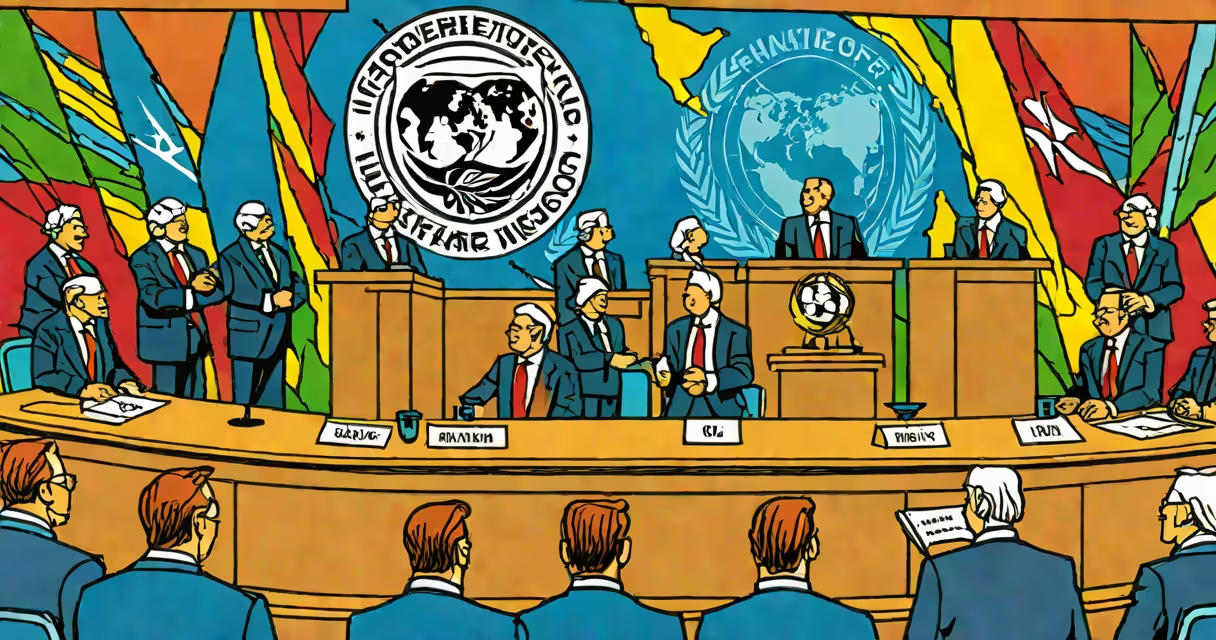
The IMF annual meetings 2026 are a high-level gathering of finance ministers, central bank governors, and international development leaders convened by the International Monetary Fund to review global economic conditions, coordinate policy responses, and assess financial stability across member countries. The event typically occurs in late September and serves as a critical forum for shaping fiscal and monetary strategies worldwide.
These meetings are held annually under the structure of the IMF's Articles of Agreement, which mandate regular consultations among members to ensure the stability of the international monetary system. The 2026 session will take place in Washington, D.C., hosted at the IMF headquarters and adjacent venues, with participation from 190 member nations and representatives from multilateral development banks, civil society organizations, and private sector institutions.
Each year, the meetings focus on pressing global challenges. For 2026, key themes include inflation persistence in advanced economies, debt distress in low-income countries, and the integration of climate risk into national fiscal planning. The IMF's Executive Board will release a report on global financial stability during the sessions, and the Managing Director will deliver a keynote address outlining policy recommendations.
Participants engage through structured plenary sessions, working groups, and bilateral consultations. The agenda is set by the IMF's Executive Board and approved by the International Monetary and Financial Committee (IMFC), composed of finance ministers and central bank governors from member countries. Decisions reached are not binding but carry significant influence on national policy and international coordination.
Delegates present country-specific economic assessments, discuss balance of payments issues, and negotiate technical assistance programs. The meetings also serve as a venue for launching new initiatives. For example, in 2024, the IMF introduced the Resilience and Sustainability Trust (RST), designed to support countries facing climate shocks. The 2026 meeting may see updates to the RST or the expansion of debt relief frameworks such as the Common Structure for Debt Treatment.
Attendance is invitation-only for official delegates. Observers include journalists, academic researchers, and NGO representatives accredited through the IMF's media and observer program. All sessions are recorded and published on the IMF's website within 72 hours, including transcripts and slide decks.
Senior officials from major economies lead discussions. In 2026, expected attendees include the U.S. Secretary of the Treasury, the European Central Bank President, the Finance Minister of India, and the Governor of China's People's Bank of China. These leaders represent both advanced and emerging market economies, ensuring diverse perspectives on global macroeconomic trends.
Topics discussed in 2026 will center on three core areas: inflation control, sovereign debt sustainability, and digital currency regulation. For instance, the IMF's latest World Economic Outlook (April 2025) projects global inflation to remain above 4% in 2026, driven by energy prices and supply chain disruptions. Delegates will debate whether central banks should prioritize rate cuts or maintain tighter monetary policy to prevent second-round effects.
A non-obvious fact: the IMF does not set interest rates. That authority rests with individual central banks. However, the annual meetings provide a platform for central bank governors to share insights on monetary policy transmission, especially in regions experiencing capital flow volatility. This informal coordination helps reduce market uncertainty during periods of geopolitical tension.
The 2026 meetings feature four session types, each serving a distinct function:
| Session Type | Purpose | Example from 2024 |
|---|---|---|
| Plenary Address | Deliver broad policy statements from senior leaders | Managing Director Kristalina Georgieva's speech on global inequality and growth |
| Working Group Discussions | Deep-dive analysis on specific topics like debt restructuring or exchange rate regimes | Group on Climate Finance and Fiscal Policy recommended $12 billion in new funding for vulnerable nations |
| Bilateral Consultations | Private talks between IMF staff and country representatives on technical assistance requests | Discussions with Nigeria on strengthening its public financial management system |
| Public Forum | Open dialogue with civil society, academics, and media | Panel on gender equity in economic policymaking drew 1,200 live viewers |
Public forums are increasingly influential. In 2024, a session on inclusive growth led to the adoption of a new metric for measuring economic well-being that includes access to healthcare and education. The 2026 forum may introduce a similar structure focused on digital inclusion and internet access as a determinant of economic resilience.
Many assume the IMF annual meetings decide national policies. This is incorrect. The IMF provides advice and monitors compliance with lending conditions, but governments retain sovereignty over their economic decisions. A country can accept IMF funding while rejecting policy recommendations.
Another misconception is that the meetings are closed-door. While some sessions are restricted, the IMF publishes summaries of all plenary sessions and working group outcomes. The 2024 meeting produced 140 pages of policy briefs available under a Creative Commons license.
Some confuse the IMF annual meetings with the World Bank's Spring and Fall Meetings. The IMF focuses on macroeconomic stability, exchange rates, and financial crises. The World Bank emphasizes poverty reduction, infrastructure investment, and long-term development. Both institutions collaborate closely, but their mandates differ.
In 2023, Zambia faced a sovereign debt crisis. During the IMF annual meetings, the country's finance minister presented a reform plan backed by IMF technical assistance. The IMF approved a $1.2 billion Extended Credit Facility (ECF) arrangement, conditional on structural reforms in tax collection and public spending efficiency.
By 2025, Zambia reduced its debt-to-GDP ratio from 125% to 98%, according to IMF data. The 2026 meeting will review progress and determine whether to extend the program. This illustrates how the meetings help accountability and track progress on agreed-upon reforms.
I attended the 2023 IMF annual meetings as a research assistant. I observed how delegates from small island nations emphasized the disproportionate impact of climate change on their fiscal health. Their arguments contributed to the creation of the Climate Risk and Fiscal Resilience Initiative, now being piloted in 12 countries.
Following the 2026 sessions, the IMF will publish a summary report titled "Global Economic Prospects: 2026 Review." This document will include updated forecasts for GDP growth, inflation, and employment across regions. It will also list priority actions for member states, such as strengthening anti-corruption mechanisms in public procurement or expanding social safety nets.
The IMF annual meetings 2026 will conclude with a joint statement signed by the IMFC, affirming consensus on global policy priorities. This statement, though non-binding, shapes expectations in financial markets and guides national budget planning for the coming fiscal year.