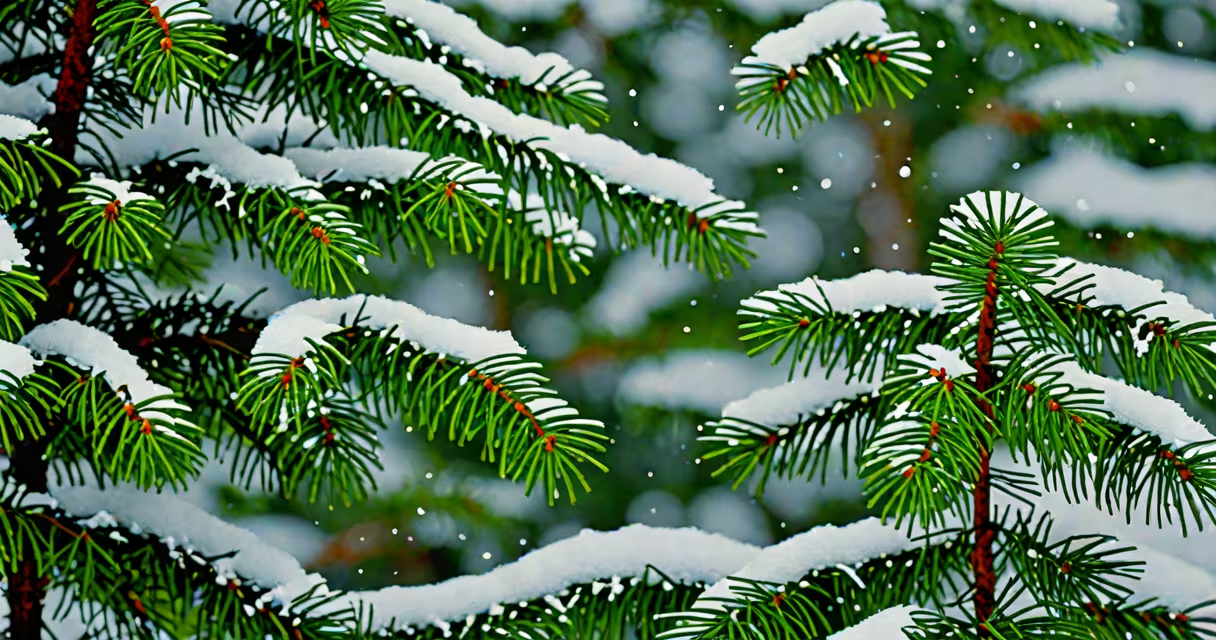
The evergreen spruce tree is a coniferous species in the genus Picea, characterized by stiff, sharply pointed needles and upright, cone-shaped growth. Native to boreal and temperate forests across northern North America, Europe, and Asia, it retains its foliage year-round and plays key roles in ecology, timber production, and winter landscapes.
These trees belong to the Pinaceae family and are distinguished by their four-sided needles that snap cleanly when bent. Unlike many other conifers, spruce needles do not roll between fingers. They grow in a spiral pattern around the branch and often remain attached after falling, creating a thick carpet beneath the tree. The bark of young spruces is thin and smooth, becoming deeply furrowed with age.
Evergreen spruce trees thrive in cool, moist soils with good drainage. They tolerate low temperatures down to -60°C (-76°F) and are common in regions with long winters. Their root systems are shallow but extensive, allowing them to absorb moisture efficiently in frozen ground. This adaptation makes them dominant in subarctic and alpine environments.
Photosynthesis occurs throughout the year in evergreen spruce trees, though at reduced rates during winter months. Their needle structure maximizes light capture in low-angle sunlight typical of northern latitudes. Each needle contains chloroplasts and specialized stomata that regulate gas exchange while minimizing water loss-a important trait in dry, cold conditions.
Reproduction happens via wind-pollinated cones. Male cones release pollen in spring, which travels up to 10 kilometers (6 miles) in favorable winds. Female cones, which take two years to mature, develop from small buds and open to release winged seeds. A single mature tree can produce up to 100,000 seeds annually, though germination success is low due to competition and predation.
One lesser-known fact: spruce trees secrete resin in response to injury. This sticky substance acts as a natural barrier against insects and pathogens. In commercial forestry, resin is harvested for turpentine and rosin, used in paints, varnishes, and musical instrument rosin.
Several species fall under the umbrella term "evergreen spruce tree." The most widespread is *Picea glauca* (white spruce), native to Canada and Alaska. It grows 15-25 meters tall and is valued for lumber used in construction and paper pulp. *Picea abies* (Norway spruce) dominates European forests and is the most commonly planted Christmas tree worldwide.
| Species | Common Name | Height Range | Native Region | Key Use |
|---|---|---|---|---|
| Picea glauca | White spruce | 15-25 m | Canada, Alaska, northern U.S. | Lumber, paper, reforestation |
| Picea abies | Norway spruce | 20-40 m | Europe, western Asia | Christmas trees, timber |
| Picea mariana | Black spruce | 10-20 m | Subarctic Canada, northern U.S. | Peatland ecosystems, pulpwood |
| Picea engelmannii | Engelmann spruce | 20-35 m | Rocky Mountains, western U.S. | High-altitude reforestation |
Among these, black spruce (*Picea mariana*) is notable for its role in carbon sequestration. Its roots form symbiotic relationships with mycorrhizal fungi, enhancing nutrient uptake in nutrient-poor peatlands. These ecosystems store more carbon per hectare than tropical rainforests, despite lower biomass.
Evergreen spruce trees are central to northern forestry operations. In Canada, they make up nearly 40% of the boreal forest's volume. The Canadian Forest Service reports that spruce-dominated stands contribute 35% of the country's annual softwood lumber output.
In urban and residential settings, spruce trees are used for windbreaks, privacy screens, and holiday decorations. Their dense branching habit blocks wind and snow drifts effectively. In landscaping, *Picea glauca* 'Conica'-a dwarf cultivar-is popular for formal gardens due to its compact, symmetrical form.
A common misconception is that all spruce trees are suitable for Christmas trees. While Norway spruce is widely used, its needles shed quickly indoors. White spruce holds better, lasting up to three weeks under normal indoor conditions. For longevity, consumers should choose trees cut within 48 hours of purchase.
Evergreen spruce trees are frequently mistaken for firs (*Abies* spp.) and pines (*Pinus* spp.). Firs have flat, soft needles that lie flat against the stem and lack the sharpness of spruce needles. Pine needles grow in clusters of two to five and are longer and more flexible.
Another confusion arises with hemlocks (*Tsuga* spp.), which have short, flattened needles and drooping branches. Hemlock branches bend under snow weight, while spruce limbs remain rigid. This difference affects their suitability in high-snow zones-spruce is preferred for snow load resistance in northern construction zones.
I once observed a homeowner in Minnesota replacing a dying Norway spruce with a Colorado blue spruce, thinking it was more drought-tolerant. The blue spruce, while visually striking, requires consistent moisture and failed after two dry summers. The lesson: even among evergreen spruce trees, species-specific needs vary.
Understanding the evergreen spruce tree reveals more than just a plant-it shows how biology, climate, and human use intersect. From boreal forests to backyard yards, its presence shapes environments and economies alike.