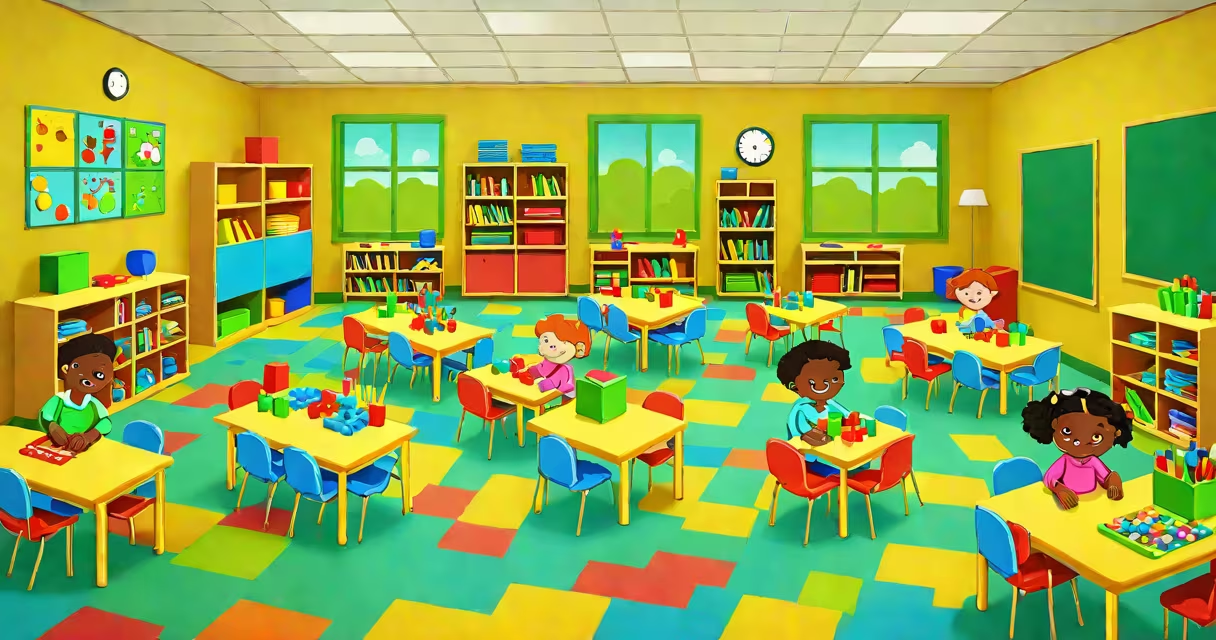
An early childhood classroom is a purpose-built educational environment for children aged 3 to 6, centered on play, exploration, and social-emotional development. It prioritizes safety, structure, and individualized attention to support foundational learning across cognitive, physical, and emotional domains.
These classrooms operate under principles of child-centered pedagogy, where curriculum emerges from children's interests and daily experiences. Activities are intentionally designed to build language, motor skills, problem-solving, and cooperation. Teachers act as facilitators, observing and guiding rather than directing lessons.
Research from the National Association for the Education of Young Children (NAEYC) confirms that high-quality early childhood classrooms improve school readiness, reduce achievement gaps, and strengthen long-term academic outcomes. Classrooms meeting NAEYC standards show 30% higher gains in literacy and numeracy by kindergarten entry compared to lower-quality settings.
Each early childhood classroom follows a predictable daily routine anchored in consistency. Mornings often begin with circle time-children gather to sing songs, share news, and practice listening. This ritual builds attention span and group cohesion.
Afterward, children rotate through designated learning centers: block play, dramatic play (like pretend kitchen or dress-up), art, sensory bins, and quiet reading corners. These spaces are arranged to minimize clutter and maximize accessibility. Materials are stored at child height, labeled with pictures and words, encouraging independence.
Teachers observe interactions, document progress using anecdotal notes or portfolios, and adjust activities based on emerging interests. A child fascinated by insects may lead to a week-long unit on bugs, including nature walks, drawing, and storytelling-all integrated into the schedule.
Physical layout matters. Classrooms should have clear zones for different types of activity, with soft flooring, low shelves, and ample natural light. The U.S. Department of Health and Human Services recommends a minimum of 35 square feet per child in indoor spaces, with access to outdoor play areas for at least 60 minutes daily.
Materials must be developmentally appropriate. For example, puzzles with large pieces suit toddlers; pattern blocks challenge older preschoolers. Toys should reflect diversity in race, gender, and ability. A study published in *Child Development* found that classrooms using inclusive materials saw a 22% increase in positive peer interactions among children.
| Type | Focus | Example Activity |
|---|---|---|
| Play-Based | Exploration, creativity | Building a city with cardboard boxes and toy vehicles |
| Developmental | Motor skill mastery | Using tweezers to transfer pom-poms into small containers |
| Academic-Prep | Emergent literacy and math | Sorting buttons by color and size, practicing letter sounds |
Classroom design also includes emotional safety. Children learn to identify feelings through picture cards and role-play. A teacher might say, "I see you're frowning. Are you sad about losing the game?" This modeling of emotional vocabulary supports later mental health and conflict resolution.
Many assume early childhood classrooms are just "playtime." They are not. While play dominates the day, it is guided, intentional, and rich in learning opportunities. A child stacking blocks isn't just having fun-they're developing spatial reasoning, understanding cause and effect, and practicing patience.
Another myth is that these classrooms require expensive equipment. High-quality early childhood education thrives on low-cost, open-ended materials. A bucket of rice, plastic spoons, and a colander can spark hours of imaginative play. The focus is not on toys but on relationships and process.
A lesser-known fact: effective early childhood classrooms maintain a student-to-teacher ratio of no more than 10:1 for children under four, and 12:1 for ages 4-6. The National Institute for Early Education Research (NIEER) reports that classrooms exceeding these ratios show lower gains in executive function and language development.
In a public preschool in Portland, Oregon, a typical morning unfolds as follows:
This day reflects a balance of structure and freedom. Children make choices, follow routines, and engage in meaningful interaction-all within a structure that supports complete development.
I once observed a classroom where a child refused to join circle time. Instead of forcing participation, the teacher offered a quiet corner with books and a stuffed animal. Within five minutes, the child returned, sat down, and joined the song. That moment illustrated how early childhood classrooms prioritize emotional regulation over compliance.
Early childhood classroom is not synonymous with daycare. While both serve young children, daycares emphasize supervision and basic care. Early childhood classrooms focus on developmentally appropriate learning goals, staffed by educators trained in early childhood theory.
It's also not a miniature version of elementary school. Introducing worksheets, timed tests, or rigid seating at age four contradicts research on brain development. The American Psychological Association states that formal academics before age six impair motivation and long-term engagement.
Finally, it's not a passive environment. Teachers are actively involved-asking open-ended questions, narrating actions ("You're putting the blue block on top"), and scaffolding learning. Their presence is changing, not static.
Every early childhood classroom is a living laboratory of growth. It blends warmth with intentionality, play with purpose, and freedom with guidance. When done well, it lays the foundation for lifelong curiosity, resilience, and connection.