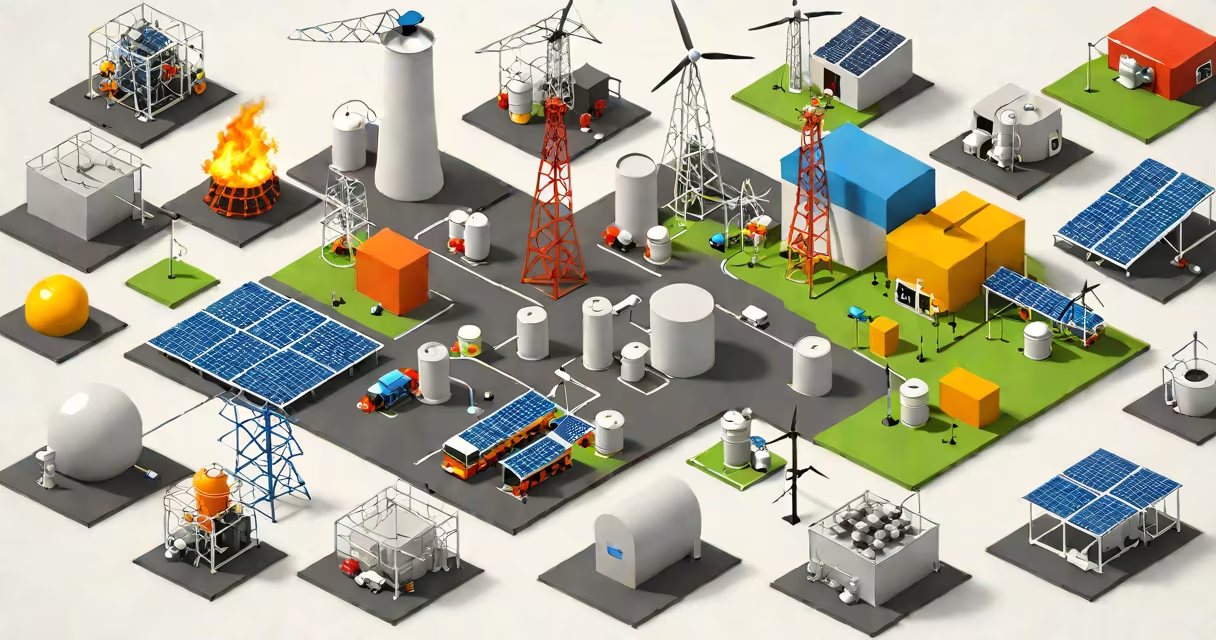
Energy sources are raw materials or processes that generate usable power. They fall into two broad categories: non-renewable (finite, depleting) and renewable (naturally replenished). The main types include fossil fuels, nuclear, solar, wind, hydroelectric, and geothermal.
Every energy source converts stored or captured energy into electricity, heat, or motion. Fossil fuels release chemical energy through combustion. Nuclear power uses fission to split atoms and release heat. Renewables rely on natural flows: sunlight, wind, water movement, and underground heat.
For example, a coal-fired plant burns pulverized coal to boil water, creating steam that spins a turbine connected to a generator. The process produces electricity but also emits carbon dioxide. In contrast, a photovoltaic solar panel converts sunlight directly into electrical current using semiconductor layers.
Energy conversion efficiency varies widely. Modern natural gas plants achieve 50-60% thermal efficiency, while older coal plants operate at 33%. Solar panels average 15-22% efficiency under standard test conditions, according to the National Renewable Energy Laboratory (NREL).
The following table outlines the six primary energy sources, their key characteristics, and real-world applications.
| Source Type | Renewable? | Global Share (2023) | Example Application |
|---|---|---|---|
| Fossil Fuels (coal, oil, gas) | No | 82% | Electricity generation, transportation fuel |
| Nuclear | No | 9% | Base-load power in countries like France and South Korea |
| Solar | Yes | 4% | Residential rooftop systems, utility-scale solar farms |
| Wind | Yes | 7% | Onshore and offshore wind farms in Denmark and Texas |
| Hydroelectric | Yes | 6% | Large dams like the Three Gorges in China |
| Geothermal | Yes | 0.3% | Direct heat and power in Iceland and California |
Data from the International Energy Agency (IEA) and BP Statistical Review of World Energy 2023 confirms that fossil fuels still dominate global supply, despite rising adoption of alternatives.
Geography shapes energy choices. Countries with abundant sunlight, like Morocco and Chile, deploy concentrated solar power (CSP) plants. Regions with consistent winds, such as the North Sea coast, host offshore wind farms generating over 1 gigawatt each.
Coal remains central in India and Indonesia due to domestic reserves and low infrastructure costs. However, air pollution from coal plants contributes to 800,000 premature deaths annually worldwide, per the World Health Organization (WHO).
A non-obvious distinction: not all renewables are low-emission during manufacturing. Solar panel production requires significant energy and rare metals like silver and indium. A 2021 study in *Nature Energy* found that lifecycle emissions for utility-scale solar are about 40 grams CO₂-equivalent per kWh-far below coal's 820 g-but higher than wind's 11 g.
Many assume "alternative energy" means only wind and solar. But biomass, hydropower, and even nuclear qualify under the broader category of low-carbon or non-fossil sources. The U.S. Department of Energy defines alternative energy as "any energy source other than traditional fossil fuels," including biofuels and hydrogen.
Another error: equating "renewable" with "always available." Solar and wind depend on weather patterns. In Germany, solar output drops to 10% of peak during winter months. Grid operators must balance variable supply with storage or backup from gas plants.
I once visited a microgrid project in rural Kenya that combined solar panels, battery storage, and a small diesel generator. During dry seasons, solar production dropped by 40%, forcing reliance on diesel. This hybrid model shows how energy sources often work together-not in isolation.