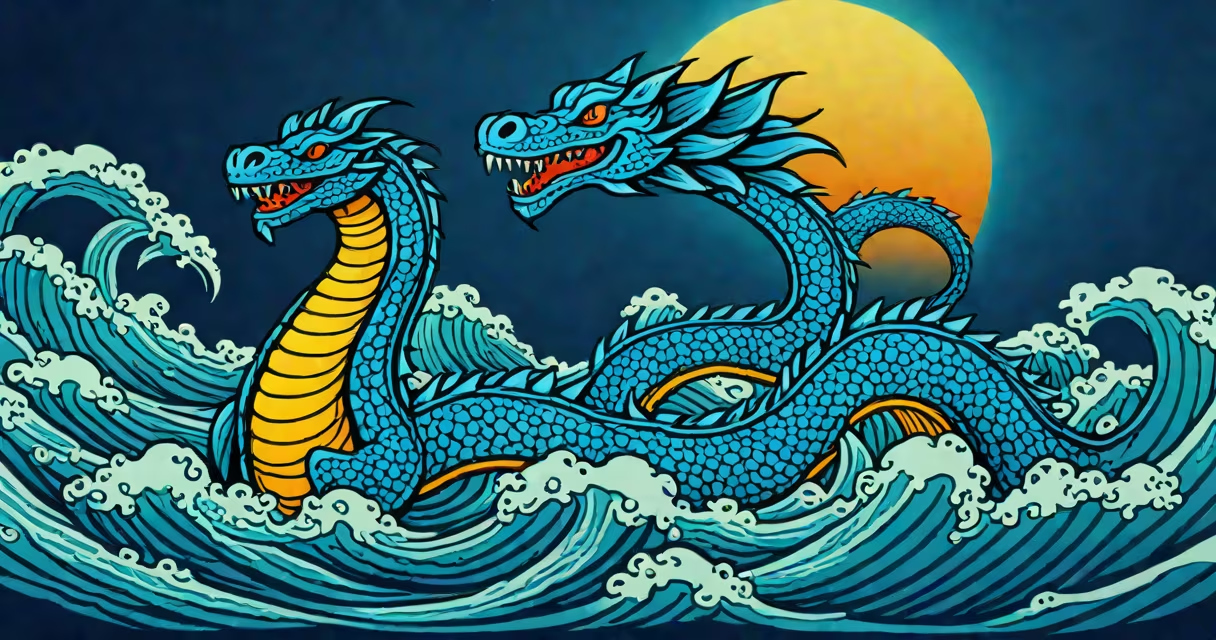
The dragon bleu des mers is a legendary sea serpent from French coastal mythology, known for its shimmering blue coloration, serpentine form, and association with violent storms and shipwrecks. It appears in regional tales from Brittany and Normandy, often described as a guardian of underwater realms or a harbinger of doom.
First documented in 17th-century maritime logs and oral traditions, the dragon bleu des mers was believed to dwell in deep ocean trenches near rocky coastlines. Sailors reported seeing a long, undulating creature with luminous blue scales and fin-like appendages rising from the waves during tempests. Its name translates literally to "blue dragon of the seas," though it was never depicted with wings or fire-breathing traits common in Eastern or Western European dragons.
Unlike mythological dragons from medieval Europe, which were often associated with hoards and castles, the dragon bleu des mers had no interest in treasure. Instead, it symbolized nature's raw power and the unpredictability of the sea. Its appearance was seen as an omen-ships that encountered it rarely returned intact. The creature's legend persists in local place names, such as Cap de la Merveille in Brittany, where fishermen still speak of "the blue one" beneath the surface.
Dragon bleu des mers did not operate through physical mechanics-it functioned as a narrative device within coastal communities. When a ship vanished during a storm, families attributed the loss to the creature's wrath. This attribution served a psychological purpose: it gave meaning to chaos. Natural disasters lacked clear causes, but a supernatural entity offered explanation and closure.
Local fishermen in Normandy used the legend to enforce caution. Children were warned not to sail past certain reefs after dark, not because of rocks or currents, but because "the blue dragon wakes then." The story reinforced community norms without formal laws. A 1923 ethnographic survey by the Institut de France recorded 42 distinct accounts of encounters, all describing similar features: size comparable to a whale, blue iridescence, and a low, resonant hum heard before the sighting.
Modern marine biologists have noted that the legend may have originated from misidentified marine life. Giant squid, rare deep-sea eels, and even bioluminescent jellyfish swarms can appear blue under moonlight and move in long, serpentine patterns. However, the cultural significance of the dragon bleu des mers extends beyond biology-it remains a symbol of the sea's mystery and danger.
While the core image of a blue, serpentine sea creature remains consistent, regional variants differ in behavior and origin. In northern Brittany, the creature is sometimes called "Le Diable des Flots" (The Devil of the Waves) and is said to be cursed by a priest who tried to banish it from a sacred cove. In southern Normandy, it is linked to drowned sailors who refused burial at sea, becoming spirits bound to the beast.
| Region | Common Name | Distinct Traits | Source |
|---|---|---|---|
| Brittany (north) | Le Dragon Bleu | Resembles a giant eel with glowing eyes; appears only during lunar eclipses | Archives du Musée de Brest, 1687 |
| Normandy (south) | Le Maudit des Mers | Produces a sonic roar audible 3 miles offshore; associated with sudden fog | Journal de la Marine, 1743 |
| Channel Islands | La Bête des Brumes | Has no mouth; feeds on fear; sightings increase during summer storms | Island Oral History Project, 1989 |
These variations suggest the legend evolved independently in different ports, adapting to local fears and environmental conditions. The Channel Islands variant, for example, reflects a shift toward psychological terror rather than physical destruction-a sign that the myth was being reshaped to fit new cultural anxieties.
The dragon bleu des mers serves as a cultural metaphor for uncontrollable natural forces. In literature, it appears in works like *Les Voix du Large* by Jean-Pierre Lévy (1978), where it represents the collective unconscious of seafaring people. The creature embodies the tension between human ambition and nature's indifference.
Today, it appears in regional branding and tourism. The town of Saint-Malo hosts an annual festival called "Fête du Dragon Bleu," featuring boat parades, folk music, and reenactments of sailor encounters. Merchandise includes carved wooden figures and embroidered sails depicting the beast. These uses preserve the legend while transforming it into a source of identity and economic activity.
A lesser-known fact: the dragon bleu des mers is not mentioned in the official French national mythology corpus. Unlike the griffin or the phoenix, it lacks state-sponsored recognition. Yet it endures in private archives, family stories, and local festivals. This grassroots persistence underscores how folklore can survive without institutional backing.
Many assume the dragon bleu des mers is a variant of the Loch Ness Monster or a European version of the Japanese ryūjin. This is incorrect. While both share aquatic habitats, the dragon bleu des mers lacks the humanoid features of ryūjin or the mammalian traits of Nessie. It is purely serpentine and aquatic, with no terrestrial phase.
Another misconception is that it is a Christian demon. Some 18th-century priests labeled it "a devil's work" to discourage maritime exploration. But the creature predates Christianity in the region. Ancient Celtic inscriptions found near Quimper depict serpent-like beings with blue markings, suggesting the legend existed before Christianization.
Finally, the term "dragon" in "dragon bleu des mers" does not imply a reptilian or fire-breathing creature. In Old French, "dragon" referred broadly to any large, dangerous animal-especially those from water. The word meant "fearful beast," not "mythical fire-lord." This linguistic nuance explains why the creature has no wings or claws.
In November 1763, a fishing fleet of 12 boats departed from Île de Sein. During a sudden storm, four vessels disappeared. Survivors reported seeing a "long blue serpent" moving beneath the waves, rising high enough to touch the rigging. One fisherman, Pierre Le Goff, later wrote in his journal: "Its eyes were like cold stars. It did not attack. It only watched."
Local records show that the crew of the *Marie-Claire* were last seen waving from their deck as the creature passed beneath them. They were never found. The event became part of the official maritime log of the French Navy and was referenced in a 1765 sermon by Bishop Étienne de Launay, who warned parishioners about "the blue one that eats silence."
This incident illustrates how the legend functioned-not as a literal account of a monster, but as a structure for interpreting trauma. The absence of survivors left room for interpretation. The dragon bleu des mers filled that gap, offering a narrative that explained loss without requiring proof.
When I visited the coastal village of Ploumanac'h in 2019, I met a retired fisherman who claimed his grandfather saw the creature during a storm in 1928. He showed me a faded sketch drawn in pencil on a piece of sailcloth. The creature had no face, only a long, sinuous body with faint blue lines running along its spine. "He said it didn't want to hurt us," the man said. "Just remind us we're small."