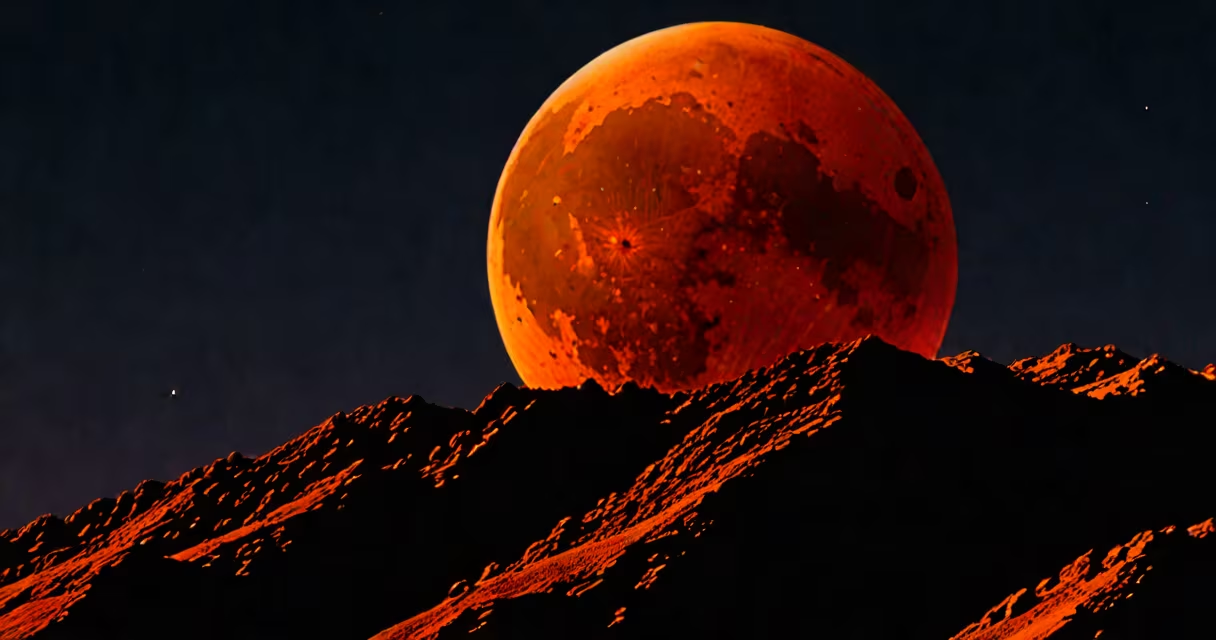
A full blood moon is the visual result of a total lunar eclipse, when Earth passes directly between the Sun and the Moon, casting a shadow that turns the Moon deep red or coppery. This phenomenon happens only during a full moon phase and when the alignment of Earth, Moon, and Sun is precise.
The term "blood moon" originated in ancient cultures to describe the eerie red hue seen during eclipses. Modern astronomy confirms the cause: sunlight passing through Earth's atmosphere bends around the planet and filters out blue wavelengths, leaving only red light to explain the Moon. The effect is similar to why sunsets appear red.
According to NASA, total lunar eclipses occur about twice per year on average, though visibility varies by location. The last such event visible across North America was on November 8, 2022. These eclipses are predictable and can be calculated centuries in advance using orbital mechanics.
A full blood moon requires three elements: a full moon, a direct alignment of Earth between the Sun and Moon, and Earth's shadow falling completely on the Moon. The Moon enters the umbra-the darkest part of Earth's shadow-causing the eclipse.
During totality, the Moon doesn't vanish. Instead, it glows in shades of red, orange, or brown. The intensity depends on atmospheric conditions. Dust, smoke, or volcanic ash in Earth's atmosphere can deepen the red color. After the 1991 eruption of Mount Pinatubo, lunar eclipses appeared darker due to increased particulates in the upper atmosphere.
For example, during the total lunar eclipse on May 16, 2022, observers in Asia and the Pacific saw a vivid crimson Moon. The event lasted 84 minutes, with maximum eclipse occurring at 11:11 UTC. Skywatchers reported the Moon looked like a burning ember suspended in darkness.
Lunar eclipses fall into three categories: penumbral, partial, and total. A full blood moon only occurs during a total eclipse. Penumbral eclipses are subtle-Earth's outer shadow barely darkens the Moon-and often go unnoticed. Partial eclipses show only part of the Moon in shadow.
| Type | Shadow Zone | Visibility | Duration |
|---|---|---|---|
| Penumbral | Outer shadow | Subtle; hard to see | 1-2 hours |
| Partial | Edge of umbra | Visible as bite taken out | 30-60 minutes |
| Total (blood moon) | Full umbra | Reddish glow; dramatic | 10-100 minutes |
Multiple total eclipses can occur in a single year. In 2022, two total lunar eclipses happened-one in May and another in November. The latter was visible across most of the Americas and parts of Europe and Africa.
Many ancient civilizations interpreted the full blood moon as a sign of change, upheaval, or transformation. The Babylonians recorded lunar eclipses as omens related to kingship and war. In Mesoamerican traditions, the red Moon signaled the presence of deities or cosmic imbalance.
Modern astrology assigns symbolic weight to the full blood moon. It's believed to amplify emotions and reveal hidden truths. The position of the Moon in the zodiac adds nuance. For instance, a full blood moon in Aquarius-such as the one on August 20, 2021-was associated with innovation, rebellion, and collective awakening.
Some spiritual communities view the event as a time for release and renewal. Rituals may include journaling, meditation, or burning symbolic items. The idea stems from the belief that lunar cycles influence human behavior and energy. However, scientific studies have found no correlation between lunar phases and mental health crises or crime rates.
One widespread myth is that a full blood moon causes erratic behavior or violence. This idea dates back to the Latin word *luna*, meaning moon, which gave rise to "lunatic." But research from the University of Melbourne found no increase in psychiatric hospital admissions during lunar eclipses.
Another confusion arises between a blood moon and a "supermoon"-a full moon near perigee, when the Moon appears larger and brighter. The two events are unrelated. A supermoon can happen without an eclipse, and a blood moon can occur when the Moon is farther from Earth.
I witnessed this firsthand during a 2018 eclipse in rural Montana. The sky turned deep purple, and the Moon emerged from Earth's shadow as a glowing red orb. Local residents gathered with binoculars and cameras. No one reported strange behavior-just awe.
While the full blood moon lacks physical impact on Earth's systems, it remains a useful symbol. It draws public interest in astronomy and encourages people to look up. Events like the 2022 eclipse sparked record engagement on platforms like YouTube and Twitter, with millions watching live streams.
Scientifically, eclipses offer rare opportunities to study Earth's atmosphere. By measuring how much light reaches the Moon, researchers can detect changes in air quality and atmospheric composition. The European Space Agency uses eclipse data to calibrate satellite sensors.
Understanding what a full blood moon means combines science and storytelling. It's not a harbinger of doom, nor a mystical force. It's a natural event shaped by planetary motion and atmospheric physics. Yet its beauty continues to inspire wonder across cultures and generations.