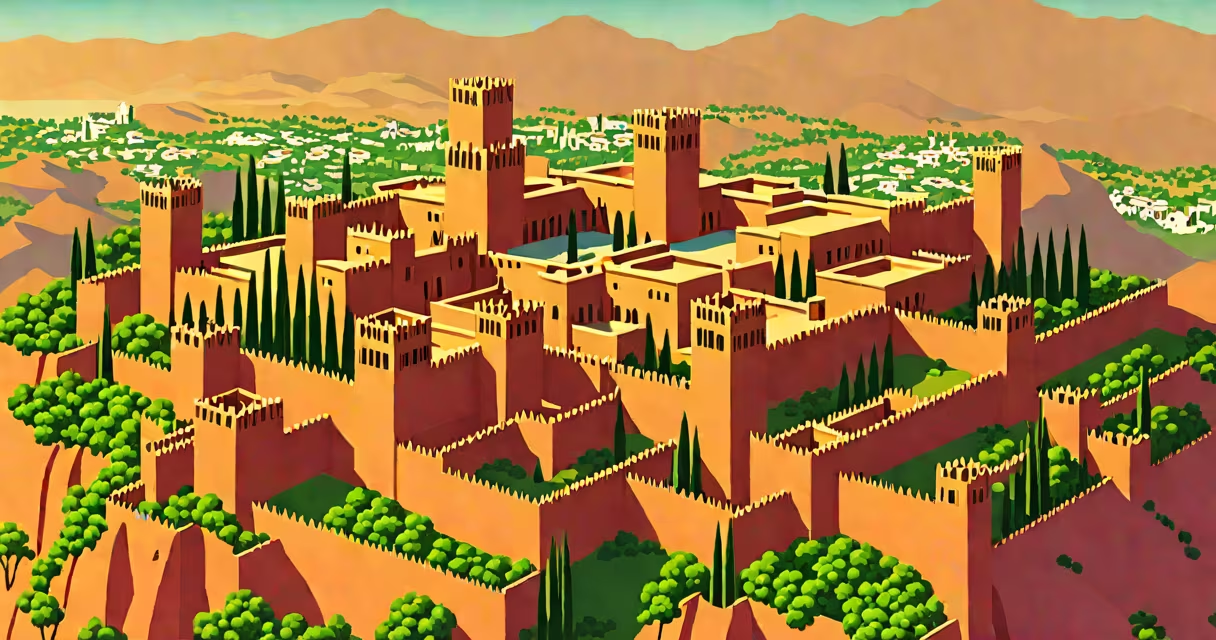
The Alhambra was constructed as a fortified palace complex by the Nasrid dynasty in 1238, serving as both a military stronghold and a seat of Moorish rule in Granada during the final centuries of Islamic Spain.
Located on a hill overlooking Granada, the Alhambra's origins trace to a small fortress built by the Berber rulers of the Almohad dynasty. When Muhammad ibn Yusuf ibn Nasr founded the Nasrid dynasty in 1230, he expanded the site into a permanent royal residence. The decision to build a new palace complex was driven by political necessity: after the fall of Córdoba and Seville, Granada became the last independent Muslim kingdom in Iberia. The Alhambra's construction began in earnest under Ibn al-Ahmar, who ruled from 1238 to 1273.
Its design reflects a blend of military function and aesthetic ambition. The outer walls were thick and high, with watchtowers spaced along the perimeter. Inside, the palaces-like the Palacio de Comares and the Palacio de los Leones-were built around courtyards with fountains, gardens, and complex tilework. Water channels ran through the grounds, symbolizing paradise and providing cooling relief in summer heat. The site's elevation offered panoramic views of the city and surrounding plains, allowing defenders to monitor approaching forces.
The Alhambra operated as a multi-layered administrative and ceremonial center. The upper part housed the sultan's private chambers, audience halls, and private baths. The lower areas included kitchens, stables, storage rooms, and barracks for soldiers. The complex was divided into zones: the Alcazaba (fortress), the Palacios Nazaríes (royal palaces), and the Generalife (summer retreat).
Water management was central to daily life. A system of aqueducts brought fresh water from the Darro River, which flowed through channels carved into stone. These channels fed fountains, pools, and irrigation systems for the gardens. The use of water wasn't decorative-it was essential for cooling, hygiene, and agriculture. The Alhambra's gardens, such as the Court of the Lions, relied on this network to maintain lush greenery in a dry climate.
Every architectural detail served a purpose. Arches were pointed to distribute weight efficiently. Stucco carvings and tile mosaics (zellige) displayed Arabic calligraphy, geometric patterns, and floral motifs-all rooted in Islamic tradition. Inscriptions quote Qur'anic verses, reinforcing divine authority. The absence of figurative art adhered to religious norms, avoiding depictions of living beings.
The Alhambra was built using local materials: sandstone from nearby quarries, lime plaster, and wood from the Sierra Nevada forests. Builders used ashlar masonry-cut stone blocks laid precisely without mortar in some areas-to create durable walls. Interior surfaces were coated with plaster and painted with natural pigments derived from minerals and plants.
Roof structures used wooden beams arranged in complex geometric patterns. These were covered with terracotta tiles that provided insulation. The famous ceiling in the Hall of Ambassadors features a coffered design with 1,600 individual panels, each hand-carved and painted. This level of craftsmanship required teams of specialized artisans-stonemasons, carpenters, tile layers, and calligraphers-working under royal supervision.
A non-obvious fact: the Alhambra's orientation was not random. Its main entrance faces east, aligning with the qibla-the direction of Mecca. This placement ensured that prayers within the palace's prayer hall were properly aligned. It also reinforced the spiritual legitimacy of the Nasrid rulers as devout Muslim leaders.
Many assume the Alhambra was built solely as a tourist attraction or romanticized palace. In reality, it was a functioning government center. The Nasrid sultans held court, issued decrees, and managed regional affairs from within its walls. The complex hosted diplomatic envoys, scholars, and military commanders.
Another misconception is that the Alhambra was abandoned after the Christian conquest in 1492. While the Catholic Monarchs, Ferdinand and Isabella, did take control, they repurposed parts of the complex. They added Gothic-style elements-like the Palace of Charles V-on the site, but left much of the original structure intact. The Alhambra remained a royal residence for Spanish monarchs until the 18th century.
Some believe the complex tilework and carvings were purely ornamental. But these designs carried meaning. Geometric patterns symbolized infinity and the unity of God. Arabic inscriptions often referenced themes of divine justice, beauty, and impermanence-reminders of human limitations in the face of eternal order.
The Alhambra consists of several distinct functional zones, each with unique architectural features:
| Zone | Purpose | Key Features | Historical Period |
|---|---|---|---|
| Alcazaba | Military fortress | Thick walls, watchtowers, gatehouses | 13th century (original) |
| Palacios Nazaríes | Royal residence | Courtyards, fountains, stucco carvings, arched halls | 13th-14th century |
| Generalife | Summer palace and gardens | Orchards, waterfalls, shaded walkways | 13th century (expanded) |
| Palacio de Carlos V | Spanish royal addition | Gothic-Renaissance architecture, courtyard with columns | 16th century |
Each zone served a different role. The Alcazaba guarded the site. The Palacios Nazaríes hosted ceremonies and private life. The Generalife offered relaxation and retreat. The later Spanish additions show how the building evolved beyond its original Islamic purpose.
I visited the Alhambra in early spring. The air was cool, and the sound of running water filled the courtyards. Standing in the Court of the Lions, I watched sunlight filter through the arches and reflect off the fountain's marble basin. The symmetry of the space felt deliberate-not just beautiful, but intentional. The 12 lions supporting the central basin were carved from single blocks of marble, each facing a cardinal direction. Their mouths spouted water into a central pool, a design meant to evoke balance and harmony.
Today, the Alhambra is a UNESCO World Heritage Site and one of Spain's most visited landmarks. Over 2 million people tour it annually. Entry is limited to timed slots to preserve the site. Restoration work continues-especially on the delicate stucco and tilework-using traditional methods and materials.
The Alhambra stands as a physical record of a complex historical moment. It represents the height of Islamic culture in Iberia, blending defense, governance, spirituality, and artistry. Its survival through centuries of conflict-Moorish rule, Christian reconquest, colonial rule, and modern tourism-testifies to its enduring significance.
According to the Spanish Ministry of Culture, the Alhambra's conservation efforts are guided by principles from the Venice Charter (1964), which emphasizes authenticity and minimal intervention. The site's ongoing maintenance includes monitoring moisture levels in walls and replacing damaged tiles with historically accurate replicas.
The Alhambra was built not just to impress, but to endure. Its walls, waterways, and carvings remain proof of the vision of a people who ruled at the edge of Europe, leaving behind a legacy that still speaks across time.