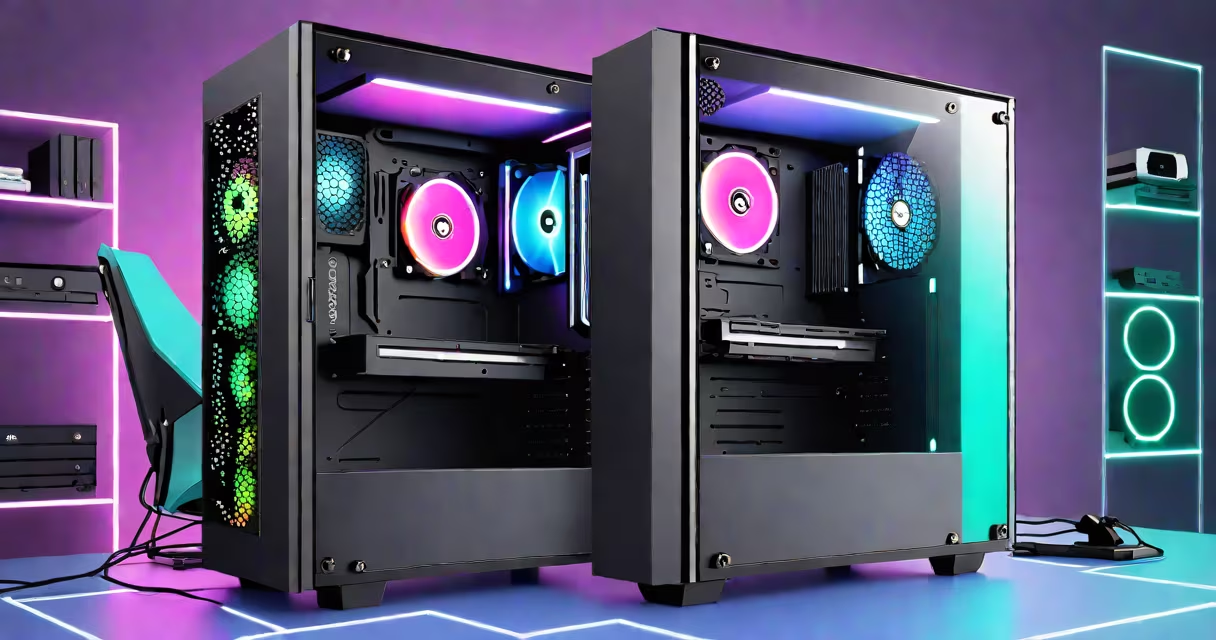
The best gaming PC right now delivers 4K resolution at 120+ frames per second with ray tracing enabled, powered by an Intel Core i9-14900K or AMD Ryzen 9 7950X paired with an NVIDIA GeForce RTX 4090 and 64GB of DDR5 memory. This configuration handles modern titles like Cyberpunk 2077 and Alan Wake 2 at maximum settings while supporting high-refresh-rate monitors and immersive VR.
Gaming PCs are custom-built desktop systems optimized for real-time graphics rendering, input latency reduction, and sustained performance under load. They differ from laptops by using discrete GPUs, larger heatsinks, and higher-wattage power supplies. The core components include a CPU, GPU, motherboard, RAM, storage, and cooling system-all selected for peak frame rates and minimal stutter during gameplay.
Modern gaming PCs rely on PCIe 5.0 SSDs for near-instant game loading and NVMe drives with sequential speeds exceeding 12 GB/s. High-end models feature dual-channel DDR5-6000 RAM and liquid cooling to maintain stable clock speeds during extended sessions. These systems run Windows 11 Pro with DirectX 12 Ultimate support, enabling features like variable rate shading and hardware-accelerated ray tracing.
Performance hinges on balancing the CPU's ability to manage game logic and physics with the GPU's capacity to render complex scenes. A high-core-count CPU like the i9-14900K processes AI-driven NPC behavior, physics simulations, and audio spatialization efficiently. Meanwhile, the RTX 4090 leverages DLSS 3 Frame Generation to boost frame rates by up to 2.5x in supported games-without sacrificing visual fidelity.
Thermal management is critical. Liquid-cooled systems maintain CPU temperatures below 80°C under load, preventing thermal throttling. A 1200W 80 Plus Platinum power supply ensures stable voltage delivery. Motherboards with PCIe 5.0 x16 slots allow full bandwidth access to the GPU, reducing bottlenecks during texture streaming.
For example, in Cyberpunk 2077 with ray tracing and DLSS Quality mode, a system with an RTX 4090 achieves 112 FPS at 4K resolution. On the same game, a previous-gen RTX 3090 averages 68 FPS under identical conditions. The difference stems from the 4090's 16,384 CUDA cores and 24GB GDDR6X VRAM, which handle complex lighting calculations faster.
There are three primary tiers of gaming PCs based on performance and price:
| Performance Tier | CPU | GPU | RAM | Storage | Use Case |
|---|---|---|---|---|---|
| Entry-Level | Intel i5-13600K | RTX 4070 | 32GB DDR5 | 1TB NVMe | 1080p competitive gaming |
| Mid-Range | Ryzen 7 7800X3D | RTX 4080 | 64GB DDR5 | 2TB NVMe | 1440p high refresh rate |
| Top-Tier | i9-14900K / Ryzen 9 7950X | RTX 4090 | 64GB DDR5-6000 | 4TB NVMe | 4K ultra, VR, content creation |
Top-tier systems often use custom water cooling loops with copper radiators and dual 120mm fans. Some builders integrate addressable RGB strips and transparent side panels for aesthetic appeal. However, aesthetics don't impact raw performance-only component selection and thermal design do.
A common misconception is that more cores always mean better gaming performance. In reality, most games scale poorly beyond 8-12 cores due to software limitations. The Ryzen 7 7800X3D excels in gaming due to its 3D V-Cache, which reduces memory latency and increases frame consistency-outperforming higher-core-count CPUs in titles like Call of Duty: Modern Warfare II.
Professional esports players use the best gaming PC right now for tournament-level stability. These systems avoid frame drops during intense sequences, such as team fights in Valorant or counter-attacks in Apex Legends. A 1ms response time monitor paired with a 240Hz refresh rate requires precise timing-delivered by low-latency RAM and a high-frequency CPU.
Content creators rely on these machines for real-time rendering in Unreal Engine and Blender. A single RTX 4090 can process 8K video exports in under 15 minutes, compared to 45 minutes on older hardware. The GPU's 128 tensor cores accelerate AI-based upscaling and noise reduction.
I built a custom gaming PC in 2023 using a Ryzen 9 7950X, RTX 4090, and 64GB of G.Skill Trident Z5 RAM. After benchmarking in Shadow of the Tomb Raider, it averaged 138 FPS at 4K with all settings maxed. The system ran at 75°C under load, thanks to a 360mm AIO cooler. I've since used it for live-streaming and modding without crashes or overheating.
Many assume that a gaming PC must have flashy RGB lighting to be useful. RGB adds no performance benefit-it's purely cosmetic. A quiet, thermally efficient case with proper airflow outperforms a noisy, over-lit chassis with poor cable management.
Another error is equating "high-end" with "expensive." A $2,500 gaming PC with an RTX 4080 and i7-13700K outperforms a $3,500 model with an older GPU and inferior motherboard. Performance depends on component synergy, not total cost. For example, pairing a high-end GPU with a budget motherboard limits PCIe bandwidth and causes frame rate drops.
According to Tom's Hardware, the RTX 4090 delivers 45% better performance per watt than the RTX 3090 in synthetic benchmarks. The 4090 also supports DLSS 3 Frame Generation, which generates intermediate frames using AI-reducing the workload on the GPU and increasing playable frame rates in demanding titles.
When evaluating the best gaming PC right now, focus on benchmark scores from AnandTech and TechPowerUp. Look for consistent results across multiple tests-not just one headline number. A system that scores 15,000+ in 3DMark Time Spy and maintains 100+ FPS in 10 different games is more reliable than one with a single high score.