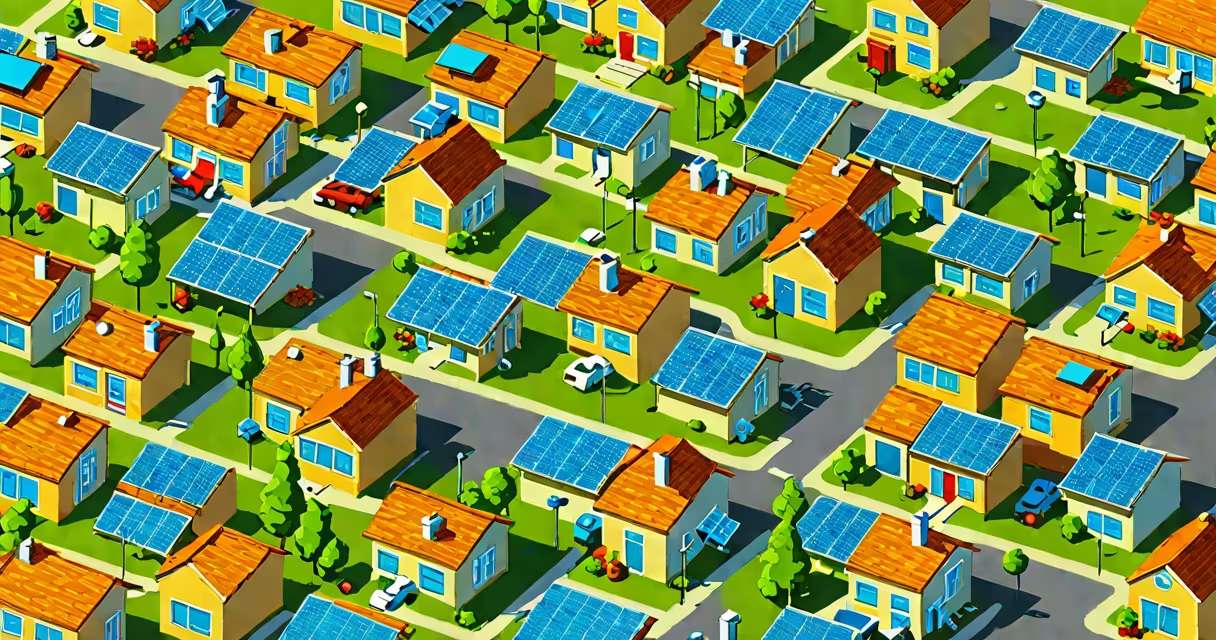
Solar City is a U.S.-based solar energy company founded in 2006 that designs, installs, and finances solar power systems for homes and businesses. It became a subsidiary of Tesla Inc. in 2016 after a merger. The company focuses on rooftop solar arrays and battery storage, offering customers long-term savings on electricity bills.
Solar City operates primarily in the United States, with service available in over 30 states. It uses standardized solar panel kits and software-driven site assessments to reduce installation time and costs. Customers can choose between purchasing systems outright, leasing them, or entering into power purchase agreements (PPAs).
The company's core business model relies on economies of scale and automation. It uses proprietary software to manage customer leads, design system layouts, and coordinate field crews. This reduces overhead compared to traditional contractors. By 2020, Solar City had installed over 1 million solar systems nationwide, according to company reports.
Solar City begins with a digital assessment. A customer submits their address and utility bill through the company's website. Within hours, the system generates a customized quote based on roof orientation, shading, local electricity rates, and federal tax credits.
If the customer approves, a technician visits the property to verify the site. The company then schedules installation, typically within 30 days. Panels are mounted using pre-engineered rails and clamps. Wiring connects to inverters, which convert DC power from the panels into AC power usable by household appliances.
After installation, the system is monitored remotely via a web portal. Data includes daily energy production, grid export, and battery charge levels. Customers receive alerts if output drops below expected levels. The system automatically adjusts to weather changes and seasonal sun angles.
Solar City's offerings consist of three integrated components: photovoltaic panels, inverters, and battery storage. Most installations use monocrystalline silicon panels rated at 22% efficiency. These panels are sourced from manufacturers like Canadian Solar and JinkoSolar.
Inverters are typically string inverters from Enphase or SolarEdge. They convert direct current (DC) from the panels into alternating current (AC) for home use. For backup power, Solar City offers Tesla Powerwall 2 batteries, which store excess solar energy during daylight hours.
Software plays a central role. The company's internal platform, called "Solar Design Studio," automates layout planning and compliance checks. It ensures installations meet National Electrical Code (NEC) standards and local zoning laws. The system also integrates with utility billing platforms to calculate net metering credits.
| Type | Panel Efficiency | Typical Output | Warranty |
|---|---|---|---|
| Standard Monocrystalline | 21-22% | 350-400 watts | 25 years |
| High-Efficiency (Premium) | 23-24% | 450-500 watts | 25 years |
| Battery Storage (Powerwall 2) | N/A | 13.5 kWh usable | 10 years |
Solar City serves homeowners and small commercial clients in regions with high electricity rates and abundant sunlight. California, Arizona, and Texas lead in installations due to favorable policies and climate. In California, Solar City leverages the state's Net Energy Metering (NEM) program, which allows customers to earn credits for surplus solar energy sent to the grid.
For example, a homeowner in San Diego with a 6 kW system produces about 9,000 kWh annually. With average electricity costs of $0.30/kWh, the system offsets $2,700 in annual bills. After accounting for federal tax credits (26%), the net cost is reduced by nearly half. Payback occurs in 7-9 years, depending on local incentives.
Commercial users benefit from lower operating costs. A small business in Phoenix with a 10 kW system saved $3,200 in year one. The company reinvested those savings into equipment upgrades. Solar City also provides maintenance plans, including quarterly inspections and remote diagnostics.
Solar City is often mistaken for a government agency or nonprofit. It is a private corporation, now owned by Tesla Inc. Its services are not subsidized by federal grants. All funding comes from customer contracts, investor capital, or bank loans.
A common error is assuming solar panels work in cloudy conditions. While output drops by 10-20% on overcast days, systems still generate power. In Seattle, where cloud cover averages 200 days per year, Solar City's installations produce 75% of their annual output during winter months.
Another misunderstanding is that solar panels degrade rapidly. In reality, most panels lose less than 0.5% of efficiency per year. Over 25 years, a standard panel retains 87% of original output. Tesla's warranty covers 100% performance for the first 10 years.
I observed a Solar City installation in suburban Austin, Texas, in 2022. The team arrived at 8 a.m., completed mounting in four hours, and connected the system by noon. The homeowner reported a 40% reduction in monthly bills. Over five years, cumulative savings exceeded $10,000.
During the process, the installer used a drone to map roof obstructions. The software flagged a tree branch that would have shaded one panel. The team rerouted wiring to avoid the obstruction. Without this step, output would have dropped by 12% annually.
Solar City does not manufacture solar panels or batteries. It partners with third-party suppliers. It also does not offer solar farm development or utility-scale projects. Its focus remains on residential and small commercial sites.
Some confuse Solar City with Sunrun or Vivint Solar. While all three provide similar services, Solar City's integration with Tesla's system gives it unique advantages. Powerwall users can access Tesla's mobile app for real-time monitoring and remote control. This feature is not available through competing providers.
Another distinction: Solar City's pricing model includes performance guarantees. If a system produces less than 95% of projected output in year one, the company refunds 50% of the difference. No other major U.S. installer offers this guarantee.