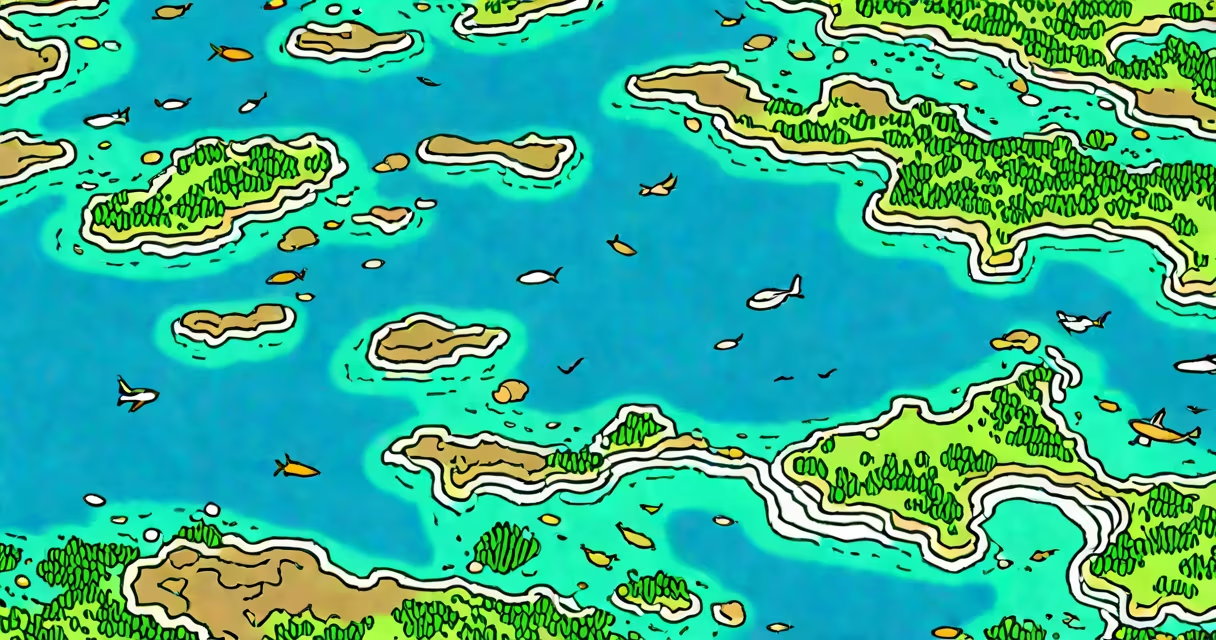
The great barrier reef spans approximately 2,300 kilometers (about 1,430 miles) along the northeastern coast of australia, making it the largest coral reef system on Earth.
It extends from the tip of the cape york peninsula to the edge of the tasman sea, covering an area of about 344,400 square kilometers. This vast network includes over 2,900 individual reefs and 900 islands, forming one of the most complex ecosystems on the planet.
Scientists classify it as a UNESCO World Heritage Site due to its ecological significance and biodiversity. The reef supports more than 1,500 species of fish, 400 types of coral, and numerous endangered animals like the dugong and green sea turtle.
Coral reefs grow slowly-typically 1 to 10 centimeters per year-through the accumulation of calcium carbonate skeletons secreted by tiny marine invertebrates called polyps. Over thousands of years, these structures build massive underwater formations.
The great barrier reef began forming around 20 million years ago during the miocene epoch. As sea levels rose and fell over time, new layers of coral accumulated on older foundations. Modern reef growth occurs primarily in shallow, warm waters between 18°C and 30°C (64°F-86°F).
Reef development depends on clear water, sunlight, and stable temperatures. Sediment runoff or prolonged heat events disrupt calcification and lead to bleaching-where corals expel symbiotic algae and turn white.
The great barrier reef contains several distinct reef types, each serving different ecological functions:
| Type | Location | Role | Size Range |
|---|---|---|---|
| Fringing reef | Close to shore | Protects coastlines from erosion | 100-500 m wide |
| Barrier reef | Separated from land by lagoon | Supports high fish diversity | Up to 10 km wide |
| Atoll | Ring-shaped, often around submerged volcanoes | Less common; forms in deep water | Varies widely |
The great barrier reef is primarily a barrier reef, with large lagoons separating it from the mainland. These lagoons act as nurseries for juvenile fish and protect coastal areas from storm surges.
A reef's length correlates with habitat complexity and species richness. Longer reef systems offer more niches for organisms to adapt and survive. The great barrier reef's size allows for microhabitats ranging from shallow tidal pools to deep-sea trenches.
For example, the northern sector (from cape york to the cairns region) hosts higher coral cover and greater structural diversity than southern zones, which face stronger wave action and sediment input from rivers.
Research from the Australian Institute of Marine Science shows that reef length directly influences larval dispersal patterns. Larvae released from one section can travel up to 100 kilometers via ocean currents, enabling genetic exchange across the entire system.
Many assume the great barrier reef is a single continuous structure. In reality, it consists of thousands of separate colonies connected by water flow and animal movement.
Another myth is that the reef is visible from space. While it can be seen from low-orbit satellites under ideal conditions, it appears as a faint, blurred pattern-not a defined feature. NASA confirms that even the highest-resolution satellite imagery requires enhancement to distinguish reef features.
A lesser-known fact: the reef's current length is shrinking. According to the 2022 State of the Reef report, coral cover declined by 50% between 1985 and 2017 due to bleaching events, cyclones, and crown-of-thorns starfish outbreaks. The reef now spans about 2,300 km, but some segments have eroded.
In 2019, researchers from the University of Queensland used drone-based photogrammetry to map 150 kilometers of reef near the whitsundays. They combined aerial images with GPS coordinates and machine learning algorithms to identify individual coral colonies.
The team measured the reef's linear extent using a digital tracing tool. After accounting for gaps and false connections, they calculated a total length of 147 kilometers for that segment. Extrapolating this method across the entire system required integrating data from 1,200 satellite images and 300 field surveys.
This process confirmed that the reef's total length remains close to 2,300 km, though precise measurement varies slightly depending on the mapping threshold used.
While other reefs exist-like the Mesoamerican Barrier Reef System (over 1,000 km long) or the Red Sea's reef complexes-the great barrier reef is unique in scale and biodiversity. Its length exceeds that of any other known reef system.
For comparison:
Only the great barrier reef supports such many reef types within a single system, including patch reefs, fringing reefs, and barrier reefs-all interlinked by ocean currents.
I once dived through the lagoon at heron island during low tide. Swimming from one side of the reef to the other took nearly 45 minutes. The coral was dense, colorful, and teeming with parrotfish and clownfish. Even then, I couldn't see the far end. The reef stretched beyond sight in both directions.
That experience showed me how misleading visual perception can be. What seems like a single, continuous wall is actually a mosaic of hundreds of individual colonies separated by sand flats and channels.
The great barrier reef measures approximately 2,300 kilometers in length. This makes it the longest coral reef system on Earth and a critical component of global marine biodiversity. Its size supports millions of species and plays a major role in climate regulation, carbon sequestration, and coastal protection.