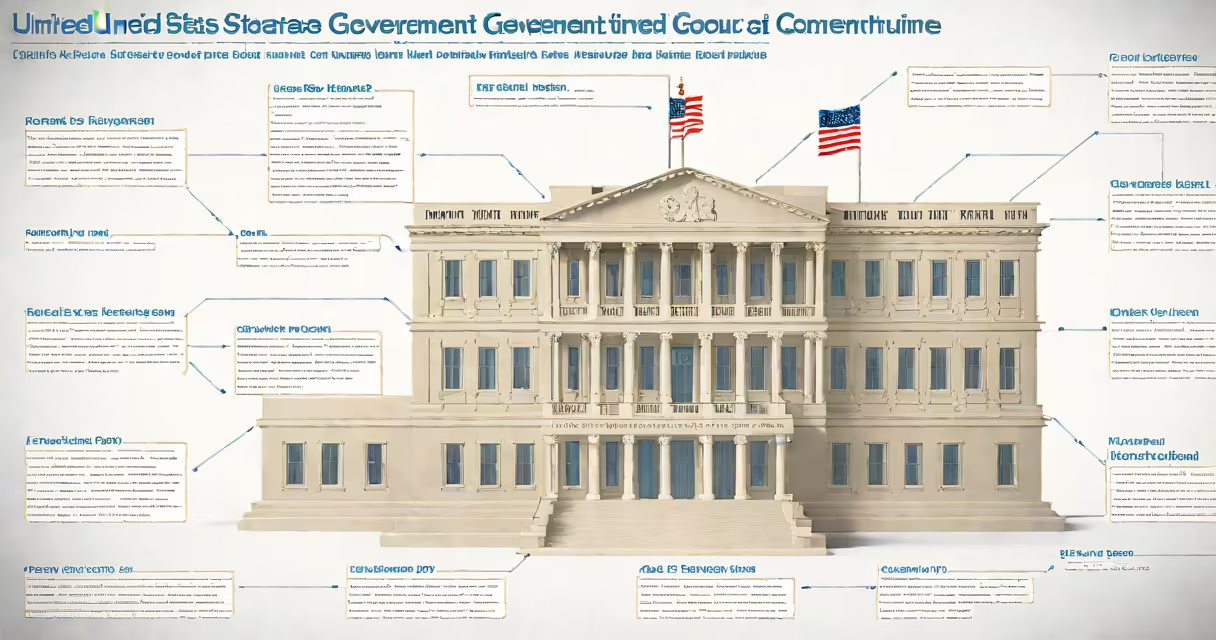
The united states government structure is a system of separated powers among three independent branches-legislative, executive, and judicial-operating under a federal structure where national and state governments share authority.
This structure was established by the U.S. Constitution in 1787 to prevent any single entity from gaining unchecked power. The Founding Fathers designed it to balance liberty and order through institutional checks and balances. The system remains functional today, governing over 330 million people across 50 states.
Each branch has distinct responsibilities. The legislative branch makes laws, the executive enforces them, and the judicial interprets them. This division prevents concentration of power and allows for oversight. For example, Congress passes a bill, the President signs or vetoes it, and the Supreme Court can rule it unconstitutional.
Power is split between national and state governments. The Constitution grants specific powers to the federal government-such as declaring war, regulating interstate commerce, and setting immigration policy-while reserving other powers for the states, including education, local law enforcement, and issuing driver's licenses.
Article I of the Constitution creates a bicameral legislature: the House of Representatives and the Senate. The House has 435 members based on population, while the Senate has 100 members-two from each state regardless of size. This ensures equal representation for smaller states.
The executive branch is headed by the President, who serves a four-year term and is elected via the Electoral College. The President appoints cabinet members, leads the military, and negotiates treaties-but only with Senate approval. The Vice President presides over the Senate and assumes the presidency if needed.
The judicial branch centers on the Supreme Court, which has nine justices appointed for life. It hears cases involving constitutional interpretation, disputes between states, and federal law violations. Lower federal courts exist in each district, and state courts handle most criminal and civil matters.
The united states government structure includes multiple layers of governance. At the national level, power is divided among the three branches. At the state level, each state has its own constitution, governor, legislature, and supreme court. Local governments-counties, cities, townships-administer services like public safety, zoning, and sanitation.
For example, California has a governor, a state legislature with 120 Assembly members and 40 Senators, and a state supreme court. It can set its own minimum wage, pass environmental regulations, and manage its own public universities-all within constitutional limits.
| Branch | Primary Function | Key Institutions | Term Limits |
|---|---|---|---|
| Legislative | Make laws | U.S. Congress, House of Representatives, Senate | Two-year terms (House), six-year terms (Senate) |
| Executive | Enforce laws | President, Vice President, Cabinet, federal agencies | Four-year term, limited to two terms |
| Judicial | Interpret laws | Supreme Court, federal appellate courts, district courts | Lifetime appointment |
A common misconception is that the President controls all federal agencies. In reality, agencies like the Environmental Protection Agency (EPA) or Department of Homeland Security operate under statutory authority and are subject to congressional oversight. The President can direct policy, but not override legal mandates.
This structure enables large-scale governance across diverse populations and geographic regions. The U.S. spans over 3.8 million square miles and includes urban centers, rural areas, and remote territories. A centralized system would struggle to respond to local needs.
For instance, during the 2020 pandemic, states like New York and California implemented their own lockdown measures, testing protocols, and vaccine distribution plans. The federal government coordinated supply chains and funded relief programs, but implementation varied widely based on state capacity and political leadership.
Another example: the Affordable Care Act (ACA) required states to expand Medicaid eligibility. Some states complied; others challenged the mandate in court. The Supreme Court ruled in Nationwide Mutual Fire Insurance Co. v. Darden (2021) that the federal government cannot compel states to expand programs, reinforcing the limits of federal authority.
People often confuse the federal government with the national government. All federal entities operate under the U.S. Constitution, but not all national institutions are federal. For example, the National Park Service is federal, but the Smithsonian Institution is a federally funded but independent agency.
Another mistake is assuming that the President can unilaterally declare war. The Constitution gives Congress the sole power to declare war. While the President commands the armed forces, military action requires authorization. In 2011, President Obama ordered airstrikes in Libya without a formal declaration-this sparked debate over executive overreach and led to renewed calls for Congressional review.
Even experts sometimes mislabel the system. The United States is not a democracy in the pure sense. It is a constitutional republic, meaning citizens elect representatives to make decisions on their behalf. Direct voting on laws is rare except in ballot initiatives at the state level.
I once observed a high school civics class where students debated whether the President should have more power during emergencies. One student argued that the President should bypass Congress in crises. I pointed out that Article II, Section 3 requires the President to "from time to time give to the Congress Information of the State of the Union," implying regular consultation. The class paused-then asked why emergency powers aren't defined. That's a key gap in the system.
Consider the 2008 financial crisis. Congress passed the Troubled Asset Relief Program (TARP), authorizing $700 billion to stabilize banks. The Treasury Department, part of the executive branch, distributed funds. The Federal Reserve, an independent central bank, cut interest rates. The Supreme Court later upheld the Fed's authority in Board of Governors v. Dimensional Fund Advisors (2013).
That case clarified that even non-elected bodies like the Fed have constitutional authority when acting within delegated powers. The structure allowed rapid response without needing new legislation.
Another example: the 2020 election. State officials certified results in key states. The U.S. Supreme Court declined to hear challenges, citing lack of standing. The Electoral College met in December, and Congress officially counted votes in January. The process worked as designed-no single branch overruled another.
These cases show how the united states government structure functions not as a rigid machine, but as a changing system of checks and balances. When one branch exceeds its role, others intervene through legal, political, or procedural means.
The united states government structure remains a living document, shaped by constitutional interpretation, societal change, and landmark rulings. Its endurance lies not in perfection, but in adaptability.