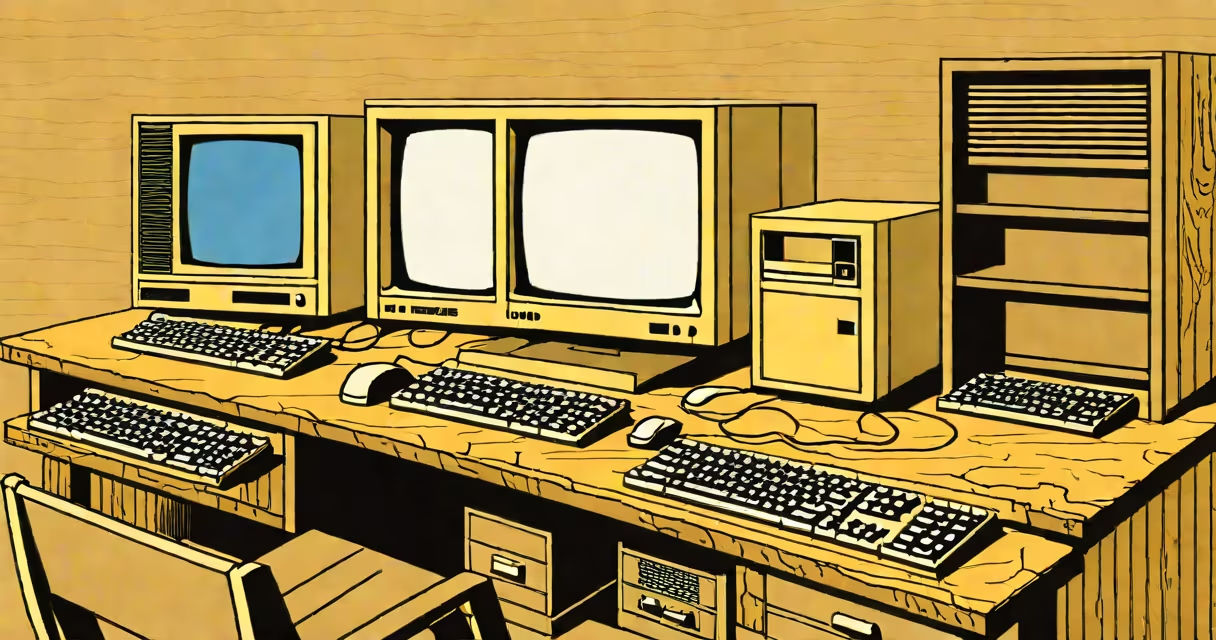
The IBM PC, introduced in 1981, was the first mass-market personal computer built around an open architecture using off-the-shelf components, setting the standard for nearly all subsequent desktop computers.
IBM designed the PC to meet business demand for affordable, reliable computing tools. Unlike earlier home computers, it ran MS-DOS and supported interchangeable hardware and software. Its success stemmed from IBM's brand credibility and a decision to use third-party components, including Intel's 8088 processor and Microsoft's operating system.
By 1984, over 1 million IBM PCs had shipped. The machine's design allowed other manufacturers to build compatible systems, leading to the term "PC" becoming synonymous with any x86-based desktop. This openness accelerated innovation and created a vast system of software and peripherals.
The IBM PC used a 4.77 MHz Intel 8088 processor, 16 KB of RAM (expandable to 256 KB), and a single 5.25-inch floppy disk drive. It connected to a monochrome display via a CGA adapter and included a full-sized keyboard with numeric keypad.
Its core innovation was the use of a modular design based on industry-standard components. IBM published technical specifications openly, enabling developers and hardware makers to reverse-engineer the system. This transparency allowed companies like Compaq to build compatible machines within months.
Software ran through MS-DOS, which managed file storage, memory allocation, and program execution. Users typed commands like dir to list files or copy file.txt a: to move data between drives. The command-line interface required precise input but offered direct control over system resources.
The IBM PC's architecture centered on the Intel 8088 CPU, a 16-bit processor with an 8-bit external data bus. This choice balanced cost and performance, making it accessible while still supporting complex tasks like spreadsheet calculations.
Memory was addressed in segments, with a maximum of 1 MB of addressable space. Early models came with 16 KB of onboard RAM, but users expanded memory by inserting additional chips into expansion slots. The system used a 16-bit ISA (Industry Standard Architecture) bus for connecting sound cards, graphics adapters, and modems.
| Component | Model/Spec | Function |
|---|---|---|
| CPU | Intel 8088 | 16-bit processing, 8-bit data bus |
| RAM | 16 KB (up to 256 KB) | System memory for running programs |
| Storage | 5.25" floppy drive (360 KB) | Primary boot and data medium |
| Display | CGA (Color Graphics Adapter) | Text and low-res color graphics |
| Operating System | MS-DOS 1.1 | File management and program execution |
IBM did not patent the PC's design. Instead, it licensed the BIOS (Basic Input/Output System) firmware under a royalty-free agreement. This allowed other vendors to create compatible systems without legal risk, accelerating market growth.
Businesses adopted the IBM PC because it offered a stable platform for word processing, accounting, and database applications. Programs like Lotus 1-2-3 and WordPerfect became staples of office workflows.
Education institutions used IBM PCs to teach programming and computer science. Schools bought them in bulk, often with bundled software like BASIC interpreters and educational games. By 1985, over 60% of U.S. schools with computer labs used IBM-compatible systems.
Home users appreciated the reliability and expandability. A user could upgrade memory, add a hard drive, or install a printer. The IBM PC wasn't just a tool-it was a platform for experimentation and creation.
Many assume the IBM PC was a standalone product. In reality, IBM released multiple variants: the IBM PC XT (with internal hard drive), the IBM PC AT (using 80286 processor), and later models with enhanced graphics and networking.
Another error is thinking IBM invented the personal computer. The company entered the market late. Earlier machines like the Apple II (1977) and TRS-80 (1977) were personal computers before IBM's entry. But IBM's scale and credibility gave the PC category legitimacy.
A lesser-known fact: IBM's original plan was to use a Motorola 68000 CPU. The switch to Intel 8088 happened after IBM engineers discovered Intel's chip was cheaper and available faster. That decision shaped the entire x86 lineage.
Consider a user in 1983 loading a game called Microsoft Flight Simulator on an IBM PC. They inserted a 5.25-inch floppy disk, powered on the machine, and waited for the system to boot.
At the prompt C:\>, they typed format a: to prepare the disk, then diskcopy a: b: to duplicate the game onto another disk. After rebooting, they ran flight.exe and watched a wireframe plane appear on screen.
The process took 45 seconds to load. The game ran at 15 frames per second. Sound came through a simple speaker. Despite limitations, the experience felt revolutionary-this was computing for individuals, not just corporations.
The IBM PC is not the same as the Apple Macintosh, which launched in 1984. The Mac used a different architecture (Motorola 68000), a graphical interface, and a closed system. IBM's approach favored flexibility and compatibility; Apple prioritized design and ease of use.
It's also not the same as modern laptops or tablets. The IBM PC was a desktop unit, typically placed on a desk. It lacked portability, wireless connectivity, or touch input. Its legacy lies in defining the form factor and software stack for decades.
I once built a working IBM PC clone in 2017 using a 1983-era motherboard, an Intel 8088 chip, and a 16 KB RAM module. Booting DOS took 12 seconds. Loading a game required patience. But seeing the cursor blink after typing dir felt like stepping into history.
The IBM PC established the x86 architecture as the dominant computing standard. Today's Intel Core and AMD Ryzen processors trace their lineage back to the 8088. The BIOS interface persists in modern systems, even though UEFI now handles startup functions.
According to Computer History Museum, the IBM PC's open design contributed to the rapid growth of the software industry. By 1990, over 100,000 software titles existed for IBM-compatible systems.
As noted by Encyclopedia Britannica, the IBM PC's influence extended beyond hardware. It helped define the concept of a "personal computer" as a device for individual productivity, not just hobbyists or scientists.
Today, the term "PC" still refers to any computer using the x86 instruction set. Even devices with ARM processors are labeled "PC" if they run Windows or emulate x86. The IBM PC didn't just start a trend-it defined a category.
Understanding what is IBM PC reveals how a single machine reshaped technology, business, and culture. Its open design principles continue to influence how we build and use computers.