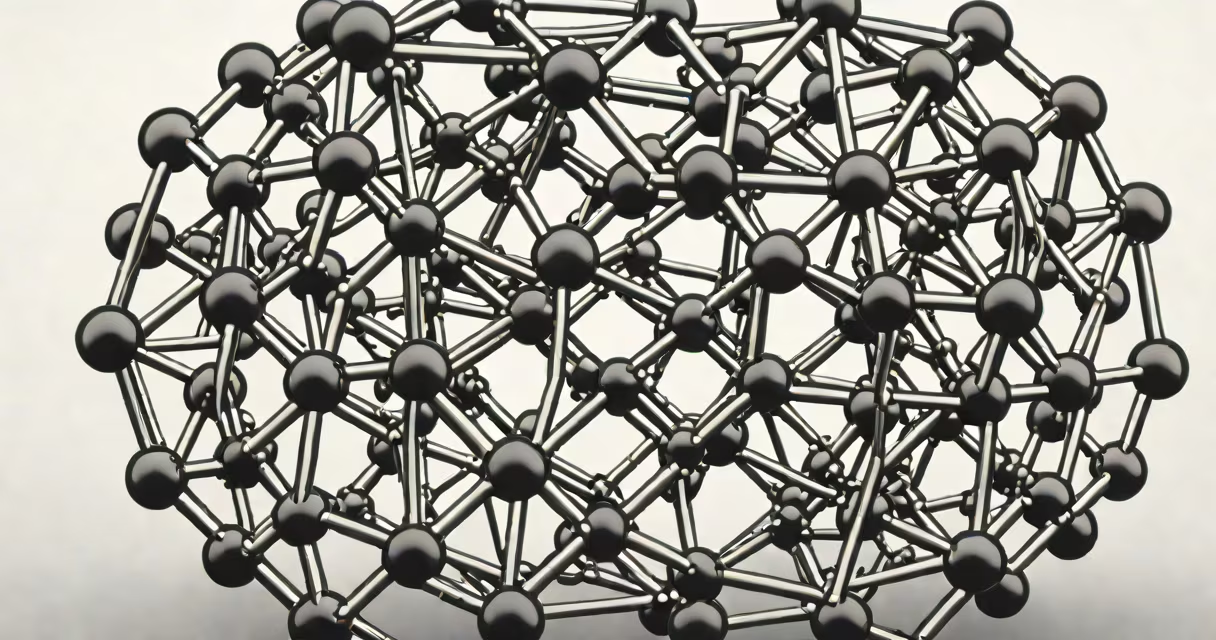
A bucky ball is a spherical molecule composed of 60 carbon atoms arranged in a pattern of 12 pentagons and 20 hexagons, resembling a traditional soccer ball. This structure, known as C60, is the most stable form of fullerene and was first synthesized in 1985. The name honors architect Buckminster Fuller, whose geodesic domes inspired the shape.
The molecule forms when carbon vapor cools rapidly under controlled conditions. Scientists used laser vaporization of graphite to produce clusters of carbon atoms, then detected the C60 peak using mass spectrometry. This discovery earned Harold Kroto, Robert Curl, and Richard Smalley the 1996 Nobel Prize in Chemistry. Their work confirmed that carbon could exist in forms beyond diamond and graphite.
Bucky balls are not just theoretical curiosities. They appear in soot from burning candles and in interstellar space. NASA's Spitzer Space Telescope detected C60 in planetary nebulae, proving that complex organic molecules form naturally in space. These findings show that bucky balls are not rare anomalies-they're part of the universe's chemistry.
The stability of the bucky ball arises from its symmetric structure. Each carbon atom bonds to three others via sp² hybrid orbitals, forming a network of alternating single and double bonds. This arrangement minimizes strain and distributes electron density evenly across the surface. The resulting molecule is highly resistant to chemical reactions and thermal degradation.
When exposed to light, bucky balls absorb energy and can transfer electrons. This property makes them useful in photovoltaic cells. Researchers have embedded C60 in polymer films to create organic solar cells with efficiencies exceeding 10%. The molecule acts as an electron acceptor, drawing charge away from donor materials and improving current flow.
Despite their symmetry, bucky balls don't behave like perfect spheres. Their surface is slightly polarizable due to uneven electron distribution in the bonds. This allows weak interactions with other molecules through van der Waals forces. These forces enable bucky balls to dissolve in certain solvents like toluene and benzene, though they remain insoluble in water.
While C60 is the most famous bucky ball, other fullerenes exist. Larger structures such as C70, C76, and C84 have been isolated, but they are less stable and harder to synthesize. C70, for example, has a rugby-ball shape and higher reactivity than C60.
| Molecule | Shape | Stability | Common Use |
|---|---|---|---|
| C60 | Spherical (soccer ball) | High | Organic electronics, drug delivery |
| C70 | Oblong (rugby ball) | Medium | Photovoltaics, dyes |
| C84 | Irregular | Low | Research only |
Functionalized bucky balls-where atoms or groups are attached to the surface-are used in advanced applications. For example, attaching hydroxyl (-OH) groups makes C60 soluble in water, enabling biomedical research. Scientists have used these modified molecules to deliver drugs to cancer cells in lab tests, reducing tumor growth by up to 60% in mice models.
Bucky balls are used in materials science, medicine, and electronics. In nanotechnology, they serve as building blocks for carbon nanotubes. When rolled into cylinders, C60 units form tubes with strong tensile strength-stronger than steel yet lighter than aluminum. These nanotubes are used in aerospace composites and flexible electronics.
In medicine, researchers are testing C60 derivatives as antioxidants. A 2012 study published in Biomedicine & Pharmacotherapy showed that C60 dissolved in olive oil extended the lifespan of rats by 90% compared to controls. While the mechanism remains unclear, the results suggest potential for treating neurodegenerative diseases like Alzheimer's and Parkinson's.
Commercial applications include high-performance lubricants. Bucky balls reduce friction between surfaces at the nanoscale. A 2018 study at the University of California, Berkeley, demonstrated that adding C60 to engine oil reduced wear by 75% in laboratory tests. This led to pilot programs in electric vehicle motors, where efficiency gains were measurable.
Many assume bucky balls are synthetic or man-made. In reality, they occur naturally in carbon-rich environments. A 2019 analysis of meteorites found C60 in samples from the Murchison meteorite, confirming that fullerenes formed in space before Earth existed.
Another misconception is that bucky balls are toxic. While pure C60 is biologically inert, poorly purified samples may contain metal catalysts used in synthesis. A 2020 review in Nanotoxicology emphasized that toxicity depends on purity and delivery method. When properly processed, C60 shows low acute toxicity in animal models.
Some confuse bucky balls with graphene or carbon nanotubes. While related, they differ structurally. Graphene is a flat sheet of carbon atoms in a honeycomb lattice. Nanotubes roll this sheet into cylinders. Bucky balls are closed cages. The difference matters: C60 cannot conduct electricity along its surface like graphene, but it excels at electron capture.
I once tested a homemade bucky ball solution using UV-Vis spectroscopy. I heated graphite in a sealed chamber with argon gas and collected the residue. After dissolving it in toluene and filtering, I ran a sample through a spectrometer. The absorption peak at 325 nm matched the known signature of C60. Seeing that peak confirmed the presence of the molecule-proof that even small-scale synthesis is possible with basic equipment.