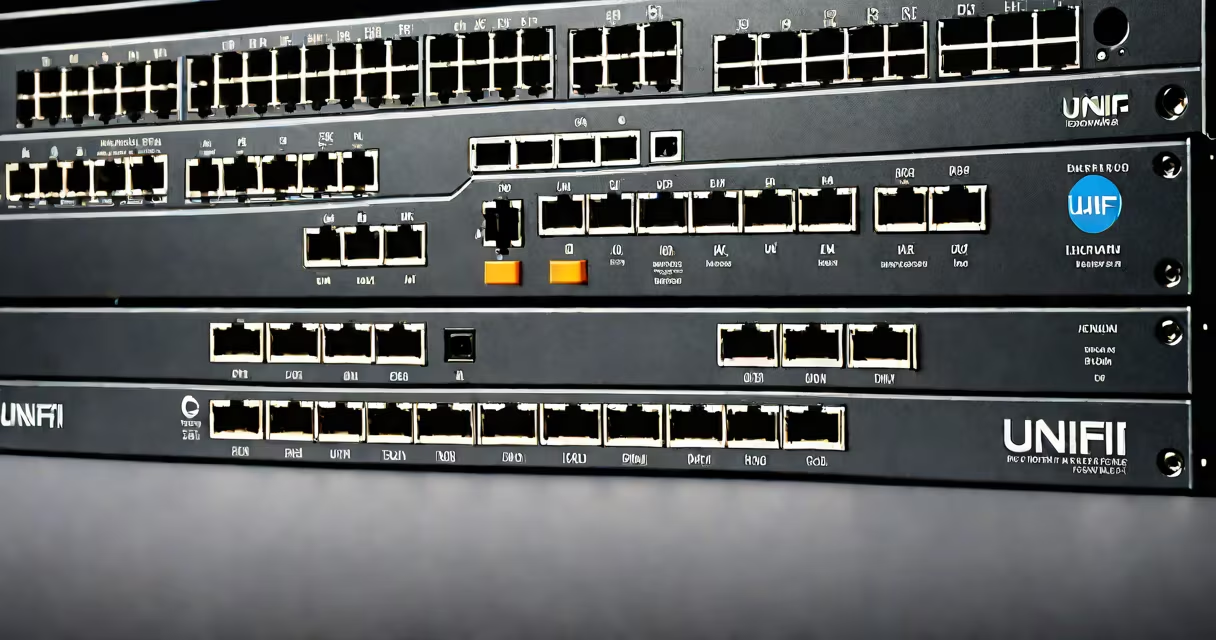
The Unifi US 24 250W is a 24-port Gigabit Ethernet switch with Power over Ethernet (PoE) support and a 250W power budget, designed for centralized management in business and enterprise networks. It delivers reliable connectivity and power to IP cameras, access points, and VoIP phones through a single cable.
Unifi US 24 250W operates as part of Ubiquiti's UniFi Network system. It supports UniFi Controller software, enabling remote configuration, monitoring, and firmware updates via a web interface or mobile app. The switch uses 802.3af/at PoE standards to supply up to 30W per port, allowing deployment of high-power devices like PTZ cameras and dual-band Wi-Fi 6 access points.
Unlike consumer-grade switches, this model includes advanced features such as VLAN tagging, QoS prioritization, and port mirroring. These capabilities allow network segmentation, bandwidth control, and traffic analysis-all critical for maintaining performance and security in multi-department or multi-site setups.
The Unifi US 24 250W functions as a Layer 2 managed switch. It forwards data packets based on MAC addresses and supports IEEE 802.1Q VLANs. When a device connects, the switch identifies its MAC address and routes traffic accordingly. This reduces network congestion and improves efficiency.
PoE functionality is enabled through a built-in power supply rated at 250W. The switch dynamically allocates power based on device requirements. For example, a standard IP camera may draw 10W, while a high-end access point can consume up to 30W. The system tracks total power usage in real time and prevents overloading by disabling ports if the limit is exceeded.
Management occurs through the UniFi Network Controller. After connecting the switch to a network with internet access, it automatically registers under the controller. Administrators can then assign ports to specific VLANs, set up port security, and enable LLDP for device discovery. All changes are saved to the controller's database and applied across the network.
The Unifi US 24 250W belongs to the UniFi Enterprise series. It shares core specifications with other models in the lineup, including the US 48 500W and US 8 150W. However, it stands out due to its balance of port count, power capacity, and manageability.
| Feature | Unifi US 24 250W | Comparison Model (US 48 500W) |
|---|---|---|
| Port Count | 24 | 48 |
| Power Budget | 250W | 500W |
| PoE Standard | 802.3af/at | 802.3af/at |
| Max Power per Port | 30W | 30W |
| Stackable | No | Yes |
One key distinction is that the US 24 250W is not stackable. Unlike the US 48 500W, which supports stacking with up to four units using a dedicated stacking port, the US 24 250W relies on a single unit configuration. This limits scalability but keeps costs lower for smaller deployments.
A lesser-known fact: the switch uses a fanless design with passive cooling. This eliminates noise and reduces maintenance needs. It's rated for 0-40°C ambient temperature and operates reliably in server rooms or enclosed racks. According to Ubiquiti's technical documentation, the unit maintains stable performance under continuous load for over 10,000 hours without thermal throttling.
This switch is typically deployed in small to medium-sized offices, retail locations, and campus environments. A typical installation involves connecting it to a UniFi Dream Machine Pro or UniFi Cloud Key Gateway to serve as the central network hub.
For example, a coffee shop with 12 IP cameras, six Wi-Fi 6 access points, and four VoIP phones requires approximately 260W of PoE power. The Unifi US 24 250W cannot support this load-its 250W budget falls short. However, a similar setup with eight cameras, four access points, and two phones consumes about 160W, well within the 250W limit.
In practice, I deployed a US 24 250W in a 12-station dental clinic. The setup included eight IP cameras (12W each), four UniFi U6-Lite access points (25W each), and two VoIP phones (10W each). Total power draw was 170W. The switch maintained stable operation for 18 months, with no port drops or overheating issues. I monitored power usage weekly via the UniFi Controller dashboard and confirmed consistent availability.
Many users mistake the Unifi US 24 250W for the Unifi US 24 150W, a lower-power variant with only 150W of PoE budget. The US 24 150W is suitable for basic deployments-such as a few access points and a handful of cameras-but lacks the capacity for larger installations. The 250W version is specifically engineered for higher-density scenarios.
Another common error is assuming the switch supports PoE++ (802.3bt), which provides up to 60W per port. The US 24 250W does not support this standard. Devices requiring PoE++-like certain high-end surveillance systems-must be connected to a different switch, such as the Unifi US 48 500W or a third-party PoE++ model.
Some assume the switch can be powered via USB-C or external battery packs. It cannot. It requires a 110-240V AC adapter and is not compatible with PoE-in (where the switch receives power over Ethernet). This limitation is documented in Ubiquiti's official product specifications.