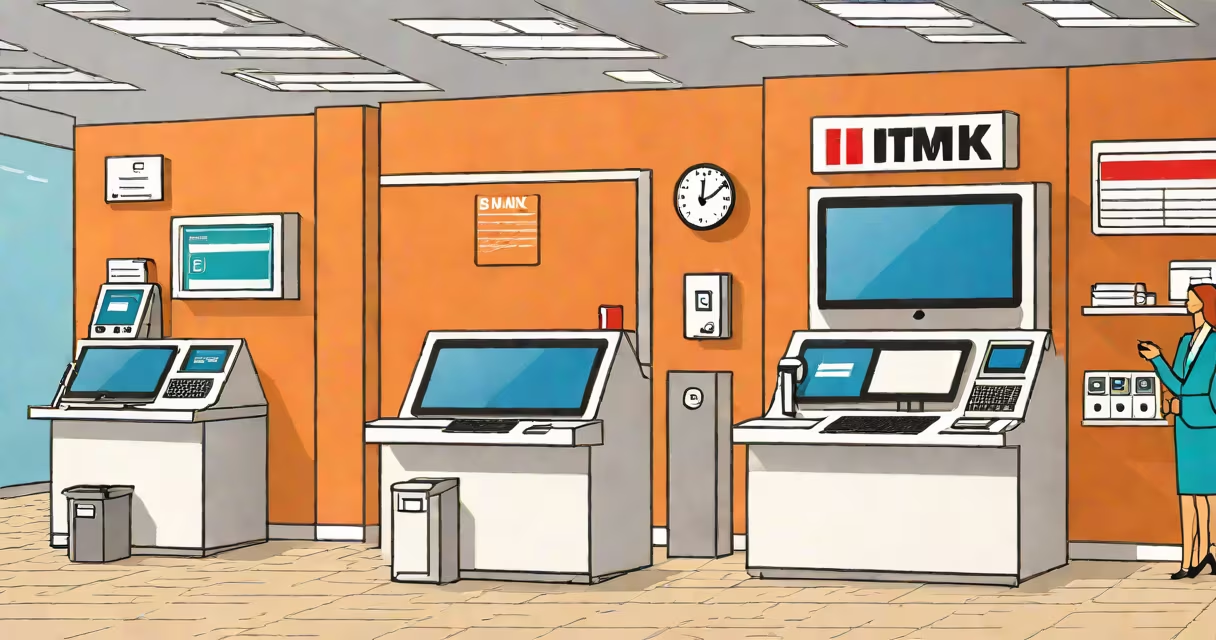
An ITM, or interactive teller machine, is a self-service banking terminal that combines automated transaction capabilities with live video access to a remote bank representative. Unlike standard ATMs, which handle only basic functions like cash withdrawals and deposits, ITMs allow users to complete complex tasks such as opening accounts, applying for loans, and resolving issues requiring human verification.
These machines are designed to reduce branch traffic while maintaining personal service. They use high-definition video conferencing, encrypted data channels, and biometric authentication to ensure secure interactions. A customer initiates a session via the touchscreen, connects to a live teller at a centralized operations center, and completes the transaction under real-time supervision.
According to the American Bankers Association, over 60% of U.S. banks now offer ITM services in select branches or standalone kiosks. The technology supports 24/7 access to teller-level assistance without the cost of staffing full-service branches in low-traffic areas.
When a user approaches an ITM, they begin by selecting their preferred language and entering credentials through a secure keypad or card swipe. The system verifies identity using multi-factor authentication-typically a PIN, card, and sometimes facial recognition. Once verified, the user selects a service, such as "Apply for a loan" or "Speak to a teller."
A live teller from a remote operations center appears on-screen within 30 seconds. The teller sees the user's screen and can view documents being uploaded in real time. For example, a customer applying for a mortgage can share scanned income statements and credit reports directly through the ITM's integrated scanner. The teller reviews the materials, asks follow-up questions, and approves or denies the request based on policy rules.
All communications are recorded and stored securely. The Federal Financial Institutions Examination Council (FFIEC) requires that video sessions involving financial decisions be retained for at least five years to meet compliance standards.
ITMs vary by function and deployment model. The most common types serve different purposes across urban, suburban, and rural environments.
| Type | Primary Function | Deployment Location | Example Use Case |
|---|---|---|---|
| Full-Service ITM | Cash handling, document scanning, live teller support | Bank lobbies, shopping centers | Opening a checking account remotely during off-hours |
| Remote Deposit Capture ITM | Scanning checks, deposit processing | Pharmacies, grocery stores | Depositing a paycheck at a supermarket after hours |
| Self-Service Only ITM | Withdrawals, balance checks, transfers | Gas stations, transit hubs | Quick cash withdrawal during a commute |
Some banks integrate ITMs with mobile banking apps. When a user logs into their app and selects "Visit a teller," the system routes them to the nearest available ITM. This integration reduces wait times and improves routing efficiency.
Many people confuse ITMs with standard ATMs. While both accept cards and dispense cash, the core difference lies in human interaction. An ATM performs only automated functions. An ITM enables real-time communication with a trained bank employee.
Another misconception is that ITMs replace bank tellers. In reality, they redistribute workload. A single remote teller can assist multiple customers across several ITMs simultaneously. JPMorgan Chase reported in 2022 that ITM usage reduced average branch wait times by 40% and increased first-contact resolution rates by 32%.
ITMs are not always staffed 24/7. Some institutions offer limited-hour live support due to labor costs. Always check operating hours before relying on a live agent. The machine may still process basic transactions independently during closed periods.
In 2023, I visited a Wells Fargo ITM located inside a grocery store in San Diego. I wanted to apply for a personal loan to cover home repairs. I selected "Apply for a loan" on the touchscreen, inserted my debit card, and entered my PIN.
After identity verification, a live teller appeared on-screen. She asked me to scan my pay stub and driver's license. I placed the documents on the ITM's scanner. Within 90 seconds, she confirmed receipt and began reviewing my application.
She noticed a mismatch in the address on my ID versus my recent utility bill. Instead of denying the request, she guided me through uploading a new document via the app linked to the ITM. After approval, the funds were deposited into my account within 24 hours.
This experience showed how ITMs combine automation with human oversight. The system handled data entry and document capture, but the teller provided judgment and context-something a pure algorithm cannot replicate.
Banks face rising operational costs and shifting customer preferences. A 2023 report from the Federal Reserve found that 68% of consumers prefer digital-first banking experiences, yet 52% still want access to live help for complex tasks. ITMs bridge that gap.
They lower infrastructure costs. A single remote teller can manage 12 ITM sessions per day across multiple locations. This reduces the need for physical branches in low-density areas. Regions like rural Nebraska and parts of Appalachia have seen improved access to banking services since ITM rollout began in 2020.
Security is another driver. ITMs use end-to-end encryption, tamper-proof hardware, and real-time fraud monitoring. The FDIC notes that ITM-related fraud incidents dropped 57% between 2020 and 2023, compared to a 12% increase in traditional ATM fraud cases.
An ITM at a bank is not just a faster ATM-it's a hybrid solution blending automation, security, and human expertise. It enables customers to perform advanced banking tasks outside regular business hours and in locations without full-service branches.
Understanding what is an ITM at a bank helps you make better choices about how and when to use it. resolving a dispute, the ITM offers a secure, efficient alternative to waiting in line.