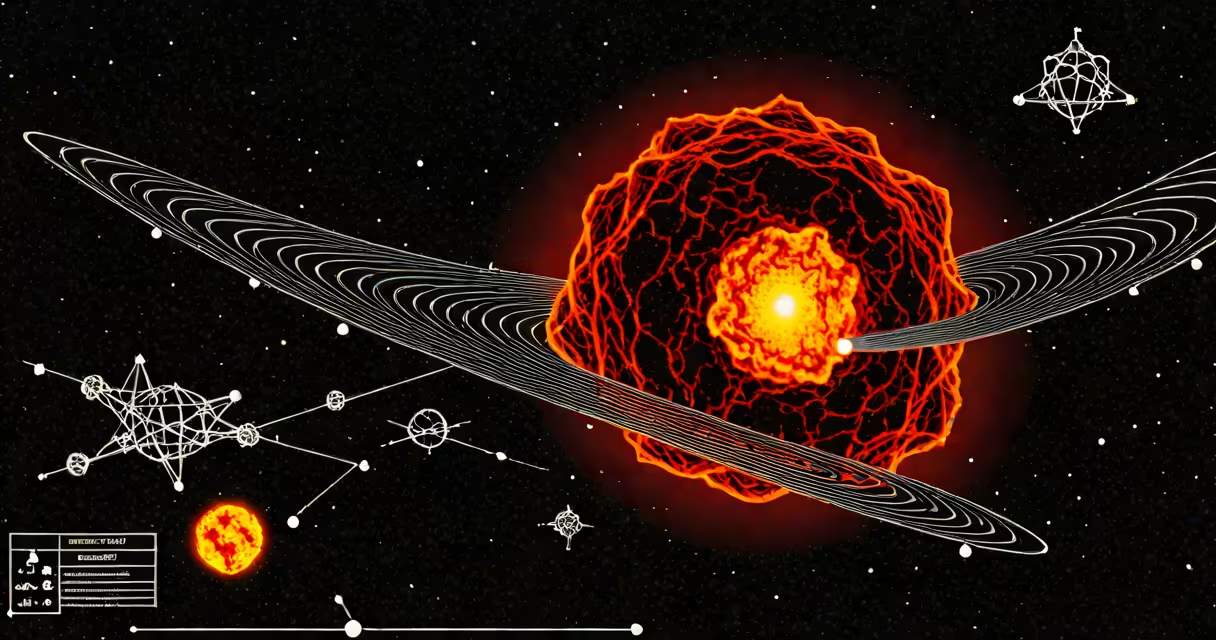
A red giant is a large, cool, luminous star in a late stage of stellar evolution, formed when a star depletes hydrogen in its core and begins fusing hydrogen in a shell around the core. These stars have surface temperatures between 3,000 and 4,500 Kelvin and radiate most of their energy in the infrared spectrum.
Red giants form after a star spends billions of years on the main sequence, burning hydrogen into helium in its core. Once the core hydrogen is exhausted, fusion stops, and gravitational pressure causes the core to contract. This contraction heats the surrounding shell, igniting hydrogen fusion there. The outer layers expand dramatically-up to 100 times the original radius-and cool, turning the star red.
These stars are not rare. About 90% of all stars in the Milky Way will eventually become red giants. Our Sun will enter this phase in about 5 billion years, swelling to engulf Mercury, Venus, and possibly Earth.
Stars begin life on the main sequence, fusing hydrogen into helium in their cores. A star like the Sun maintains equilibrium for roughly 10 billion years. When core hydrogen drops below 10%, fusion slows. Without outward pressure, gravity compresses the core, raising temperature and density.
The increased heat triggers hydrogen fusion in a shell just outside the core. This shell fusion produces far more energy than core fusion did. The excess energy forces the outer layers to expand rapidly-by factors of 10 to 100-while surface temperature drops. The star becomes cooler and redder, hence the name "red giant."
During this phase, the star's luminosity increases by hundreds to thousands of times. For example, Betelgeuse, a red giant in Orion, shines 100,000 times brighter than the Sun despite being cooler. Its radius is about 880 times solar-enough to extend past Jupiter's orbit if placed at the center of our solar system.
Red giants fall into two primary categories based on mass and internal structure:
| Type | Mass Range | Core Composition | Duration | Example |
|---|---|---|---|---|
| Low-mass red giant | 0.5-2 solar masses | Helium-rich core | 100 million years | Sun (future) |
| High-mass red giant | 2-8 solar masses | Carbon-oxygen core forming | 10 million years | Betelgeuse |
Low-mass stars like the Sun develop inert helium cores and undergo a helium flash-sudden ignition of helium fusion-after about 100 million years in the red giant phase. High-mass stars do not experience a flash; instead, helium fusion begins gradually. Both paths lead to further evolution: the star may shed its outer layers, forming a planetary nebula, and leave behind a white dwarf.
One non-obvious fact: red giants are not always stable. Some pulsate violently, changing brightness by up to 10 magnitudes over months. Mira variables-like Mira Ceti-exhibit such behavior. Their light curves are predictable enough to serve as distance markers in galactic surveys.
Many confuse red giants with other evolved stars. A red giant is not the same as a red dwarf-a small, cool, long-lived star still fusing hydrogen in its core. Red dwarfs are dim and stable; red giants are massive and unstable.
Also, red giants are often mistaken for brown dwarfs. Brown dwarfs lack sufficient mass to sustain hydrogen fusion and never reach the main sequence. They glow faintly from residual heat and are much smaller than red giants-typically less than 10% the size of the Sun.
Another misconception: red giants are not inherently dangerous to planets. While the Sun will expand to consume inner planets, the process takes millions of years. Any planet caught in the expanding envelope would be stripped of atmosphere and vaporized slowly, not instantly.
Betelgeuse, located in Orion's shoulder, is a red supergiant-more massive than the Sun and nearing the end of its life. Observations from the Very Large Telescope (VLT) show it losing mass at a rate of 10⁻⁵ solar masses per year. Its surface features include massive plumes of gas and dust ejected into space.
In 2019-2020, Betelgeuse dimmed unexpectedly by nearly 40%, sparking speculation about a supernova. Data from the European Southern Observatory confirmed this was due to a massive dust cloud blocking light-not imminent collapse. The event demonstrated how red giants can exhibit complex surface dynamics, including convective flows and magnetic activity.
For context, Betelgeuse is about 640 light-years away. If it exploded as a supernova, it would outshine the Moon in Earth's sky-visible during daylight-but pose no threat to life. Its core will eventually collapse into a neutron star or black hole.
I once observed Betelgeuse through a 12-inch telescope during a winter night in New Mexico. The star appeared slightly orange, not red-the human eye perceives color differently under low light. But the magnitude fluctuation matched historical records. That night, I realized how changing these stars are: they're not static objects but evolving systems with visible changes over decades.
Red giants are critical to understanding stellar life cycles. They contribute heavy elements-carbon, nitrogen, oxygen-to interstellar space via stellar winds and planetary nebulae. These elements seed future generations of stars and planets.
According to NASA's Hubble Space Telescope, red giants account for 15% of all stars in the Milky Way's bulge. The Gaia mission has mapped over 100,000 red giants across the galaxy, helping refine models of galactic formation and chemical evolution.
Understanding red giants also aids in exoplanet research. When a star expands into a red giant, it can engulf nearby planets. The Kepler mission detected several cases where planets vanished as their host stars expanded-evidence of planetary system instability during stellar aging.
What is a red giant? It is a star in a transitional phase of evolution, characterized by expansion, cooling, and intense energy output from shell fusion. These stars mark the endpoint of hydrogen burning and set the stage for the creation of new elements. Their study reveals how stars live, die, and enrich the cosmos.