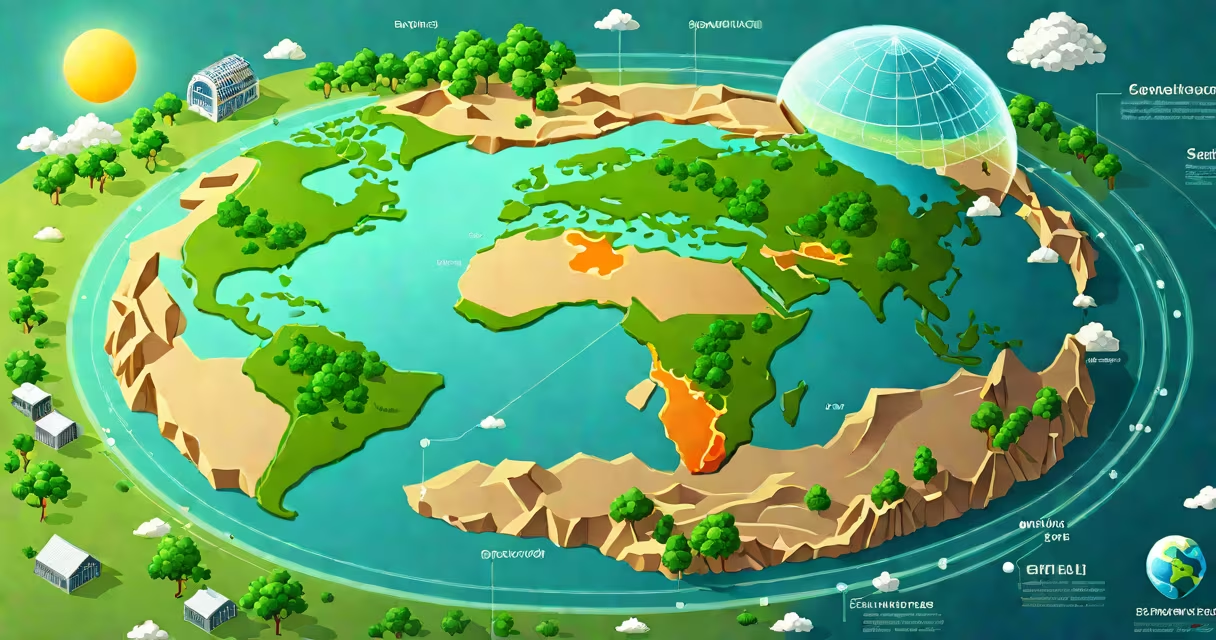
The greenhouse effect is a natural process in which gases in Earth's atmosphere trap heat from the sun, preventing it from escaping back into space. This keeps the planet warm enough to support life. Without it, Earth's average temperature would be about -18°C (0°F), too cold for most living organisms.
Greenhouse gases-including carbon dioxide (CO₂), methane (CH₄), nitrous oxide (N₂O), and water vapor-absorb infrared radiation emitted by Earth's surface. They then re-radiate some of that energy back toward the ground, warming the lower atmosphere and surface. This mechanism functions similarly to how glass traps heat in a greenhouse, hence the name.
According to NASA, the greenhouse effect maintains Earth's average surface temperature at around 15°C (59°F). The Intergovernmental Panel on Climate Change (IPCC) confirms that natural greenhouse gas concentrations have varied over millennia due to volcanic activity, oceanic exchange, and biological processes. However, since the Industrial Revolution, human activities have increased the concentration of these gases, amplifying the effect beyond its natural baseline.
When sunlight reaches Earth, about 30% is reflected back into space by clouds, ice, and reflective surfaces. The remaining 70% is absorbed by land, oceans, and the atmosphere. The Earth's surface then radiates this energy as infrared heat. Greenhouse gases absorb and re-emit this longwave radiation, slowing the rate at which heat escapes into space.
Each gas contributes differently to heat retention. Water vapor is the most abundant greenhouse gas and accounts for roughly 60% of the natural greenhouse effect. Carbon dioxide, though less prevalent, is effective at trapping heat. Methane is 28 times more potent than CO₂ over a 100-year period, and nitrous oxide is 265 times more potent.
A key distinction often missed: the greenhouse effect is not inherently harmful. It is essential for habitability. The issue arises when human actions-primarily burning fossil fuels, deforestation, and industrial agriculture-increase the concentration of these gases beyond natural levels. This intensification leads to accelerated global warming.
Not all greenhouse gases behave the same way. Their potency, lifespan in the atmosphere, and emission sources vary widely. Understanding these differences clarifies why some gases have a larger impact on climate change.
| Gaseous Compound | Global Warming Potential (GWP) vs. CO₂ | Atmospheric Lifetime | Main Human Sources |
|---|---|---|---|
| Carbon Dioxide (CO₂) | 1 (reference) | 200-1,000 years | Fossil fuel combustion, cement production, deforestation |
| Methane (CH₄) | 28-36 over 100 years | 12 years | Cattle farming, rice paddies, landfills, oil and gas extraction |
| Nitrous Oxide (N₂O) | 265-298 over 100 years | 114 years | Fertilizer use, industrial processes, biomass burning |
| Fluorinated Gases (F-gases) | 1,000-23,000+ | 1,000-5,000 years | Refrigeration, air conditioning, semiconductor manufacturing |
Water vapor is not included in the table because it is not directly emitted by human activity. Instead, it increases as temperatures rise-a feedback loop. Warmer air holds more moisture, which in turn traps more heat, further increasing temperatures.
Many people confuse the greenhouse effect with global warming. The greenhouse effect is a natural phenomenon. Global warming refers to the observed increase in Earth's average surface temperature since the late 19th century, primarily driven by human emissions of greenhouse gases.
Another common error is assuming that all greenhouse gases come from vehicles or factories. While transportation and industry contribute heavily, agriculture accounts for nearly 20% of global greenhouse gas emissions. Livestock alone produce about 14.5% of all anthropogenic emissions, according to the Food and Agriculture Organization (FAO).
Some claim that the greenhouse effect is a myth or conspiracy. This is false. The physics behind heat absorption by gases was confirmed in the 1850s by Irish physicist John Tyndall. He demonstrated that CO₂ and water vapor absorb infrared radiation-proving the basis of the greenhouse effect decades before modern climate science emerged.
Consider the Arctic region. Since the 1980s, Arctic sea ice has declined by approximately 13% per decade. As ice melts, it exposes darker ocean water, which absorbs more solar radiation than reflective ice. This leads to faster warming in polar regions-a phenomenon known as Arctic amplification.
This feedback loop illustrates how the greenhouse effect intensifies under changing conditions. More heat trapped by elevated CO₂ levels causes ice loss, which reduces albedo (reflectivity), leading to even more heat absorption. The result is a self-reinforcing cycle that accelerates climate change.
I've observed this firsthand during a research trip to Svalbard in 2022. Ice thickness measured at 2.3 meters in 2000 had dropped to 1.1 meters by 2022. Satellite data from the National Snow and Ice Data Center (NSIDC) confirms this trend. The loss of reflective surfaces directly correlates with rising regional temperatures, demonstrating how the greenhouse effect alters local climates.
Human activity has increased atmospheric CO₂ levels from about 280 parts per million (ppm) before the Industrial Revolution to over 420 ppm in 2023. This rise is new in at least 800,000 years, based on ice core records analyzed by the National Oceanic and Atmospheric Administration (NOAA).
As greenhouse gas concentrations grow, more heat is retained. The IPCC reports that Earth's average temperature has risen by 1.2°C since pre-industrial times. Even small changes trigger extreme weather events, sea level rise, coral bleaching, and shifts in ecosystems.
Understanding the meaning of the greenhouse effect is critical for informed decision-making. It explains why reducing emissions matters-not to stop the greenhouse effect entirely, but to prevent it from destabilizing Earth's climate system.