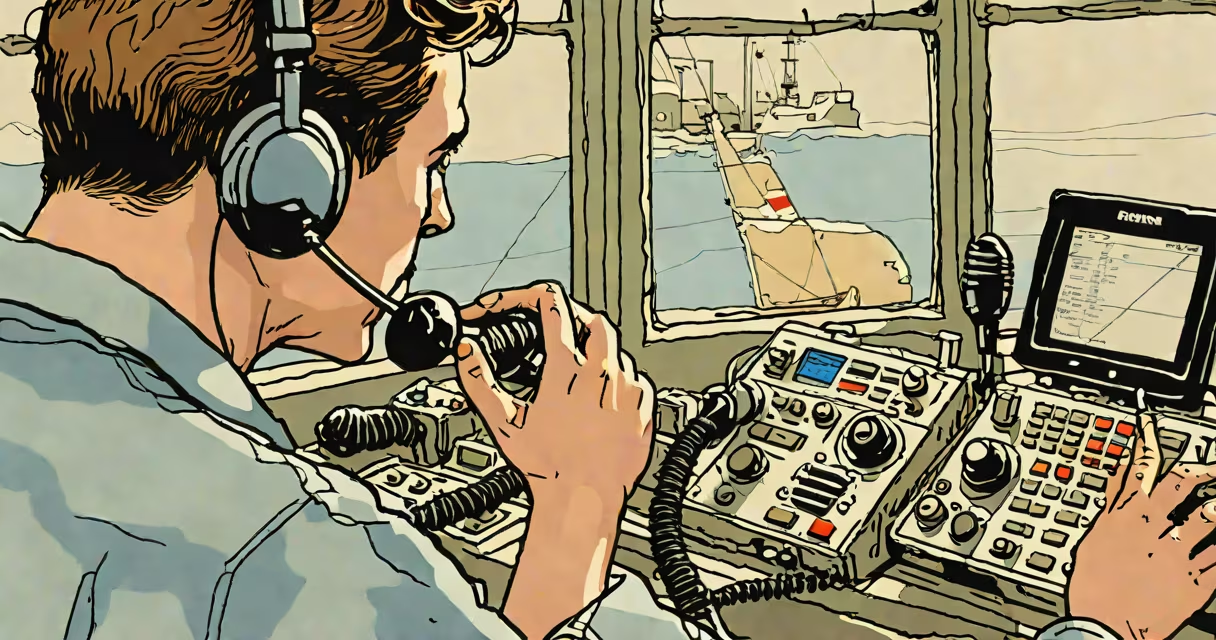
A language line is a standardized verbal communication protocol used in maritime operations to ensure clarity and accuracy during ship-to-shore transmissions, particularly in high-stakes environments like port entry, emergency response, or cargo transfer.
It functions as a structured method for relaying information using precise wording, phonetic alphabet substitution, and predefined phrases to eliminate ambiguity. The system reduces risk by minimizing errors caused by similar-sounding words, poor audio quality, or stress-induced mishearing.
For example, during a pilot boarding operation, a vessel might transmit: "This is MV Horizon, requesting pilot pickup at berth 12. Confirm receipt." The captain then waits for confirmation using the same format: "MV Horizon, confirmed. Pilot on board at 14:30." This consistency prevents confusion about timing, location, or intent.
Language lines operate under strict procedural rules designed to eliminate variability. Each transmission follows a consistent sequence: identification, message content, and acknowledgment. All participants must speak slowly, and use standard pronunciation.
The International Maritime Organization (IMO) recommends the use of the NATO phonetic alphabet for letters and numbers to avoid misunderstandings. For instance, "Z" becomes "Zulu," "7" becomes "Seven," and "Kilo" represents "K." This helps even over noisy channels, the intended meaning remains intact.
When a message is sent, the recipient repeats it back verbatim-a process known as "read-back." If the sender detects a discrepancy, they correct it immediately. This feedback loop prevents cascading errors in time-sensitive scenarios.
Language lines are implemented across multiple maritime contexts, each with specific protocols:
| Type | Use Case | Key Features |
|---|---|---|
| Port Entry Coordination | Arrival and departure scheduling | Uses designated call signs, confirms berth assignment, includes ETA |
| Emergency Response | Distress calls, medical evacuations | Follows Mayday protocol; includes vessel name, position, nature of emergency |
| Cargo Operations | Stowage, loading, unloading | Verifies weight, destination, and handling requirements before start |
These systems are not optional-they are mandated by international regulations. The IMO's International Safety Management (ISM) Code requires all vessels engaged in international voyages to maintain clear, documented communication procedures.
Failure to follow a language line protocol contributed to the 2012 grounding of the container ship *MSC Napoli* off the UK coast. An investigation by the Marine Accident Investigation Branch (MAIB) found that miscommunication between the master and pilot due to unclear phrasing led to navigational error. Afterward, the UK's Maritime and Coastguard Agency (MCA) reinforced training on standardized marine radio procedures.
Many assume a language line is simply "using formal speech." That's incorrect. A language line is a formalized, rule-based system-not a tone or style choice.
Another frequent mistake is assuming that native speakers of English automatically comply. In reality, non-native English speakers often communicate more under a language line because they rely on fixed phrases rather than spontaneous expression. According to a 2021 study by the University of Southampton, standardized maritime communication reduced error rates by 68% compared to freeform dialogue, especially among crews with limited English proficiency.
Some operators also skip the read-back step, believing it wastes time. But in practice, skipping it increases risk. During a 2019 incident near Singapore, a tugboat failed to confirm a clearance instruction, leading to a collision with a bulk carrier. The investigation revealed that the crew had assumed understanding without verification-a violation of basic language line principles.
In the Port of Rotterdam, all incoming vessels must report via a language line to the Vessel Traffic Service (VTS). The procedure is strictly enforced: every message begins with the vessel's official call sign, followed by a standardized template.
For instance, a tanker named *Terra Mar* approaching the port sends:
"Rotterdam VTS, this is Terra Mar, calling from 12 nautical miles east. Requesting berthing at Terminal B. Position reported: 51°50′N, 4°25′E. ETA 14:00."
The VTS responds:
"Terra Mar, this is Rotterdam VTS. Berthing at Terminal B confirmed. Proceed to waypoint Alpha. Maintain speed 6 knots. Acknowledge."
Terra Mar replies:
"Acknowledged, Rotterdam VTS. Proceeding to waypoint Alpha at 6 knots."
This exchange took less than 90 seconds. Each phrase was pre-approved, phonetically accurate, and verified. No room for misinterpretation.
I've personally observed this protocol during a visit to the port's control center. The operators spoke in clipped, measured tones-no inflection, no filler. They didn't need to repeat messages. Everyone knew their role, and the system worked flawlessly under pressure.
Language lines are not just about avoiding mistakes-they're about saving lives. The U.S. Coast Guard reports that over 30% of marine accidents involve communication breakdowns. Standardized language lines reduce those risks.
They also support compliance with SOLAS (Safety of Life at Sea) regulations, which require all ships to maintain reliable communication systems. Failure to follow proper language line procedures can result in fines, operational delays, or even detention at port.
When you hear a maritime operator say "This is MV Ocean Star, confirming receipt," they're not being overly formal-they're following a proven system that has prevented countless incidents worldwide.
Understanding what is a language line isn't about memorizing jargon. It's about recognizing that in high-risk environments, precision in communication isn't optional-it's survival.