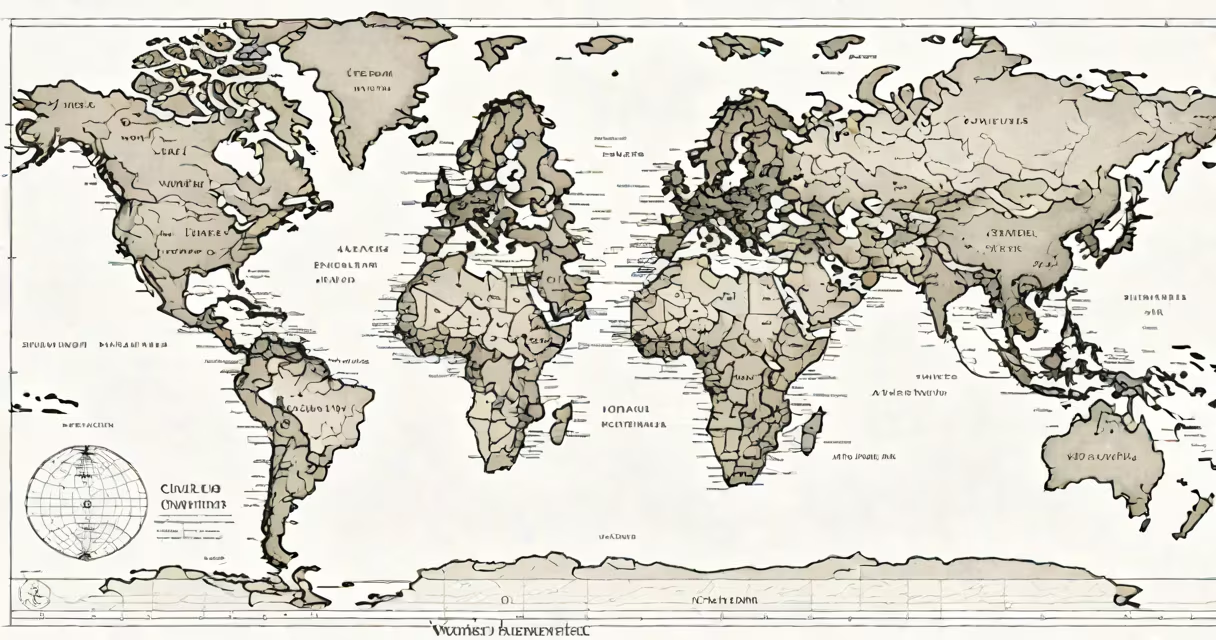
There are 195 recognized countries in the world, comprising 193 United Nations member states and two observer states: the Holy See (Vatican City) and Palestine. These nations are sovereign entities with defined territories, populations, governments, and international recognition.
The term "country" in modern usage refers to a sovereign state-territory with permanent population, defined borders, government, and capacity to enter into relations with other states. The United Nations recognizes 193 member states, while two additional entities hold observer status. This count excludes dependent territories, micronations, and unilaterally declared states without broad recognition.
Recognition varies. For example, Taiwan is governed by the Republic of China but is not a UN member due to diplomatic pressure from the People's Republic of China. Similarly, South Ossetia and Abkhazia declared independence from Georgia but lack widespread recognition. Only states meeting criteria set by the Montevideo Convention on the Rights and Duties of States are universally accepted as countries.
International recognition hinges on four principles: permanent population, defined territory, government, and capacity for foreign relations. The Montevideo Convention (1933) formalized these standards. A state must demonstrate control over its territory and maintain institutions capable of enforcing laws and conducting diplomacy.
Recognition is political. The United States recognizes 195 countries, but some nations remain unrecognized due to geopolitical disputes. For instance, Somaliland declared independence in 1991 but lacks official recognition despite functioning as a de facto state with its own military, currency, and constitution.
UN membership is not automatic. As of 2023, 193 countries are UN members. The process requires Security Council approval and General Assembly vote. The most recent additions were South Sudan (2011) and Montenegro (2006), both following territorial conflicts and referendums.
States differ in size, governance, and economic structure. The largest by land area is Russia (17.1 million km²), while the smallest is Vatican City (0.49 km²). By population, India ranks first with 1.4 billion people, and Tuvalu has the fewest at around 11,000.
| Type | Examples | Key Feature |
|---|---|---|
| Unitary | Japan, France, New Zealand | Central government holds most power; local authorities derive authority from central rule. |
| Federal | United States, Germany, Canada | Power divided between national and regional governments; constitutions define jurisdictional boundaries. |
| Confederation | None currently recognized | Loose alliance of independent states; weak central authority. Historical examples include the Articles of Confederation (U.S., 1781-1789). |
| Monarchy | Saudi Arabia, Japan, Sweden | Ruler inherits position. Constitutional monarchies (e.g., UK) have limited powers; absolute monarchies (e.g., Brunei) retain full executive authority. |
Some states operate under hybrid systems. Singapore combines parliamentary democracy with strict civil controls. Qatar uses an emirate system where hereditary rulers govern under Islamic law and constitutional frameworks.
People often confuse "country" with "nation," "state," or "region." A nation is a cultural or ethnic group sharing language, history, or identity-such as the Kurds, who span Turkey, Iran, Iraq, and Syria but lack a single sovereign state. A state is a political entity with sovereignty; a country is a state recognized internationally.
"Country" also differs from "territory." Territories like Puerto Rico (U.S.) or Hong Kong (China) are not independent nations. They are administered by another state and lack full sovereignty. Puerto Rico has U.S. citizenship but cannot vote in presidential elections.
A lesser-known fact: the International Olympic Committee recognizes 206 National Olympic Committees. Some represent states (e.g., Germany), others represent regions (e.g., Hong Kong, Puerto Rico). This illustrates how recognition varies by context-even within global organizations.
Accurate country lists are essential for travel, trade, and data compliance. The ISO 3166 standard defines two-letter codes (e.g., US for United States, DE for Germany) used in databases, passports, and shipping logistics. The World Bank and UN use these codes to track development indicators.
I once compiled a dataset of 195 countries for a migration analysis project. I cross-referenced the UN's official list with the CIA World Factbook and ISO 3166. Discrepancies arose only in disputed areas-like Western Sahara, which the UN lists as a non-self-governing territory but is claimed by Morocco.
For example, when setting up a form for international users, using ISO 3166-1 alpha-2 codes ensures consistent data entry. Entering "FR" for France avoids ambiguity compared to "France" or "French Republic."
The United Nations maintains a complete list of member states on its website. The CIA World Factbook provides detailed profiles, including capital cities, populations, GDP, and official languages. Both sources are updated annually and cited by academic and policy institutions.
When citing country counts, always clarify the basis. Saying "there are 195 countries" is accurate if referencing UN and ISO standards. Claiming "200 countries exist" misrepresents reality unless specifying a non-standard structure.
Final note: no list of countries is static. New states emerge through conflict resolution or peaceful secession. The last new country was South Sudan in 2011. Future changes may come from climate-induced displacement, such as rising sea levels threatening island nations like Kiribati and the Maldives.