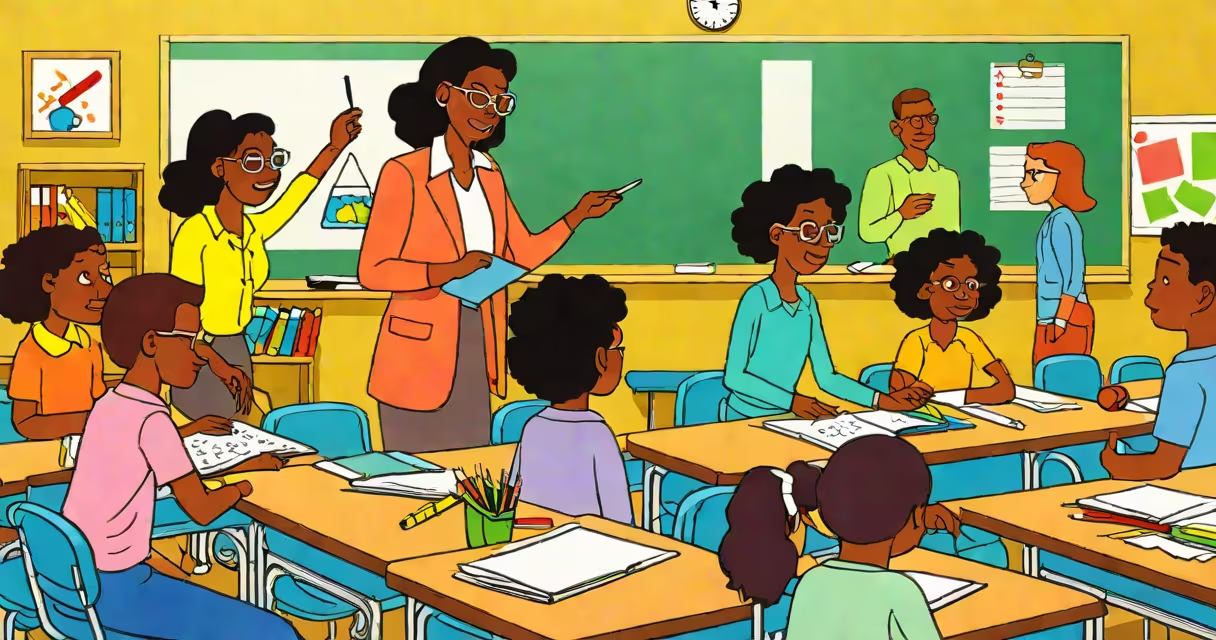
A classroom assistant is a trained individual who supports teachers in managing daily classroom operations, delivering targeted academic assistance, and promoting student engagement. They work under a teacher's direction to ensure a structured, inclusive, and productive learning environment. This role is common in public and private schools, especially in grades K-8.
Classroom assistants perform tasks such as organizing materials, monitoring student behavior, assisting with lesson delivery, and providing one-on-one support to students with special needs. Their presence allows teachers to focus on curriculum planning and direct instruction while ensuring students receive consistent attention throughout the school day.
According to the National Association of School Psychologists, classroom assistants contribute to improved student outcomes by reducing behavioral disruptions and increasing instructional time. The U.S. Department of Education notes that effective classroom support roles are linked to higher rates of student participation and reduced achievement gaps in underserved classrooms.
Classroom assistants operate within a structure of clear responsibilities defined by the school district and the lead teacher. They do not replace teachers but serve as extensions of the instructional team. Daily routines often begin with setting up learning stations, preparing handouts, and greeting students at the door.
During lessons, assistants may circulate among students, offering clarification on assignments, checking for understanding, or guiding small groups through hands-on activities. For example, during a math lesson on fractions, an assistant might work with a group of four students using fraction tiles to model addition problems, reinforcing concepts taught in whole-group instruction.
When a student becomes distracted or disengaged, the assistant intervenes with subtle redirection-such as asking a clarifying question or adjusting seating-to maintain focus. These micro-interactions prevent minor disruptions from escalating and preserve instructional momentum.
Classroom assistants vary by school system, funding model, and student population. The most common types include paraprofessionals, volunteers, and instructional aides.
| Type | Qualifications | Typical Responsibilities | Common Setting |
|---|---|---|---|
| Paraprofessional | High school diploma; certification in special education support; state-specific training | Assists students with IEPs, manages behavior plans, supports literacy and math interventions | Special education classrooms, inclusion settings |
| Volunteer | No formal certification required; background check | Reads aloud to students, helps organize supplies, supervises recess | General education classrooms, literacy programs |
| Instructional Aide | Associate degree or college credits in education; state credentialing | Delivers supplemental lessons, tracks student progress, prepares assessments | Elementary and middle schools, high-need districts |
One key distinction often missed is that not all classroom assistants are certified. Volunteers typically lack formal training and cannot provide academic instruction independently. Paraprofessionals and instructional aides, however, undergo standardized training and are accountable under federal regulations like IDEA (Individuals with Disabilities Education Act).
In my experience working with a Title I elementary school in Baltimore, a paraprofessional named Maria supported five students with dyslexia during reading blocks. She used multisensory techniques-like tracing letters in sand and using color-coded phonics cards-to reinforce decoding skills. Over one semester, those students showed a 30% increase in word recognition accuracy compared to baseline data.
Classroom assistants are most prevalent in schools serving high-need populations. Research from the Center for American Progress shows that schools with higher percentages of low-income students are 40% more likely to employ classroom assistants than wealthier districts. This reflects a strategic effort to close equity gaps in access to individualized support.
They are particularly valuable in classrooms with diverse learning needs. For instance, in a mixed-ability fifth-grade science class, an assistant might help set up lab stations, monitor safety protocols, and assist students with limited English proficiency by pairing visual aids with simplified language.
Another non-obvious fact: classroom assistants often serve as cultural bridges between families and schools. In multilingual communities, they may translate notices, explain school procedures, or advocate for student needs during parent-teacher conferences. This role extends beyond academics into social-emotional development and family engagement.
Classroom assistants are frequently mistaken for substitutes or tutors. Substitutes fill in temporarily when a teacher is absent. Tutors provide one-on-one academic remediation outside regular school hours. Classroom assistants are embedded in the daily structure of a classroom and work alongside the teacher throughout the school year.
Another misconception is that assistants only help struggling students. While they play a critical role in supporting students with Individualized Education Programs (IEPs), they also assist advanced learners by facilitating enrichment activities or managing peer tutoring sessions. In one middle school math class, an assistant ran a "Problem of the Week" challenge that engaged gifted students in collaborative problem-solving.
Some educators assume assistants reduce teacher autonomy. Data from the Learning Policy Institute shows that 78% of teachers report feeling more effective when paired with a classroom assistant. The assistant handles logistical tasks-like distributing materials or collecting homework-freeing the teacher to engage in deeper instructional planning.
A classroom assistant is a important part of modern education infrastructure. They improve classroom efficiency, support differentiated instruction, and strengthen student outcomes. When properly trained and integrated into school teams, they improve both teaching quality and student well-being.