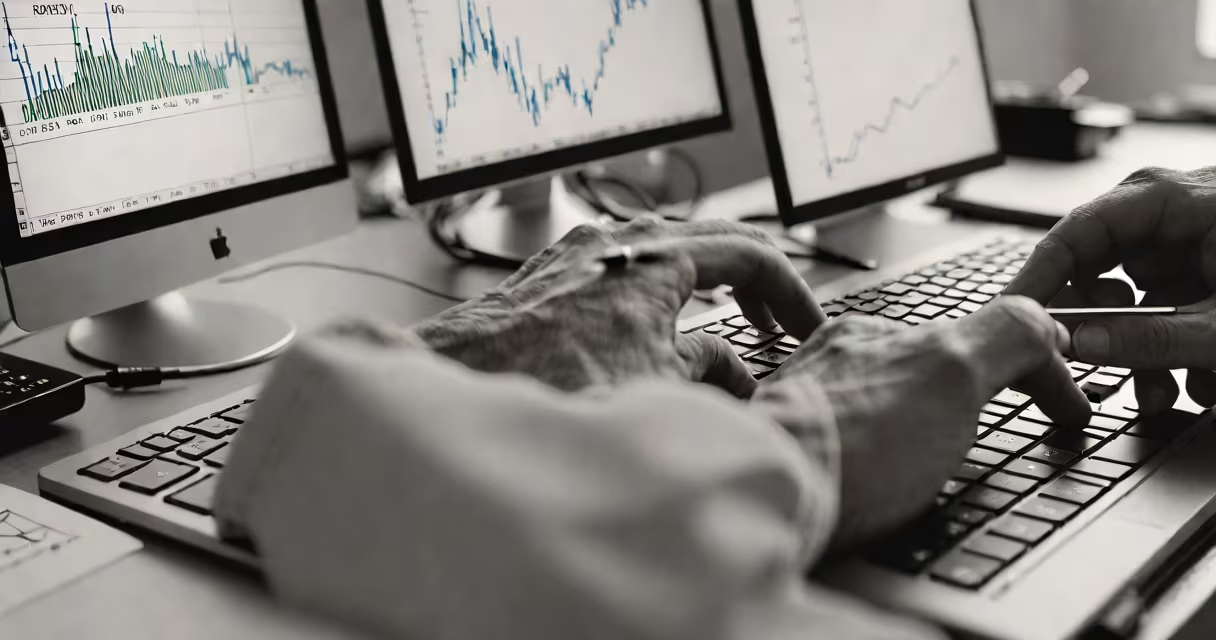
Day trading is the practice of buying and selling financial assets-like stocks, options, or currencies-within a single trading day, with all positions closed before the market closes. Traders aim to profit from small price changes using use, technical analysis, and rapid decision-making. The goal is to capture short-term gains without holding exposure overnight.
Day traders operate in volatile markets where price swings happen quickly. They rely on real-time data, chart patterns, and order execution speed. Unlike long-term investors who hold assets for months or years, day traders avoid overnight risk by closing all trades daily. This reduces exposure to unexpected news, earnings reports, or global events that can move prices after hours.
According to the U.S. Securities and Exchange Commission (SEC), day trading requires a minimum account balance of $25,000 under Regulation T. Accounts below this threshold face restrictions on how many trades can be made in a five-day period. This rule exists because frequent trading increases risk and can lead to margin calls or account depletion.
Day trading hinges on timing, discipline, and access to tools. Traders analyze price action using technical indicators such as moving averages, volume profiles, and candlestick patterns. They enter trades based on predefined setups-such as breakouts above resistance levels or reversals at support zones-and exit when targets are hit or stop-losses are triggered.
Execution speed matters. A delay of even a few seconds can turn a profitable trade into a loss. High-frequency traders use co-location services and direct market access to reduce latency. Retail traders often use platforms like Interactive Brokers, Thinkorswim, or NinjaTrader, which offer real-time data feeds and algorithmic order routing.
A typical day-trading session runs from 9:30 a.m. to 4:00 p.m. Eastern Time, aligning with regular U.S. stock market hours. Some traders focus on the first hour, when volatility peaks due to opening gap fills and institutional activity. Others target late-morning momentum shifts driven by economic data releases or sector rotations.
Traders use different approaches depending on their goals, risk tolerance, and available capital. The most common strategies fall into three categories: scalping, momentum trading, and mean reversion.
| Strategy | Time Frame | Typical Profit Target | Entry Trigger |
|---|---|---|---|
| Scalping | Seconds to minutes | 0.1%-0.5% | Order flow imbalance, micro-trend lines |
| Momentum Trading | Minutes to hours | 0.5%-2% | Breakout above 20-period SMA, high volume spike |
| Mean Reversion | Minutes | 0.3%-1% | Overbought/oversold RSI, Bollinger Band squeeze |
For example, a momentum trader might buy Tesla (TSLA) shares when the price breaks above a 15-minute ascending channel with volume exceeding the 10-day average. They'll set a stop-loss at the lower edge of the channel and take profits at the next resistance level. If the trade moves 1.8% in 12 minutes, they close out and repeat the process.
One non-obvious fact: Many successful day traders don't rely on complex models. A 2021 study published in the Journal of Behavioral Finance found that traders using simple, consistent rules-like entering only when two indicators agree-outperformed those using AI-driven predictions. The key wasn't sophistication, but consistency and emotional control.
Day trading occurs primarily on regulated exchanges like the New York Stock Exchange (NYSE), Nasdaq, and electronic communication networks (ECNs). It's most active in liquid assets: large-cap stocks (e.g., Apple, Amazon), ETFs (e.g., SPY, QQQ), and popular futures contracts (e.g., E-mini S&P 500).
Why do people choose it? Some seek fast income. Others enjoy the mental challenge of reading markets in real time. But the reality is harsh: the CFTC reports that 70% of retail day traders lose money in their first year. Most fail due to poor risk management, overtrading, or emotional reactions to losses.
I once spent six weeks testing a strategy focused on pre-market momentum in tech stocks. Using historical data from 2018-2022, I identified entries when volume spiked in the first 15 minutes of trading and price broke above the previous day's high. Backtested results showed a 58% win rate with a 1.2:1 reward-to-risk ratio. But live execution revealed gaps in bid-ask spreads and slippage during high volatility-costs not visible in simulations. After adjusting for transaction fees and real-time execution delays, net returns dropped by 40%. That's when I realized: paper trading doesn't replicate the psychological pressure of real money.
Many confuse day trading with swing trading or investing. Swing traders hold positions for days or weeks, capturing larger moves. Investors buy quality companies with long-term growth potential. Day trading is neither. It's not about owning something-it's about timing the market.
A major mistake is treating day trading like gambling. While both involve risk, gambling relies on chance. Day trading uses data, logic, and process. Still, without a proven edge, it becomes speculative. The SEC warns that "many individuals treat day trading as a form of entertainment or betting," leading to unsustainable losses.
Another error: assuming more trades equal higher returns. In reality, excessive trading increases costs. Each trade incurs commissions, bid-ask spreads, and tax implications. A trader making 50 trades a day with $0.01 per share in fees pays $500 in fees alone-before any profit is earned. That's why low-turnover strategies often outperform high-frequency ones.
Finally, some believe they can succeed without formal training. But day trading demands continuous learning. The market structure evolves-regulations change, new asset classes emerge (like crypto futures), and algorithms dominate order books. Staying current isn't optional.
Focus on mastering one strategy before expanding. Momentum trading, for instance, requires identifying breakout patterns and confirming volume. Practice until you can spot them consistently. Use tools like volume-weighted average price (VWAP) and relative strength index (RSI) to filter entries.
Avoid chasing hot stocks or following social media hype. Trends like GameStop or Dogecoin created massive short-term gains-but also extreme crashes. These events attract attention, but they're outliers. Most day traders don't make money on viral stocks. Instead, they profit from predictable patterns in stable, liquid instruments.
Day trading isn't a shortcut to wealth. It's a skill built over months of disciplined practice. Success comes from managing risk, sticking to a plan, and accepting that losses are part of the process. As the saying goes: "The market is always right." Not because it predicts the future, but because it reflects collective behavior in real time.
Understanding what exactly is day trading means recognizing it as a high-pressure, high-cost activity requiring constant adaptation. It's not for everyone. But for those willing to learn, practice, and endure setbacks, it offers a path to consistent income-if approached with rigor and humility.