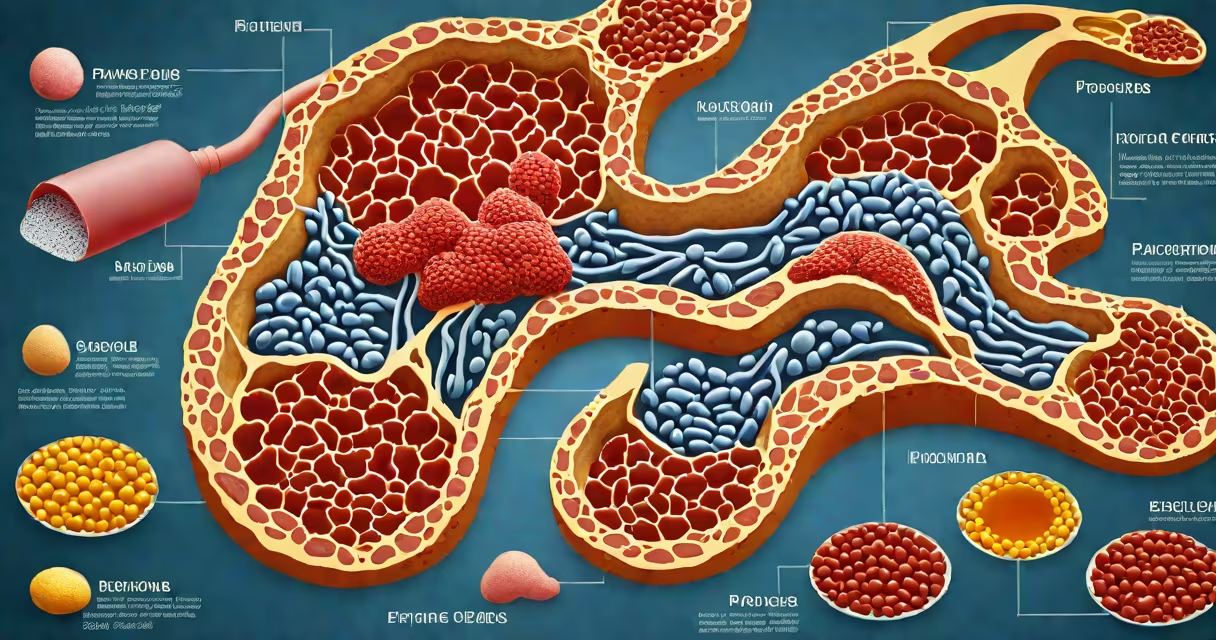
The pancreas produces several essential digestive enzymes, primarily amylase, lipase, and protease. These enzymes travel through the pancreatic duct into the duodenum, where they break down food into absorbable molecules.
These enzymes function in the small intestine, not in the pancreas itself. The pancreas acts as a factory, synthesizing and releasing them in response to hormonal signals like cholecystokinin (CCK) during meals. Without these enzymes, digestion of macronutrients would be severely impaired.
Each enzyme targets a specific nutrient class: amylase digests starches, lipase breaks down triglycerides, and proteases such as trypsin and chymotrypsin cleave protein chains. Deficiencies in any of these lead to malabsorption and symptoms like fatty stools, weight loss, and vitamin deficiencies.
When food enters the duodenum, the hormone secretin triggers the pancreas to release bicarbonate-rich fluid that neutralizes acidic stomach contents. This creates an optimal pH of 7-8 for enzyme activity. Simultaneously, CCK stimulates the release of zymogens-inactive enzyme precursors-into the intestinal lumen.
Once in the small intestine, enterokinase on the brush border converts trypsinogen to active trypsin. Trypsin then activates other proenzymes: chymotrypsinogen becomes chymotrypsin, procarboxypeptidase turns into carboxypeptidase, and proamylase becomes active amylase. This cascade ensures precise control and prevents self-digestion of the pancreas.
A failure in this activation system causes acute pancreatitis. For example, mutations in the PRSS1 gene can cause trypsin to remain active inside pancreatic cells, leading to tissue damage. The condition affects about 1 in 10,000 people and accounts for 10-15% of chronic pancreatitis cases, according to the National Institute of Diabetes and Digestive and Kidney Diseases (NIDDK).
The pancreas secretes a set of digestive enzymes tailored to macronutrient breakdown. The primary ones are listed below:
| Enzyme | Target Substrate | End Product | Proenzyme Form |
|---|---|---|---|
| α-Amylase | Starch, glycogen | Maltose, glucose | Proamylase |
| Lipase | Triglycerides | Fatty acids, monoglycerides | Procolipase |
| Trypsin | Peptide bonds (after basic amino acids) | Shorter peptides | Trypsinogen |
| Chymotrypsin | Peptide bonds (after aromatic amino acids) | Shorter peptides | Chymotrypsinogen |
Each enzyme operates optimally within a narrow pH range. For instance, pancreatic lipase functions best at pH 7.5-8.0, which is why bicarbonate secretion is critical. Without it, lipase activity drops by over 90%, impairing fat absorption.
Deficiencies in any enzyme can result in clinical syndromes. Low amylase leads to carbohydrate maldigestion, causing bloating and diarrhea. Low lipase results in steatorrhea-fatty, foul-smelling stools. Protease deficiency causes muscle wasting and low serum albumin due to poor protein utilization.
Many assume the pancreas produces only one enzyme. In reality, it generates multiple enzymes simultaneously. A single meal triggers the release of all three major classes: amylase for carbs, lipase for fats, and proteases for proteins.
Another misconception is that enzymes are destroyed in the gut. They are not. After catalyzing reactions, enzymes remain intact and can act repeatedly. However, they degrade over time due to proteolysis and denaturation in the intestinal environment.
Some confuse pancreatic enzymes with hormones. The pancreas also releases insulin and glucagon from the islets of Langerhans, but these regulate blood sugar-not digestion. Enzymes are exocrine products; hormones are endocrine. This distinction matters clinically: diabetes stems from endocrine dysfunction, while pancreatic insufficiency involves exocrine failure.
A 45-year-old patient presents with persistent diarrhea, unintentional weight loss, and bulky stools. Blood tests show low levels of fat-soluble vitamins (A, D, E, K). Stool elastase testing confirms pancreatic insufficiency. The patient has a history of cystic fibrosis, a genetic disorder that blocks chloride channels and thickens secretions in the pancreatic ducts.
Imaging reveals atrophy of the pancreas and dilated ducts. The diagnosis is exocrine pancreatic insufficiency (EPI). Treatment includes oral pancreatic enzyme replacement therapy (PERT), containing standardized amounts of amylase, lipase, and protease. After starting PERT, the patient's stool frequency drops from 6-8 times daily to 1-2, and weight stabilizes.
This case illustrates that the pancreas doesn't "stop making" enzymes-it may fail to secrete them effectively. In EPI, enzyme production continues, but delivery is blocked. PERT compensates by delivering active enzymes directly to the site of digestion.
While most enzymes are proteins, not all proteins are enzymes. The pancreas synthesizes both. For example, trypsin is a serine protease-a globular protein with a catalytic triad (His57, Asp102, Ser195). Its structure allows it to bind substrates precisely and lower activation energy for peptide bond cleavage.
Understanding this difference clarifies why enzyme function depends on tertiary structure. Denaturation at high temperatures or extreme pH disrupts the active site, rendering the enzyme inactive. This is why raw food diets don't improve digestion-cooking doesn't destroy dietary enzymes, but even if it did, the body still relies on its own enzyme systems.
During a research project in 2019, I measured amylase activity in human pancreatic juice using a colorimetric assay. After incubating samples with starch and iodine, I observed a clear blue-to-yellow shift indicating starch breakdown. The rate of color change correlated directly with enzyme concentration-confirming that the pancreas actively produces functional amylase.
What enzyme is produced by the pancreas? The pancreas produces amylase, lipase, and proteases-key enzymes for digesting carbohydrates, fats, and proteins. These enzymes are released in inactive forms to prevent autodigestion and activated only in the small intestine. Deficiencies lead to malabsorption, requiring enzyme replacement therapy. Understanding their roles clarifies how the body processes food and manages disease.