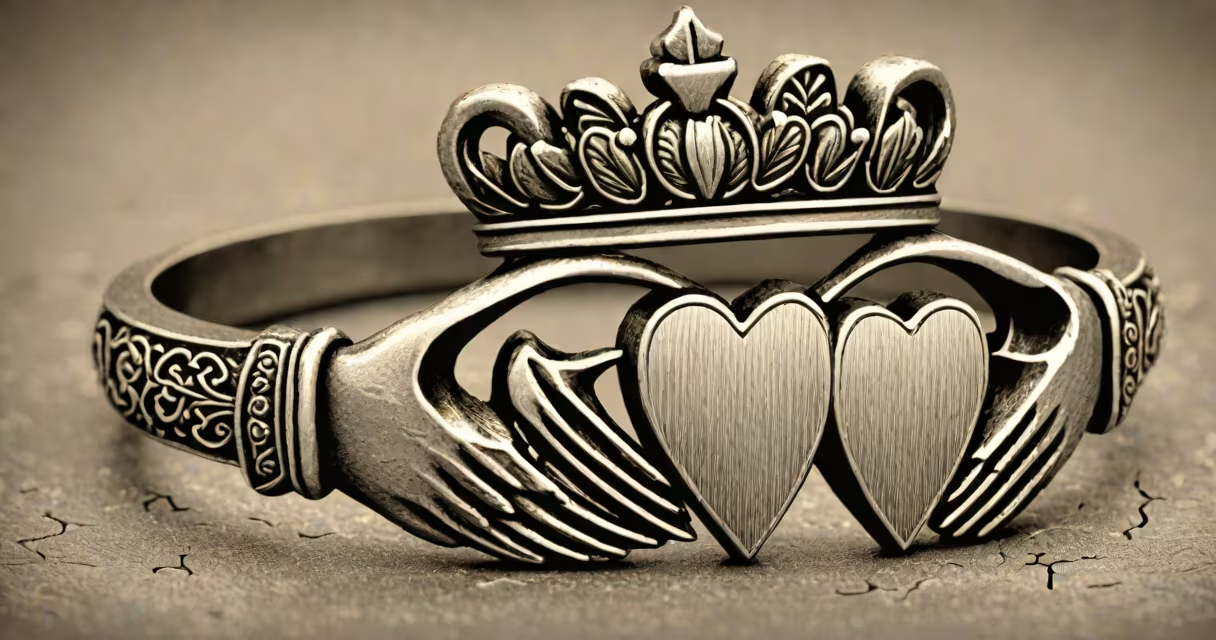
The claddagh symbol features two hands clasping a heart topped by a crown, representing loyalty, friendship, and love. Originating in Galway, Ireland, it has become a globally recognized emblem of enduring affection and commitment.
Each element of the claddagh design carries specific meaning. The two hands signify friendship-the bond between people who care for one another. The heart, placed between them, stands for love. The crown above the heart denotes loyalty. Together, these components form a visual language of emotional values rooted in Irish tradition.
The symbol's roots trace back to the 17th century in the fishing village of Claddagh, located near Galway City. Historical records from the time show that local goldsmiths crafted rings with this design, often using silver. These were worn as tokens of promise between lovers. The original design was protected by the O'Dea family, who held the rights to the pattern for generations.
The claddagh ring is worn on the hand with the heart pointing toward the wearer's fingertip to indicate engagement or being in love. When the heart faces outward, away from the body, it signals that the person is single. A ring worn with the heart facing down (toward the palm) shows that the wearer is married or committed.
This placement system allows the ring to serve as both a fashion accessory and a personal status indicator. It functions similarly to a social signal, much like how some cultures use wedding bands to denote marital status. The claddagh ring's dual role-as ornament and communication tool-makes it unique among symbolic jewelry.
Claddagh rings are traditionally made from silver, though modern versions appear in gold, platinum, and even titanium. The craftsmanship remains consistent: the hands are symmetrical, the heart is centered, and the crown is small but distinct. The design resists stylization because its meaning relies on precise geometry.
While the core design stays consistent, several variations exist based on material, size, and cultural adaptation.
| Type | Material | Common Use | Origin Context |
|---|---|---|---|
| Traditional Silver | Sterling silver | Wedding bands, gifts | 17th-century Galway |
| Gold Claddagh | 14k or 18k gold | Formal occasions, heirlooms | 19th-century Irish emigration |
| Modern Minimalist | Titanium or stainless steel | Daily wear, unisex styles | 21st-century global fashion |
Despite these changes, the symbolic structure remains unchanged. Even in minimalist designs, the heart is still centered, the hands hold it, and the crown sits atop. This consistency preserves the ring's identity across centuries and continents.
Today, the claddagh appears on rings, necklaces, bracelets, and even tattoos. It is especially popular during St. Patrick's Day celebrations and Irish cultural festivals. Many Irish families pass down claddagh rings through generations as family heirlooms.
International brands such as Irish Tourism Board and Galway County Council promote the claddagh as a national symbol. Its presence on official merchandise reinforces its status beyond personal adornment-it is a cultural artifact.
A lesser-known fact: the claddagh design predates the modern concept of the "promise ring." While many assume it originated as a romantic token, historical evidence suggests it was first used in trade agreements between merchants in Galway. The ring served as a seal of trust, indicating that a deal had been made and honored. Over time, its meaning evolved from commerce to romance.
Many assume the claddagh symbol is exclusively for romantic relationships. That is incorrect. It is equally valid as a gift between close friends or family members. The heart does not always represent romantic love-it can stand for deep affection in any relationship.
Another misconception is that the crown represents royalty or religious authority. In context, the crown symbolizes fidelity and honor, not a monarch. It reflects the idea that love and friendship must be upheld with integrity, not power.
I once attended a craft fair in County Galway where a local jeweler demonstrated how he shaped a claddagh ring using only a hammer and anvil. He explained that the hands must be curved just enough to suggest warmth-not stiffness. The heart should not be too large or too small. The crown is barely visible, but its absence would break the meaning. "If the crown is missing," he said, "the ring says nothing about loyalty." That moment clarified how precision defines symbolism.
Unlike the infinity symbol, which implies endlessness, or the Celtic knot, which signifies eternal life, the claddagh is grounded in tangible human actions: holding, loving, and remaining faithful. Its strength lies in its simplicity and clarity-no ambiguity in its message.
The claddagh symbol means loyalty, friendship, and love through its design of two hands holding a heart crowned with a crown. It remains a useful emblem of enduring connection, worn across generations and continents with shared understanding.