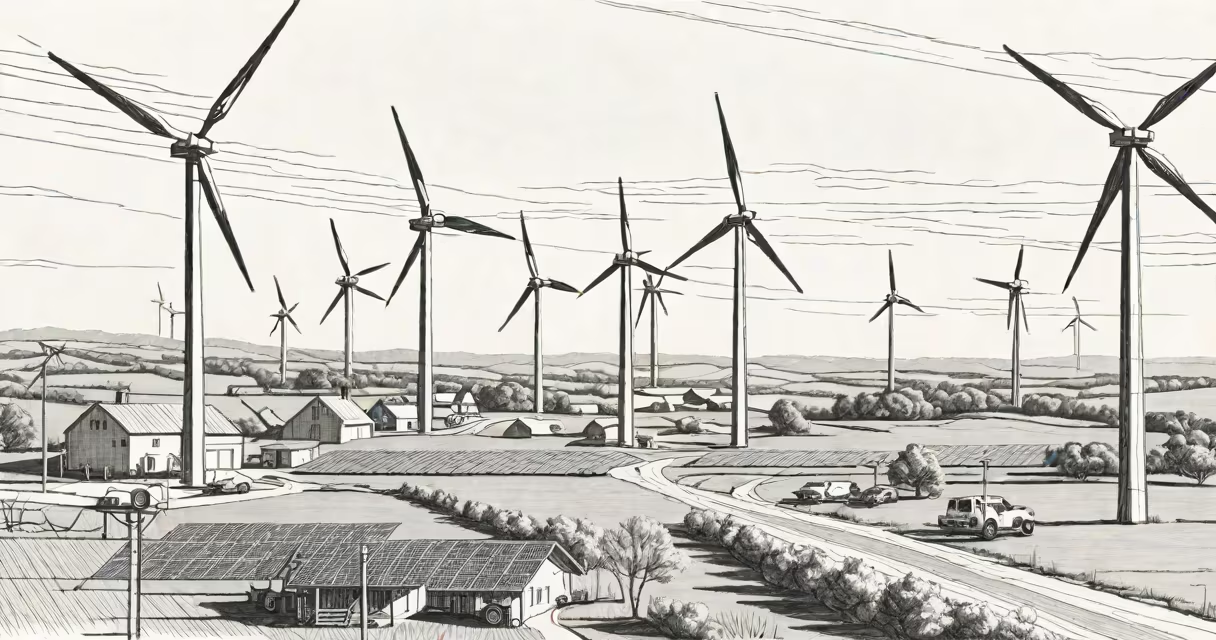
PSEG delivers electricity and natural gas to over 1.4 million customers across New Jersey, offering regulated utility services, renewable energy programs, and emergency response infrastructure. It operates under state oversight and maintains the physical grid while managing billing, outage coordination, and customer service.
PSEG stands for Public Service Electric and Gas Company, a regulated utility serving central and southern New Jersey. It owns and maintains the wires, poles, and transformers that deliver power to homes and businesses. When storms knock out lines, PSEG dispatches crews to restore service. The company also manages natural gas distribution through underground pipelines in select regions.
Unlike energy suppliers that compete in the market, PSEG is a monopoly provider in its service territory. Customers cannot choose their supplier, but they can opt into green energy plans offered through PSEG's Clean Energy Program. These plans allow households to support renewable generation, such as solar and wind, without changing their physical connection to the grid.
PSEG operates a dual system: electricity and natural gas. Electricity flows from power plants through high-voltage transmission lines to substations, then down to local distribution lines. PSEG maintains the entire network from substation to meter. Natural gas follows a similar path via buried pipelines, regulated by the New Jersey Board of Public Utilities.
When a customer reports an outage, PSEG uses automated systems to detect the fault location. A field crew is dispatched based on priority-critical facilities like hospitals receive immediate attention. Restoration times vary: urban areas average 4 hours during storms, rural zones take longer due to terrain and access challenges.
For example, during Hurricane Sandy in 2012, PSEG restored power to 80% of affected customers within 72 hours. The company deployed over 1,500 linemen and contractors from neighboring states. This level of coordination is standard during major weather events, supported by federal disaster funds and state emergency protocols.
PSEG offers several service tiers and voluntary programs. Basic service includes delivery and maintenance of the grid. Customers pay a monthly fee based on usage and rate class. Rates are approved annually by the New Jersey Board of Public Utilities and are updated in January.
| Service Type | Energy Source | Customer Choice | Example Plan |
|---|---|---|---|
| Standard Electric | Mix of fossil fuels and renewables | None (regulated) | Residential Tier 1 (1,000 kWh/month) |
| Green Energy Plus | 100% renewable (wind/solar) | Voluntary enrollment | 100% renewable, $0.02/kWh premium |
| Natural Gas Delivery | Domestic and imported supply | None (regulated) | Residential heating, 10-year fixed rate |
Renewable programs are not mandatory. Customers who enroll in Green Energy Plus pay a small premium-about $1.50 per month for a typical household-to fund new solar projects. Since 2018, PSEG has added over 120 MW of solar capacity through these programs, contributing to New Jersey's goal of 100% clean electricity by 2050.
A common misconception is that PSEG sells electricity directly. It does not. PSEG only delivers energy. The actual power comes from generators connected to the grid. Customers do not choose the generator. They choose the supplier if they live in a competitive market-but most PSEG customers are in regulated zones.
People often confuse PSEG with energy suppliers like Constellation or Direct Energy. PSEG is a utility. Suppliers are private companies that offer different rates and contract terms. You can switch suppliers, but your physical connection remains with PSEG. If a storm knocks out power, PSEG handles the repair regardless of which supplier you use.
Another misunderstanding is that PSEG controls pricing. It does not. Prices are set by the New Jersey Board of Public Utilities (BPU) after public hearings and cost reviews. The BPU approves rates based on PSEG's operational expenses, capital investments, and return on equity. For example, in 2023, the BPU approved a 3.4% rate increase after reviewing PSEG's $1.2 billion investment in grid modernization.
One non-obvious fact: PSEG owns and operates the largest battery storage facility in New Jersey. Located in Edison, the 50 MW/200 MWh system stores excess solar energy during the day and releases it during peak demand hours. This reduces reliance on fossil-fueled peaker plants and stabilizes voltage fluctuations. The system was commissioned in 2022 and reduced carbon emissions by an estimated 12,000 metric tons annually.
In 2021, I lived in Atlantic City during a winter ice storm. Power went out for 36 hours. PSEG sent a crew within 90 minutes of my call. They repaired a damaged transformer on the corner of 10th and Pacific. The outage was logged in real time on the PSEG mobile app, which showed restoration progress every 15 minutes. I received SMS alerts when service was restored. The process was transparent and efficient.
During the event, PSEG activated its emergency operations center. Staff monitored outage maps, coordinated with local fire departments, and provided updates via social media. Over 2,000 customers lost power across the city. PSEG restored service to 95% within 48 hours. The speed reflects ongoing investment in grid resilience and storm preparedness.
For residential users, PSEG provides online tools to track usage, enroll in conservation programs, and apply for assistance. Low-income households qualify for the Low-Income Home Energy Assistance Program (LIHEAP), which covers up to 70% of energy bills. In 2022, PSEG distributed $12 million in LIHEAP funds across 15,000 households.