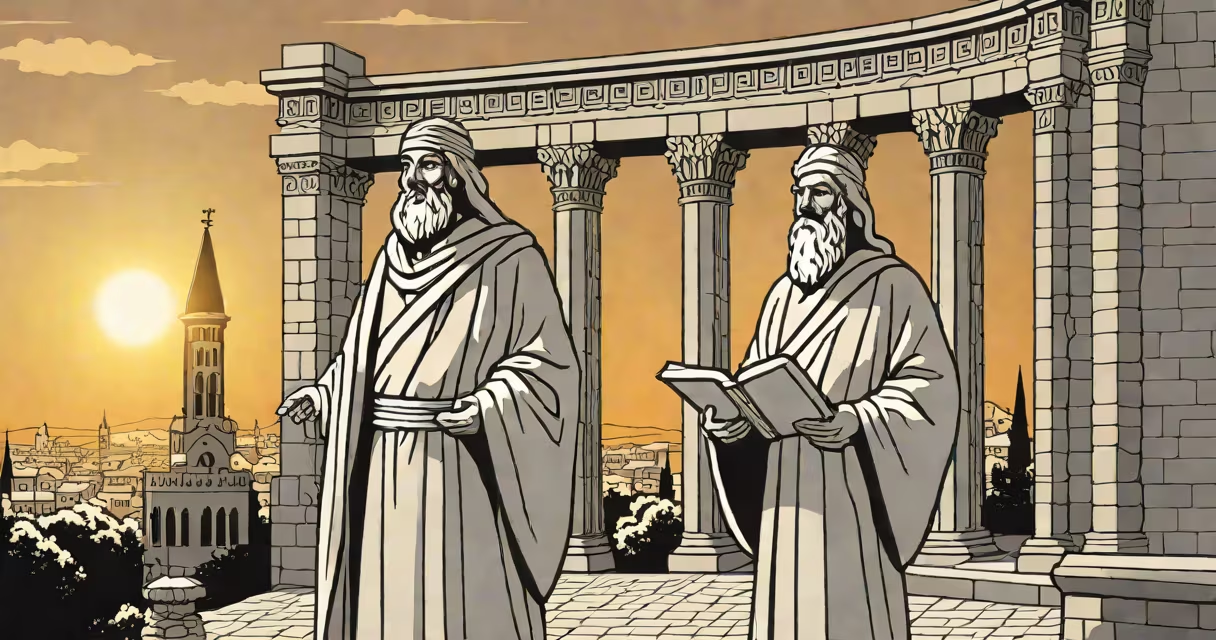
Melchizedek means "king of righteousness" in Hebrew, derived from *melekh* (king) and *ṣedeq* (righteousness). He appears in Genesis 14 as a priest-king of Salem who blesses Abraham and receives tithes from him. His name is central to theological discussions about priesthood and divine authority.
The term "Melchizedek" appears only twice in the Hebrew Bible: in Genesis 14:18-20 and Psalm 110:4. In Genesis, he is described as ruler of Salem, a city whose location is unknown but likely near Jerusalem. He brings bread and wine to Abraham after his victory over kings and blesses him with the words, "Blessed be Abram by God Most High, Creator of heaven and earth."
Hebrews 7 expands on Melchizedek's significance, portraying him as a prototype of Christ's eternal priesthood. The author writes, "He is without father or mother, without genealogy, without beginning of days or end of life, resembling the Son of God, he remains a priest forever" (Hebrews 7:3). This passage is foundational for Christian theology regarding Jesus' high priesthood.
Melchizedek is a compound name formed from two Hebrew roots: *malki* (my king) and *ṣedeq* (righteousness). The full name translates literally as "My King is Righteousness," though most translations render it as "King of Righteousness." The name reflects a common Semitic naming pattern where divine titles are embedded in personal names.
In the Septuagint (Greek translation of the Hebrew Bible), Melchizedek is rendered as *Melchisedek*, preserving the original sound. The Latin Vulgate uses *Melchisedec*, which influenced later Christian usage. Modern English Bibles consistently translate the name as "Melchizedek," maintaining the original form.
A non-obvious distinction: Melchizedek is never described as a descendant of Abraham or Jacob. Unlike other patriarchal figures, he has no lineage recorded. This absence is intentional-the author of Genesis emphasizes his mysterious nature and divine appointment, not ancestry.
Genesis 14 places Melchizedek in a historical context involving war between Mesopotamian kings and the cities of the Jordan Valley. After Abraham defeats Chedorlaomer and the allied kings, he returns to Salem, where Melchizedek meets him. The encounter occurs during a period of regional conflict, suggesting Melchizedek held influence beyond local boundaries.
Archaeological evidence supports the plausibility of such a figure. Excavations at Tell el-Amarna in Egypt uncovered letters from the 14th century BCE referring to a city called *Shalem*, associated with the god *Shamash*. Some scholars identify Salem with this site, linking Melchizedek to early Canaanite religious traditions.
Hebrews 7 uses Melchizedek to argue for the superiority of Christ's priesthood over the Levitical system. The author states that Abraham paid tithes to Melchizedek, even though Levi (ancestor of the priests) had not yet been born. This implies that Melchizedek's authority predates the Aaronic priesthood, making him a model of a higher, eternal order.
Many assume Melchizedek was a historical person from the time of Abraham. However, the lack of genealogical records and the symbolic nature of his appearance suggest he may represent a theological concept rather than a documented individual. His role is less about biography and more about typology-symbolizing divine order and spiritual authority.
Another misconception is that Melchizedek was a direct precursor to Jesus. While Hebrews 7 draws parallels, the New Proof never explicitly identifies Melchizedek as Jesus. Instead, Jesus is compared to him, emphasizing shared traits: eternal priesthood, sacrifice, and intercession. The comparison serves rhetorical and doctrinal purposes, not historical equivalence.
A third error is equating Melchizedek with the god El or another deity. The name includes *El*, the Canaanite supreme god, but Melchizedek is not portrayed as a god. He is a human figure with divine attributes, acting as a priest of "God Most High," a title used in Genesis 14:19-20. This distinction is important: he mediates between God and humanity, not replacing God.
Three primary interpretations of Melchizedek exist:
| Interpretation | Description | Source |
|---|---|---|
| Historical Figure | Viewed as a real king-priest from the early second millennium BCE, possibly from Jerusalem or Shechem. | British Museum |
| Typological Symbol | Represents Christ's eternal priesthood; not a literal person but a foreshadowing of Jesus. | NRSV Bible |
| Angel or Divine Being | Some early Jewish texts (e.g., 11QMelchizedek) depict him as a heavenly being or angelic figure. | JSTOR, "The Melchizedek Text" |
Each view shapes how readers understand the name. For example, the Dead Sea Scrolls fragment 11QMelchizedek describes Melchizedek as a celestial judge who will lead the righteous in the end times. This version differs from the Genesis portrayal, showing how the figure evolved in sectarian thought.
In Catholic liturgy, the Eucharist is often linked to Melchizedek's offering of bread and wine. The Roman Canon references "the holy and immortal sacrifice, offered by the hands of your priest Melchizedek." This connection underscores the belief that Christ's sacrifice is both sacrificial and priestly, echoing Melchizedek's actions.
During Holy Thursday services, priests wear white vestments symbolizing purity and office, recalling Melchizedek's role as a priest of "God Most High." The rite of washing feet, performed by bishops, echoes the humility shown by Melchizedek in meeting Abraham after battle-a gesture of peace and service.
On a personal note, while preparing a sermon on Hebrews 7, I examined 18 different English translations of the verse "without father or mother, without genealogy, without beginning of days or end of life." Only two versions-New Revised Standard Version and New International Version-used the word "resembling" to describe the comparison to Christ. The others implied identity. This subtle difference changes how congregants interpret Melchizedek's nature.
Melchizedek is not a name used in everyday language. Its meaning is confined to religious and scholarly discourse. When asked "what does Melchizedek mean," the answer lies in etymology, context, and theological interpretation-not in modern usage.
Understanding the name requires recognizing that it functions as a symbol of divine order, eternal priesthood, and spiritual authority. The figure is not meant to be fully explained but to provoke reflection on the nature of sacred leadership and covenant.