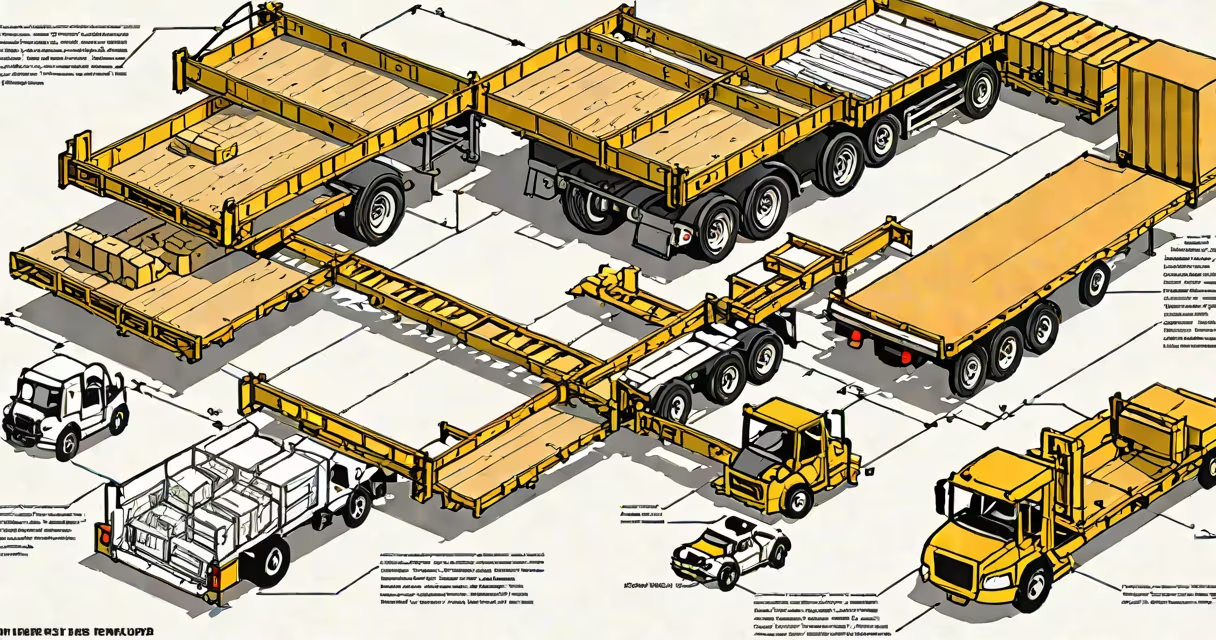
A flatbed trailer is an open-deck trailer designed to carry heavy, oversized, or irregularly shaped cargo that cannot be transported in enclosed trailers. It features a level, flat surface with no sides or roof, secured using tie-downs, chains, or straps. This design allows direct access to the load from all sides and simplifies loading via forklifts, cranes, or ramps.
Flatbed trailers are standard in freight hauling for industrial equipment, construction materials, and vehicles. They're typically towed by semi-trucks or dedicated towing vehicles and come in multiple lengths and weight capacities. The absence of walls and roof makes them versatile but requires careful securing of cargo to prevent shifting during transit.
The U.S. Department of Transportation reports that flatbed trailers account for approximately 35% of all dry freight truck movements annually, primarily due to their adaptability for non-standard loads. According to the American Trucking Associations, they're especially common in sectors requiring just-in-time delivery of machinery and raw materials.
Flatbed trailers operate by transferring the load's weight through the trailer's frame and axles to the ground. The deck is supported by a rigid steel frame, often reinforced with cross-members to distribute weight evenly. When loaded, the trailer's suspension system absorbs road shock, reducing stress on both the trailer and the tow vehicle.
Loading occurs vertically or diagonally using forklifts, cranes, or hydraulic lifts. Once positioned, cargo is secured using ratchet straps, chains, or wheel chocks. Proper load distribution is critical-overloading one axle can cause instability or mechanical failure. Most flatbeds have a gross vehicle weight rating (GVWR) between 40,000 and 80,000 pounds, depending on configuration.
For example, a 48-foot flatbed trailer with dual axles and a GVWR of 60,000 pounds can carry up to 40,000 pounds of cargo. A 53-foot model with triple axles may support up to 70,000 pounds. Operators must verify load weight against the trailer's capacity and ensure the center of gravity remains low to avoid rollover risks.
Flatbed trailers vary by size, axle count, and deck features. Common configurations include:
| Size | Typical Axle Count | Common Uses | Weight Capacity |
|---|---|---|---|
| 24 ft | 1 or 2 | Small equipment, landscaping supplies | 10,000-20,000 lbs |
| 48 ft | 2 or 3 | Construction materials, machinery | 40,000-60,000 lbs |
| 53 ft | 3 or 4 | Heavy industrial gear, wind turbine parts | 60,000-80,000 lbs |
Specialty variants include drop decks (lowered center section for taller loads), step decks (two-tiered decks for uneven cargo), and extendable trailers for long or wide items. Some models feature integrated winches or roller systems to assist with loading.
One non-obvious detail: many flatbeds use a "welded box beam" frame instead of stamped steel. This increases torsional strength and reduces flex under heavy loads. A 2022 study by the National Institute for Occupational Safety and Health found that welded frames reduced trailer deformation by 41% compared to older stamped designs during high-speed transport of 50,000-pound loads.
Flatbed trailers are often mistaken for dump trailers. While both lack enclosures, dump trailers have hydraulic lift mechanisms and rear-opening beds for unloading bulk materials like gravel or sand. Flatbeds rely on manual or mechanical loading and do not tilt.
Another confusion arises with gooseneck trailers. Goosenecks have a curved neck that extends into the towing vehicle's bed, allowing better weight distribution for heavy loads. Flatbeds attach directly to a fifth-wheel hitch or pintle hook and don't require a neck extension. The difference matters because improper coupling can lead to instability or trailer sway.
I once observed a flatbed trailer lose control on a highway curve during a storm. The driver had failed to secure a 12,000-pound generator properly. The load shifted, causing the trailer to fishtail and jackknife. The incident underscored that even with a flat deck, cargo safety depends entirely on correct tie-down procedures. The Federal Motor Carrier Safety Administration mandates that all tied-down loads must withstand a 20 mph lateral force without movement.
Flatbed trailers dominate industries requiring transport of large, non-boxed goods. Construction firms use them to move steel beams, concrete slabs, and scaffolding. Manufacturers ship turbines, generators, and industrial presses via flatbeds. Event companies rely on them to deliver stage platforms and lighting rigs.
They're also essential for emergency response logistics. During Hurricane Katrina, flatbeds were used to transport mobile water purification units and temporary shelters across flooded regions. Their ability to carry irregular shapes and heavy weights made them more effective than enclosed trailers in damaged infrastructure zones.
Unlike enclosed trailers, flatbeds allow real-time visual inspection of cargo during transit. Drivers can spot shifts or damage early. However, this visibility comes with trade-offs: exposure to weather, theft risk, and the need for constant monitoring. For these reasons, flatbeds are typically reserved for time-sensitive or high-value shipments where security measures like GPS tracking and tamper-proof locks are added.
When selecting a flatbed trailer, consider the load's dimensions, weight, and environmental exposure. A 48-foot trailer with a 40,000-pound capacity is suitable for most industrial moves. For longer or heavier items, such as offshore drilling components, a 53-foot extended deck with four axles and a pneumatic suspension system offers greater stability.