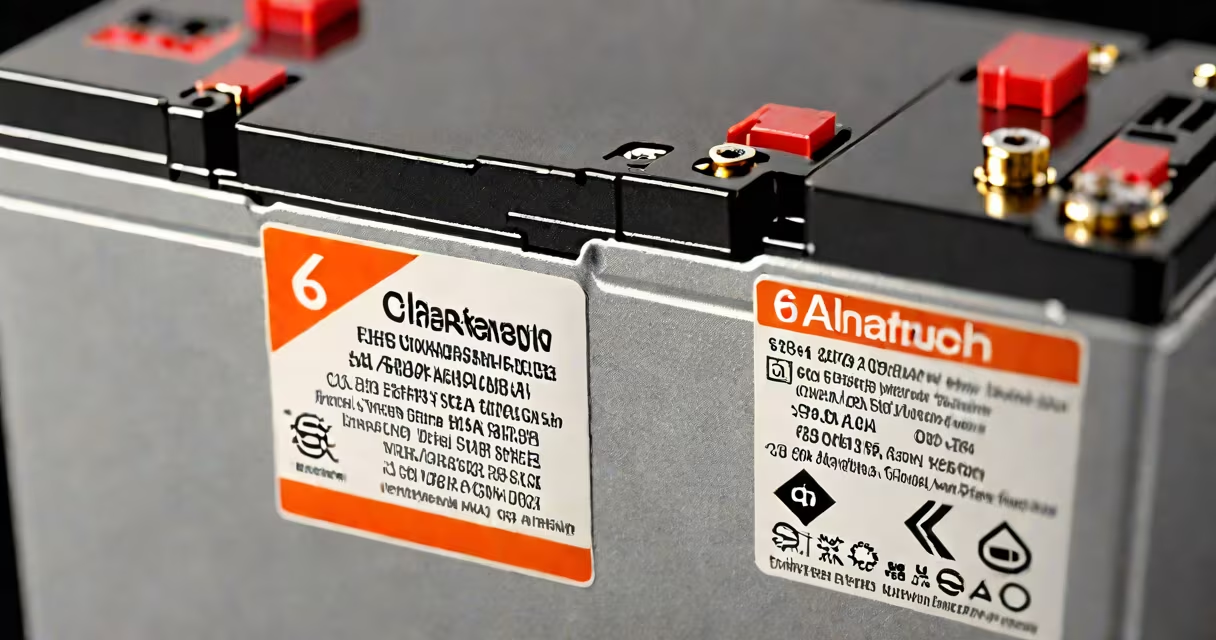
6ah on a battery means it can deliver 6 amps of current for one hour, or 1 amp for six hours, under standard conditions. This rating measures the battery's charge capacity, indicating how long it can power a device before needing recharge.
Battery capacity is measured in amp hours (Ah), a unit derived from electrical current multiplied by time. A 6ah battery stores enough energy to supply 6 amperes continuously for one hour. The higher the amp hour number, the longer the battery lasts under a given load. This metric is critical for comparing batteries used in tools, scooters, solar systems, and backup power supplies.
For example, a 12V 6ah battery can provide 72 watt-hours of energy (12 volts × 6 amp hours = 72 watt-hours). That's enough to run a 12-watt LED light for 6 hours, or a 6-watt fan for 12 hours. Real-world runtime varies due to efficiency losses, temperature, and discharge rate.
Amp hours describe how much charge a battery holds, not its voltage. Voltage determines the electrical pressure, while amp hours determine how long that pressure can last. A 6ah battery at 12 volts delivers 72 watt-hours of total energy. A 6ah battery at 6 volts delivers only 36 watt-hours - half the energy despite the same amp hour rating.
Discharge rate affects actual capacity. Batteries lose effective capacity when drained quickly. A 6ah battery rated at a 20-hour discharge (0.3A) may only deliver 4.5ah if discharged at 3A. This is due to internal resistance and chemical inefficiencies under high load. Always check the discharge rate specified by the manufacturer.
For context, a typical car battery is 50-100ah, designed to start engines. A 6ah battery is suited for smaller devices like electric wheelchairs, garden tools, or uninterruptible power supplies (UPS). It's too small for vehicles but ideal for portable applications needing moderate runtime.
Lead-acid batteries commonly use 6ah ratings. These are affordable, widely available, and used in older electric scooters, solar lights, and alarm systems. They're heavy and have shorter lifespans than lithium-ion, but they're stable and easy to maintain.
Lithium-ion batteries also come in 6ah configurations. These are lighter, more efficient, and retain charge better over time. A 6ah lithium-ion battery powers cordless drills, drones, and e-bikes. However, they require protection circuits to prevent overcharging or overheating.
| Battery Type | Weight (approx.) | Typical Use | Expected Lifespan |
|---|---|---|---|
| Sealed Lead-Acid (SLA) | 10-15 lbs | UPS, security cameras, small scooters | 2-5 years |
| Lithium-Ion (Li-ion) | 2-4 lbs | Cordless tools, e-bikes, drones | 3-7 years |
When selecting a 6ah battery, match the chemistry to your environment. SLA batteries tolerate heat and vibration well but degrade faster in cold. Li-ion performs better in variable temperatures but risks thermal runaway if damaged.
People often confuse amp hours (Ah) with milliamp hours (mAh). A 6ah battery equals 6,000 mAh. Devices like smartphones use mAh - a 5,000mAh phone battery is smaller than a 6ah scooter battery. The units differ only by scale, not concept.
Another error is assuming higher Ah always means better performance. A 6ah battery won't power a 100W motor for long - even though it has decent capacity. Runtime depends on both Ah and voltage. A 12V 6ah battery can run a 12W device for 6 hours, but a 24V 6ah battery can run a 24W device for the same duration.
Some assume 6ah means "6 hours of use." That's only true for a 1-amp load. A 6ah battery powering a 6-amp device lasts just one hour. Always calculate runtime using: Runtime (hours) = Battery Capacity (Ah) ÷ Load Current (A).
Consider a 350W electric scooter using a 12V 6ah battery. The motor draws about 29A at full throttle (350W ÷ 12V ≈ 29.2A). At this rate, the battery lasts roughly 12 minutes (6Ah ÷ 29.2A ≈ 0.2 hours). At low speed, drawing 3A, it runs for 2 hours.
This shows why manufacturers list battery life under specific conditions. A scooter advertised as "up to 2 hours" assumes moderate riding. Heavy use or hills reduce that time. Always test under expected loads.
I once replaced the 6ah battery in my electric wheelchair with a 10ah model. The original lasted 1.5 hours on flat ground. The upgrade extended range to 2.5 hours. But the new battery weighed 40% more, requiring adjustments to the mounting bracket. Size and weight matter beyond capacity.
When evaluating batteries, compare both amp hours and voltage. A 6ah battery at 12V stores 72 watt-hours. A 10ah battery at 12V stores 120 watt-hours - 67% more energy. But a 6ah battery at 24V stores 144 watt-hours - double the energy of the 12V version.
Always check the discharge rate. A 6ah battery rated at C/20 (0.3A) gives accurate capacity. One rated at C/5 (1.2A) may only deliver 4.5ah. Look for "20-hour rate" on labels for reliable comparisons.
For deeper insight into battery specs, see this guide. To understand how 6ah compares to larger capacities like 5,000mAh, explore what does 5000 mah battery mean.
Understanding what 6ah means on a battery ensures correct selection for devices. It's not just a number - it's a predictor of runtime, efficiency, and system compatibility.