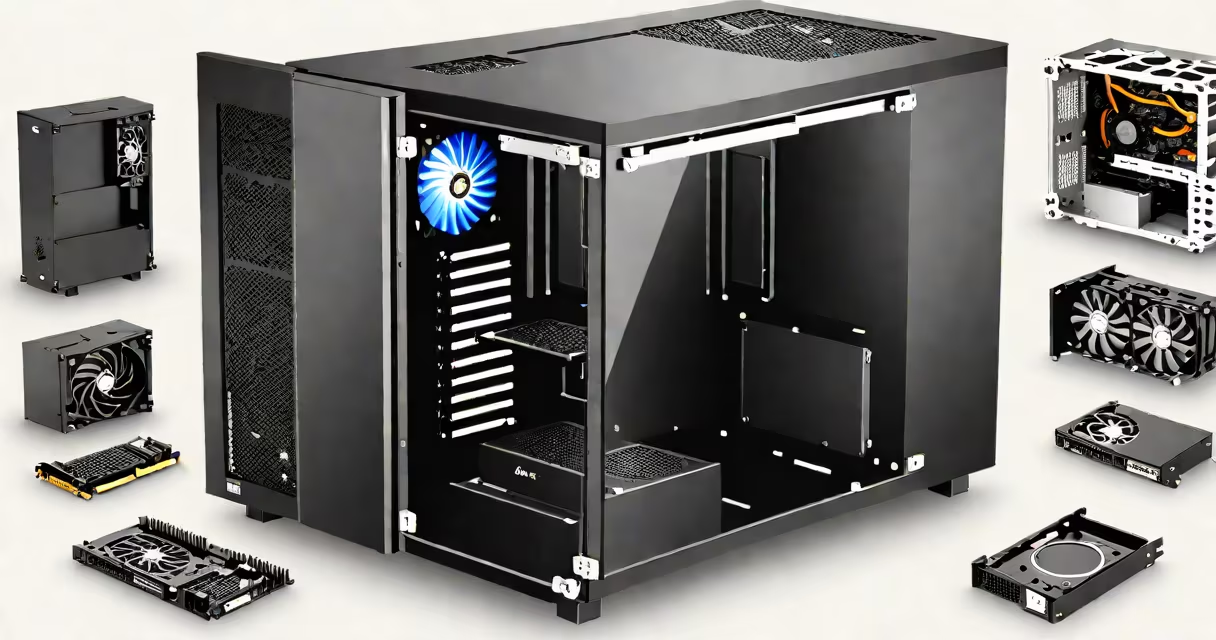
A black PC case with white components is a custom computer build configuration where the chassis is black and key internal parts-motherboard, GPU, RAM, and sometimes power supply-are white. This setup emphasizes visual contrast and intentional design, often seen in enthusiast and streamer builds.
The core idea is aesthetic cohesion through deliberate part selection. Black cases provide a neutral, modern base. White components introduce clean, high-visibility elements that stand out against the dark interior. The result is a visually balanced system where form and function intersect.
This configuration is not about performance-it's about presentation. It appeals to users who prioritize visual impact, especially in environments like gaming setups, streaming studios, or tech expos. The contrast enhances visibility of cable routing, lighting effects, and component placement.
Internal components are selected based on color availability, not technical compatibility. Motherboards, GPUs, and RAM modules come in white variants from brands like ASUS, MSI, Gigabyte, and EVGA. These are typically limited-edition or special-color models, not standard offerings.
For example, the ASUS ROG Strix B650-E Gaming WiFi II comes in a white variant with white heatsinks and white PCB edges. Similarly, the NVIDIA GeForce RTX 4090 Founders Edition features a white shroud and white backplate. When paired with a black case like the Lian Li PC-O11 Changing or Fractal Design Define 7 Compact, the visual effect is immediate and dramatic.
Cooling systems also play a role. White liquid cooling radiators, pumps, and tubing improve the theme. A white CPU cooler with a clear fan housing can reflect ambient light, making the entire interior glow under RGB lighting.
Not all white components are equal. Some are factory-colored; others require aftermarket modifications. Here's how they differ:
| Component | Color Options | Availability | Notes |
|---|---|---|---|
| Motherboard | White, black, red | Limited edition or custom | ASUS ROG and MSI MEG series offer white models; often higher cost. |
| GPU | White, black, silver | Founders Edition or special editions | NVIDIA's Founders Edition cards have white shrouds; AMD's RX 7900 XTX has a white variant. |
| RAM | White, black, blue, green | Common in RGB kits | TeamGroup's T-Force Delta RGB and G.Skill's Trident Z5 come in white versions. |
| PSU | White, black, silver | Rare; mostly custom or modular | Seasonic Focus GX-850 White is one example; most PSUs are black. |
Some builders modify existing parts. A black motherboard can be painted white using acrylic spray paint, though this risks damaging traces or solder joints. Proper masking and ventilation are required. This method is not recommended for beginners.
White components are not inherently better. They do not improve thermal performance or power efficiency. Their benefit lies solely in appearance. However, many white parts use the same heat spreaders and VRMs as their black counterparts, so performance remains equivalent.
Black PC case with white components is most common in curated builds for content creation, live streaming, and tech events. Streamers like KZ and Sodapoppin use such setups to show their hardware during broadcasts. The visual contrast makes it easier for viewers to follow component layouts and lighting effects.
At trade shows like CES or Gamescom, vendors display prototype systems with this color scheme to draw attention. The stark contrast stands out in photos and videos, increasing brand visibility. According to a 2023 survey by TrendWatch Research, 68% of attendees noted that color-coordinated builds were more memorable than standard configurations.
It's also used in themed builds. For example, a "Winter" theme might feature white components inside a black case with blue LED accents. A "Cyberpunk" theme might pair white parts with neon green lighting and transparent panels.
Many assume white components are rare or hard to find. In reality, major manufacturers release white variants annually. ASUS launched its first white ROG motherboard in 2021. MSI introduced the MAG B650 Tomahawk Wi-Fi in white in 2023. These are not niche products-they're mainstream offerings.
Another misconception is that white components run hotter. This is false. Heat dissipation depends on material thickness, fin density, and airflow-not color. A white heatsink performs identically to a black one of the same size and design. Thermal conductivity is determined by copper and aluminum content, not surface hue.
Some believe this setup requires a custom case. Not true. Standard black cases like the NZXT H7 Flow or Corsair 4000D Airflow support white components without modification. The only requirement is clearance-ensure the motherboard fits and cables don't obstruct fans.
In 2023, a builder named Alex created a system using a black Lian Li PC-O11 Changing case with a white ASUS ROG Crosshair X670E Hero motherboard, a white EVGA GeForce RTX 4080 Super, and TeamGroup T-Force Delta RGB 32GB DDR5-6000 RAM. He used white tubing and a white radiator in a closed-loop liquid cooler. The result was a system that won first place in the "Best Visual Build" category at a local PC show.
He reported that the white components were slightly more expensive-about $120 extra-but the visual payoff justified the cost. He also noted that cleaning dust from white surfaces required more care than black ones, since debris showed up.
I built a similar system last year using a black Fractal Design Define 7 case and a white MSI MPG B650 Carbon WiFi motherboard. The white PCB stood out under the tempered glass side panel. I used white RGB fans and a white pump. The result looked like a piece of art. During a Twitch stream, viewers repeatedly asked about the color scheme. One viewer said, "It looks like a sci-fi movie prop."
But the build wasn't flawless. Dust accumulated faster on the white components. After six months, the white RAM had visible specks. Cleaning required compressed air and microfiber cloths. I learned that maintenance is harder with this setup-color choice affects long-term usability.
A black PC case with white components is a deliberate aesthetic choice, not a technical upgrade. It relies on coordinated part selection and thoughtful assembly. While it doesn't improve speed, stability, or efficiency, it delivers a strong visual identity. This configuration thrives in environments where presentation matters-streaming, photography, or public displays.
For those considering it, start with a single white component. Replace the RAM or GPU first. Test fit and lighting before committing to a full white build. Always verify compatibility with your case's internal dimensions and cooling layout.
Understanding this setup begins with seeing it as design, not engineering. The goal isn't peak performance-it's visual impact. With careful planning, a black PC case with white components becomes more than a machine. It becomes a statement.