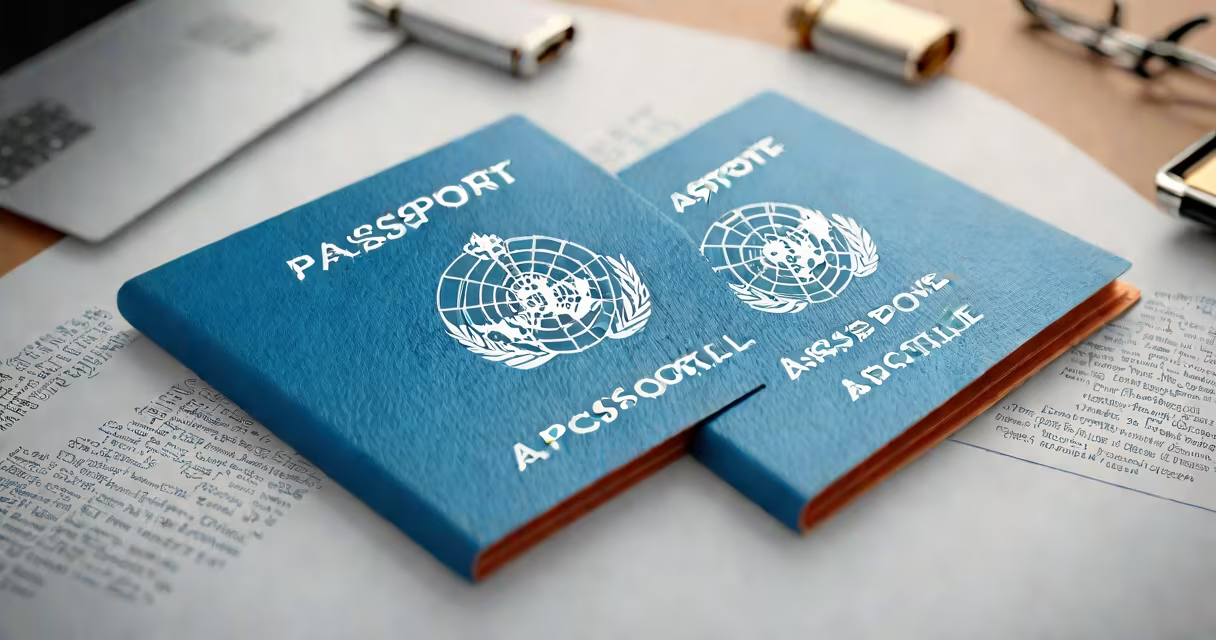
Translate and apostille is the process of officially translating a document and certifying its authenticity through an apostille, enabling it to be recognized in countries that are part of the Hague Convention. This dual step verifies both language accuracy and document legitimacy for international use.
When a document originates in one country and must be presented in another, language barriers and trust gaps can block acceptance. Translate and apostille closes that gap. The translation ensures meaning is preserved across languages. The apostille confirms the signatory's authority and the document's integrity under international law.
The process applies to birth certificates, marriage licenses, academic transcripts, contracts, and power of attorney forms. Without it, foreign governments may reject documents outright. For example, a U.S. birth certificate submitted to a German embassy for a child's visa application must be in German and bear an apostille to be valid.
Translation and apostille are sequential steps. First, a certified translator renders the original document into the target language. Second, a government authority issues an apostille to verify the translator's credentials and the document's authenticity.
Certified translation requires a professional who meets national standards. In the U.S., translators must be qualified under the American Translators Association (ATA) guidelines or state-specific requirements. They sign a sworn statement affirming accuracy. The translation is then notarized, proving the translator's identity and intent.
After notarization, the document goes to the state secretary's office or equivalent authority. That office issues the apostille-a standardized certificate affixed to the document. The apostille includes the issuing country, date, and a unique reference number. It is printed on the document or attached as a separate sheet.
For example, a Canadian university transcript sent to a UK university must be translated into English and apostilled by the Canadian Ministry of Foreign Affairs. The UK institution accepts it only if the apostille is issued under the Hague Apostille Convention.
Not all documents need translate and apostille. Only those used in official international contexts do. Common categories include:
| Type | Use Case | Required Country |
|---|---|---|
| Birth Certificate | Visa applications, citizenship petitions | Germany, Japan, Australia |
| Academic Transcript | University admissions, credential evaluation | France, South Korea, Canada |
| Marriage License | Spousal visa, property ownership | Spain, Brazil, UAE |
| Business Contract | International partnerships, licensing | Switzerland, Norway, Singapore |
Documents from non-Hague Convention countries require consular legalization instead. This involves multiple steps at the foreign embassy and takes longer. For example, a document from India must go through Indian consulates and then the destination country's consulate. The apostille skips this by relying on mutual recognition among member states.
A common mistake is assuming that Google Translate or machine translation qualifies. It does not. Machine-generated translations lack legal standing. A single error-like misreading "son" as "daughter"-can invalidate an entire application. Always use a certified human translator.
Many assume that apostille alone validates a document. It does not. The apostille only confirms the authenticity of the signature and seal on the document. It does not verify content accuracy. That responsibility lies with the translator.
Another misconception is that apostilles are permanent. They are not. An apostille is valid only for the specific document it certifies. If the document is altered later, even slightly, the apostille becomes invalid. A new apostille is required.
Also, not all countries accept apostilles. Some require additional steps. For example, China does not recognize the Hague Apostille. A Chinese embassy may demand notarization by a Chinese consulate and a separate certification from the Chinese Ministry of Justice. Always check the receiving country's requirements before beginning.
I once processed a client's divorce decree for submission to a Swedish court. The document was translated by a freelance translator using free software. The Swedish embassy rejected it. The error? The translator had omitted a clause about asset division. After hiring a certified translator and getting the apostille from the New York State Department of State, the document was accepted on the second try.
Legal translation demands precision. Words like "joint custody," "irrevocable trust," or "force majeure" carry different meanings across jurisdictions. A word-for-word translation fails if it doesn't reflect local legal concepts.
For example, "custody" in U.S. law differs from "guardianship" in French civil law. A certified translator adjusts terminology to match the recipient country's legal structure. This is called "functional equivalence." It's not just about language-it's about context.
According to the International Organization for Standardization (ISO), certified translation services must meet ISO 17100 standards. These cover qualifications, quality control, and documentation. A translation that meets ISO 17100 is considered reliable for legal and administrative purposes.
Always confirm that your translator is accredited. In the U.S., look for ATA certification. In Europe, check for EN 15038 compliance. Avoid freelancers offering low rates without credentials. The cost of a failed application far exceeds the price of proper service.
Begin with a certified translator. Provide the original document and specify the target language and country. The translator returns a signed, notarized translation.
Next, submit the notarized translation to the appropriate government office. In the U.S., this is typically the Secretary of State's office in the state where the notarization occurred. They issue the apostille within 3-5 business days.
Finally, send the apostilled document to the recipient. Keep copies of all paperwork. Some institutions require a notarized copy of the apostille itself.
For faster processing, use expedited services. Many state offices offer rush options for an extra fee. For urgent cases, consider a private courier service with tracking and delivery confirmation.
Translate and apostille is not optional for international legal and administrative processes. It helps documents are both linguistically accurate and formally recognized. When done correctly, it prevents delays, denials, and costly rework.