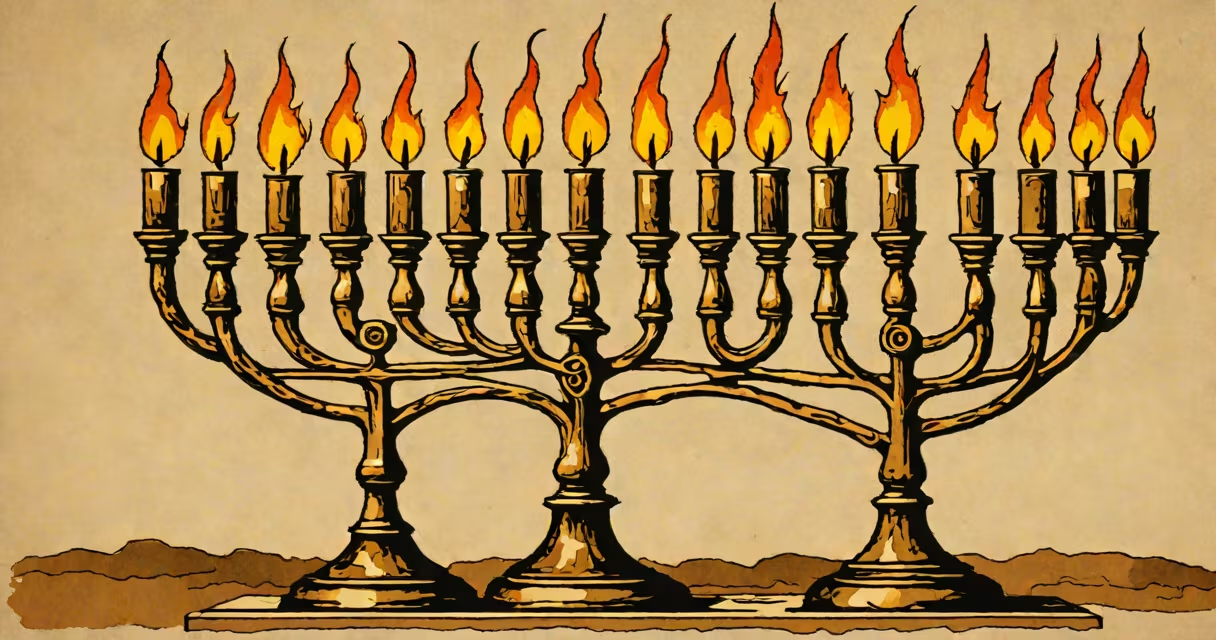
The seven lampstands in Revelation are symbolic representations of the seven churches in Asia Minor, as described in the opening vision of the Book of Revelation. They appear in John's vision of Christ walking among them, holding the seven stars in His right hand.
John saw "seven golden lampstands" in the heavenly area, and Christ identified them as the seven churches. The imagery draws from the Tabernacle and Temple worship, where the menorah was a central feature. In Exodus 25:31-40, God commanded Moses to make a seven-branched lampstand from pure gold, lit daily with oil. Its purpose was to provide light in the Holy Place, symbolizing divine presence and guidance.
Revelation 1:12-13 states: "I turned around to see the voice that was speaking to me. And when I turned, I saw seven golden lampstands, and among the lampstands was someone like a son of man." The lampstands are not physical objects in heaven but metaphors for living communities of believers. Their golden material signifies holiness and divine approval.
Each lampstand represents a local church in the Roman province of Asia Minor-Ephesus, Smyrna, Pergamum, Thyatira, Sardis, Philadelphia, and Laodicea. These were actual congregations facing persecution, moral compromise, and spiritual apathy. Christ addresses each church individually through messages delivered via John.
The lampstands function as both identifiers and indicators of spiritual condition. When Christ says He walks among them, He emphasizes His constant presence and oversight. He sees their works, their trials, and their failures. The lampstands are not static symbols-they are changing, reflecting the health or decay of each church.
For example, in Revelation 2:5, Christ warns Ephesus: "But I have this against you, that you have abandoned your first love." The lampstand of Ephesus is still lit, but its flame is dimming. The message is clear: physical existence does not guarantee spiritual vitality.
Interpretations of the seven lampstands fall into three broad categories: literal, symbolic, and prophetic. The literal view holds that they refer exclusively to the seven churches of Asia Minor. The symbolic view extends the meaning to all churches throughout history. The prophetic view sees them as stages in the Church Age, progressing from purity to apostasy.
| Interpretation Type | Scope | Key Source | Example |
|---|---|---|---|
| Literally historical | First-century churches | Revelation 1:11, 2:1 | Ephesus addressed for losing its first love |
| Symbolic universal | All churches across time | Matthew 5:14-16, 1 Peter 2:9 | Christ as light in every generation |
| Prophetic sequential | Church ages from AD 30-present | Historical theology (e.g., Chiliasm) | Laodicea as last church before return |
A common misinterpretation is equating the lampstands with individual believers. But the text consistently uses plural language: "seven lampstands," not "seven lamps." The focus is on community, not personal spirituality. A single believer cannot be a lampstand; only a gathered body of believers can fulfill this role.
The seven lampstands appear in Revelation 1:12-20, during John's vision on Patmos. He was exiled there under Emperor Domitian's reign (AD 81-96), likely for preaching Christianity. The setting matters: he was isolated, persecuted, and seeking assurance. Christ's appearance in glory-white hair, eyes like fire, feet like burnished bronze-was designed to restore his confidence.
Christ's posture-walking among the lampstands-indicates intimate involvement. He is not distant or indifferent. He knows each church's struggles and strengths. The lampstands are not passive; they are part of a living scene where Christ moves among them, inspecting, judging, and offering grace.
One non-obvious fact often missed: the lampstands are made of gold, but the light they emit is not from the metal itself. The fire comes from the oil, which must be continually replenished. This reflects the truth that the church's light comes not from human effort or wealth, but from the Holy Spirit. Without ongoing dependence on God, even a golden lampstand becomes useless.
Some interpret the seven lampstands as representing the seven days of creation, drawing a parallel between the seven days and the seven churches. This is incorrect. The structure of Revelation is not chronological. The seven churches are listed in geographical order, not theological progression. The sequence follows the route of a Roman postal courier traveling from Ephesus to Laodicea.
Another error is treating the lampstands as literal objects in heaven. The text uses visionary language: "I turned around" and "I saw." This is not a physical description but a symbolic vision. The golden lampstands are not meant to be mapped to celestial geography. They are metaphors for the church's identity and mission.
Even scholars disagree on whether the seven churches represent a complete cycle or a snapshot of the Church Age. However, the most consistent reading-supported by the New International Version (NIV) and the English Standard Version (ESV)-is that the seven churches are distinct, historically grounded communities to whom John wrote letters.
I once visited the ruins of Ephesus in Turkey. Standing near the ancient theater and the site of the original church, I saw a small replica of the seven-branched menorah displayed in the museum. It was not gold, but the craftsmanship reminded me of the sacredness of the symbol. The real weight came not from the artifact, but from knowing that the church there had endured under Roman rule, faced internal division, and still stood as a beacon.
The seven lampstands in Revelation are not abstract metaphors but concrete symbols of the church's mission and identity. They represent the seven churches of Asia Minor, each with unique challenges and promises. Their golden form speaks of divine value, while their placement among Christ's feet shows His intimate care. Understanding them requires grounding in historical context, biblical exegesis, and attention to literary form.
When you read about the seven lampstands in Revelation, remember: they are not relics of the past. They are living images of Christ's ongoing presence among His people. The light continues-not because of human strength, but because He walks among them, holding the stars in His hand.