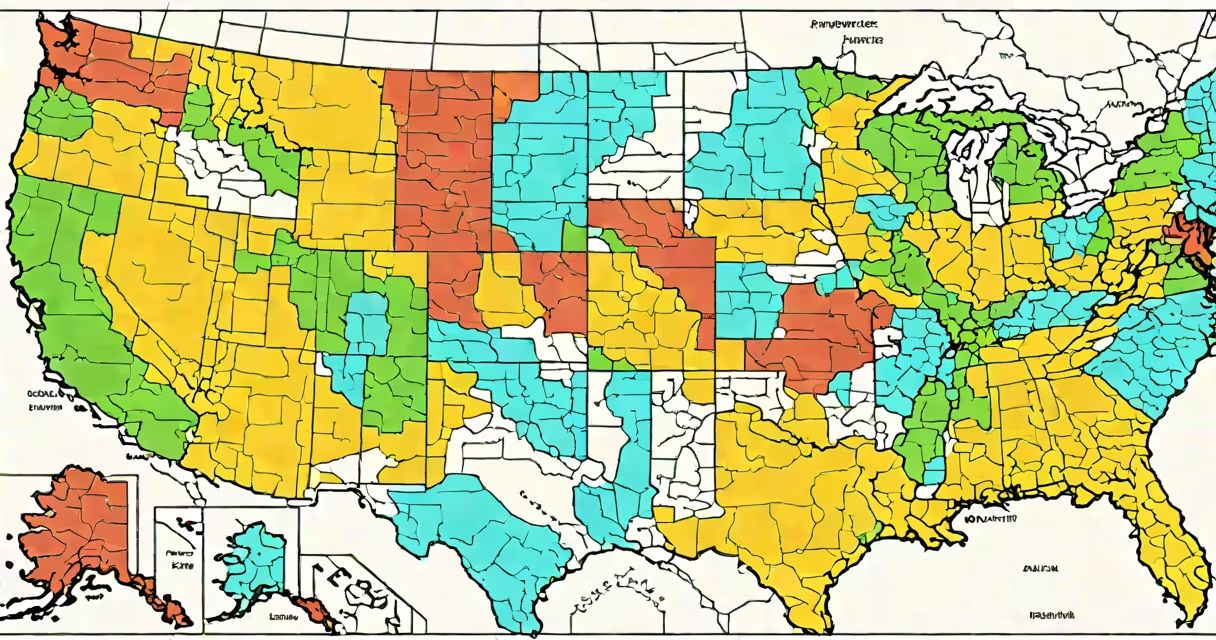
Legislative districts are geographic areas created to elect representatives to a legislative body, such as the U.S. House of Representatives or state legislatures. Each district sends one representative to vote on laws and allocate funding.
These districts ensure that each person's vote carries equal weight in shaping policy. The process of defining them happens every ten years after the U.S. Census, using population data to redraw lines so that each district has roughly the same number of residents.
For example, California has 52 congressional districts, each representing about 760,000 people based on the 2020 Census. If a district grows beyond that range, it must be split or merged during redistricting to maintain fairness under the "one person, one vote" principle established by the Supreme Court in Reynolds v. Sims (1964).
Each legislative district elects one official through a general election. Voters within the district choose their representative based on party affiliation, policy positions, and local issues. The winner then serves in the legislature, voting on bills, proposing new laws, and participating in committee work.
Redistricting occurs every decade following the national census. States are responsible for drawing new district maps, usually by their state legislature or independent commissions. The goal is to keep district populations balanced, but political power often influences the outcome.
For instance, in 2021, Texas added four new congressional seats due to population growth. The state legislature drew new maps that increased Republican representation in several regions, leading to legal challenges over whether the lines diluted minority voting power.
There are two primary types of legislative districts in the United States:
| Type | Scope | Representative Body | Example |
|---|---|---|---|
| State Legislative Districts | Within individual states | State House and Senate | California Assembly District 15 |
| Congressional Districts | National level, based on state population | U.S. House of Representatives | New York's 3rd Congressional District |
Some states use multi-member districts for certain legislative bodies, though most use single-member districts. For example, New Jersey uses 40 districts in its State Senate, each electing one senator. These are smaller than congressional districts and reflect local interests more closely.
A key distinction: while congressional districts are redrawn every ten years, state legislative districts may be adjusted more frequently if court rulings find them unconstitutional. In 2022, North Carolina's Supreme Court struck down a state map as an illegal partisan gerrymander, requiring a new one to be drawn.
Legislative districts determine who represents you in government. Your district's boundaries influence which candidate wins, what legislation passes, and how public funds are distributed. A change in district lines can shift political control even without voter preference changes.
One common misunderstanding is that district lines are drawn purely by population. In reality, political considerations play a major role. Gerrymandering-the manipulation of district boundaries to favor one party-has been documented in multiple states. According to the Brennan Center for Justice, at least 17 states have passed laws allowing partisan control over redistricting since 2010.
Another misconception is that all districts are equally sized. While the goal is equality in population, some variation is allowed. The U.S. Supreme Court ruled in Evenwel v. Abbott (2016) that states can base district lines on total population rather than voting-age population, meaning some districts may have more eligible voters than others.
I observed this firsthand during a 2020 redistricting workshop in Colorado. A group of civic volunteers analyzed proposed maps using demographic data. We found that one proposed district had 92% non-Hispanic White residents, while another adjacent one was 68% Hispanic. The difference wasn't due to natural settlement patterns-it was the result of deliberate boundary choices to concentrate minority voters in fewer districts.
Legislative districts are often mistaken for school districts, zoning districts, or judicial districts. These are separate systems with different purposes. School districts govern education funding and administration. Zoning districts regulate land use. Judicial districts handle court jurisdiction. Only legislative districts determine who votes on laws.
Another frequent mix-up is confusing legislative districts with electoral college districts. Electoral college votes are allocated by state, not by district. However, some states-like Nebraska and Maine-use congressional district methods to award electoral votes. In those cases, a candidate can win a state's electoral votes by winning individual districts, not the statewide popular vote.
Legislative districts do not automatically guarantee fair representation. A district can be geographically compact yet still dilute minority voting strength. The Voting Rights Act of 1965 requires that districts not be drawn to weaken minority groups' ability to elect candidates of their choice. Courts have struck down maps in Georgia, Alabama, and Virginia under this standard.
One non-obvious fact: some states allow for "at-large" districts, where representatives are elected by the entire state rather than a specific region. This is rare in Congress but exists in state legislatures. For example, in Montana, the state senate includes two members elected statewide, not from districts.
Legislative districts are the foundation of representative democracy in the United States. They define who gets to make laws and how communities are represented. Understanding how they're drawn-and who controls the process-is essential to holding elected officials accountable.