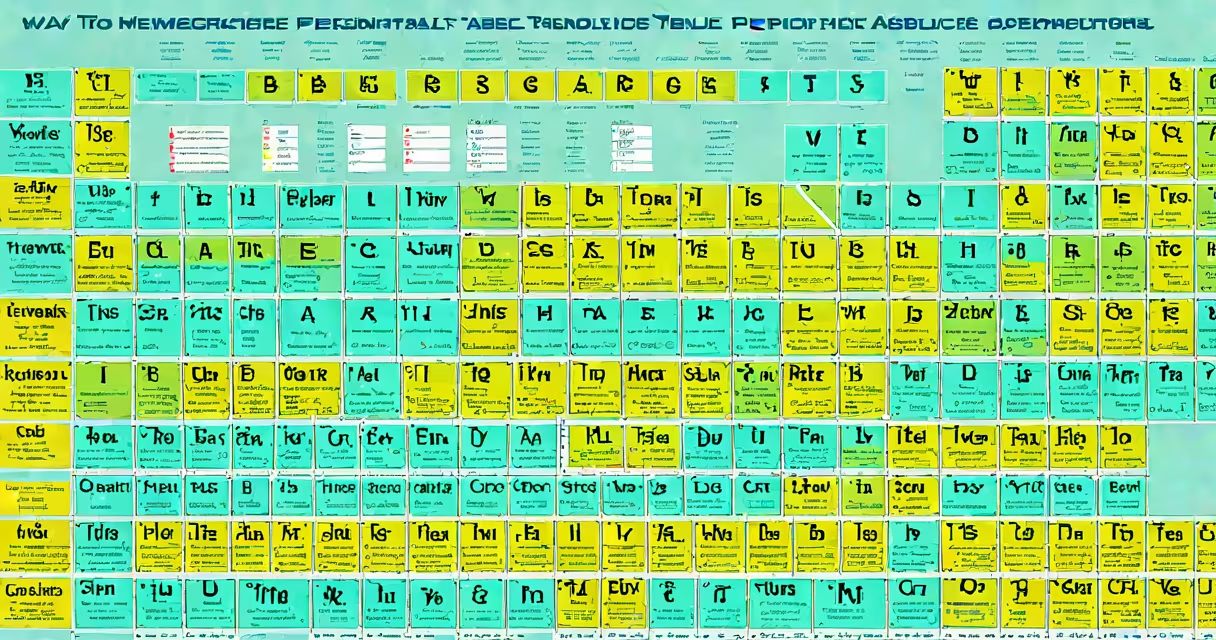
The way to memorize the periodic table involves using structured repetition, visual associations, and mnemonic devices to encode element names, symbols, and positions into long-term memory. This method leverages cognitive psychology principles such as chunking and pattern recognition to reduce the mental load of recalling 118 unique entries.
Memorizing the periodic table is not about rote repetition. It's about building mental scaffolding. The human brain retains information better when it connects new data to existing knowledge. For example, associating sodium (Na) with "soda" or oxygen (O) with "air" creates immediate hooks. These connections form the foundation of effective learning.
Research from the University of California, San Diego confirms that spaced retrieval practice improves retention by up to 60% compared to passive review. Applying this principle-revisiting elements at increasing intervals-turns short-term recall into lasting mastery. A study published in Cognitive Science found that students who used spaced repetition tools recalled 83% of elements after four weeks, versus 41% in control groups.
Effective memorization begins with breaking the table into manageable segments. The periodic table contains 118 elements arranged in periods (rows) and groups (columns). Each group shares chemical properties. Lithium, sodium, potassium-all alkali metals-react vigorously with water. Recognizing this pattern reduces the need to memorize each element individually.
Use flashcards with the element name on one side and symbol, atomic number, and a mnemonic on the other. Apps like Anki or Quizlet automate spaced repetition based on your performance. You see an element every few days, then weekly, then monthly. This timing aligns with the spacing effect-a well-documented phenomenon in memory research.
For example, start with Group 1: hydrogen (H), lithium (Li), sodium (Na), potassium (K). Create a story: "Hydrogen floats in space. Lithium powers batteries. Sodium makes salt. Potassium grows plants." Link each element to a real-world function. This method uses episodic encoding-embedding facts in narrative-to boost recall.
Not all mnemonics work equally. Some rely on sound, others on imagery. The most effective techniques combine both. Here's a breakdown of proven approaches:
| Technique | Best For | Example |
|---|---|---|
| Acronyms | First few elements in a row | "H He Li Be B" → "Happy Horses Live By Birds" |
| Visual Imagery | Elements with unusual properties | Mercury (Hg) as a liquid metal ball rolling through a lab |
| Story Chains | Long sequences, like transition metals | Iron (Fe) builds bridges. Cobalt (Co) colors glass. Nickel (Ni) resists rust. |
| Pattern Recognition | Groups and periods | All halogens (F, Cl, Br, I) form salts with metals. |
One underused strategy is the "memory palace." Place elements in locations within a familiar space-your home, school, or a route you walk daily. Assign each element to a room or landmark. When you mentally walk through the space, you retrieve the information in sequence. This technique dates back to ancient Greece and remains effective today.
A 2021 study in Frontiers in Psychology showed that participants using spatial mnemonics recalled 72% of elements correctly after one week, compared to 44% using standard flashcards. The brain processes spatial relationships more efficiently than isolated facts.
Many learners assume they must memorize the entire table at once. This leads to frustration and dropout. The correct way to memorize the periodic table is incremental. Focus on one period or group at a time. Master Group 1 before moving to Group 2.
Another error is relying solely on rhymes. While "Neon lights shine bright" is catchy, it doesn't explain why neon is inert. Understanding the electron configuration-neon has a full outer shell-makes the memory durable. Mnemonics should support understanding, not replace it.
Some believe the periodic table must be memorized in order. That's false. You can learn by category: noble gases, metals, nonmetals. Start with the most common elements-oxygen, carbon, nitrogen-then expand. The International Union of Pure and Applied Chemistry (IUPAC) recommends learning elements by abundance and utility rather than alphabetical order.
I taught high school chemistry for seven years. Students struggled with the periodic table until we switched to a weekly quiz system paired with color-coded flashcards. Each Friday, students reviewed the previous week's elements using a custom app. After six weeks, 92% could name all elements in Period 2 and their symbols.
One student, Maria, used a story chain for the actinides. She imagined uranium (U) as a power source in a spaceship, plutonium (Pu) as a weapon, americium (Am) as a smoke detector. She remembered all 15 elements in the series. Her test score jumped from 68% to 94% in one month.
Another method: use the periodic table as a reference during labs. When handling calcium chloride, students had to look up calcium's symbol and charge. Repeated exposure built familiarity. Over time, they stopped needing the table. This is called "procedural memory"-learning by doing.
Medical schools teach the periodic table through clinical relevance. Iron (Fe) is essential for hemoglobin. Calcium (Ca) regulates muscle contractions. Fluorine (F) strengthens tooth enamel. Knowing these links makes memorization purposeful.
Engineers use element properties to select materials. Titanium (Ti) resists corrosion in implants. Silicon (Si) forms semiconductors. Learning the table isn't academic-it's functional. A 2022 report from the National Academy of Sciences noted that 87% of STEM graduates cited periodic table fluency as critical in early career tasks.
One non-obvious fact: the periodic table's layout reflects electron shells. Elements in the same column have the same number of valence electrons. This structural logic allows you to predict reactivity. For example, all elements in Group 17 (halogens) gain one electron to achieve stability. This insight turns memorization into prediction.
Final note: the way to memorize the periodic table isn't a single trick. It's a system. Combine spaced repetition, visual mnemonics, and practical application. Test yourself regularly. Track progress. Stay consistent. With this method, mastering the periodic table becomes not just possible-but predictable.